


Mothers in crimson dresses and fathers clutching umbrellas huddled together in drizzly Beijing after sending their children into an exam hall yesterday, the first day of China’s biggest gaokao (高考) tests that will shape the futures of millions of high-school children.
The number of students taking this year’s multisubject gaokao series is set to be a record high, with the Chinese Ministry of Education saying that 13.42 million candidates have registered for the high-stakes tests.
“People say that this is the start of a life,” 50-year-old mother Zhi Haihong said. “So one cannot slack off.”
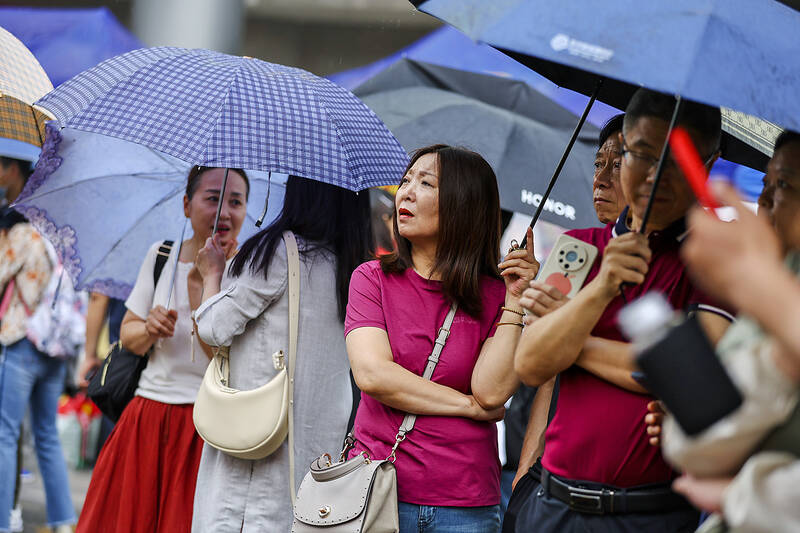
Photo: EPA-EFE
Zhi donned a traditional qipao to take her daughter to the examination site in central Beijing, hoping that its auspicious bright red color would bring good luck.
China’s gaokao drills high-school students on subjects including Chinese, English, mathematics, science and humanities, the results of which are critical for gaining admission to university.
High-level education has expanded rapidly in China in recent decades, as an economic boom pushed up living standards — as well as parents’ expectations for their children’s careers.
The job market that fresh graduates enter is no longer as rosy as it once was, as the world’s second-largest economy struggles to achieve a post-pandemic recovery, with high youth unemployment a significant concern.
“I think this is a necessary process of growing up,” Zhi said when asked about the pressures young people face,” she said.
“[The gaokao] is also a method for the country to select talented people,” she said. “Only after undergoing pressure can one’s mental tolerance increase. Then you will be able to withstand these pressures in the future when working in society... I think this is understandable.”
A list of top-trending topics on social media site Sina Weibo yesterday morning was studded with exam-related discussions, with many users sharing pictures of uniformed students exchanging high-fives and hugging their parents before entering testing centers.
Even the official Weibo account of China’s Chang’e-6 lunar probe, which began carrying samples back to Earth from the far side of the Moon on Tuesday, offered encouragement.
“Every one of you that is striving hard is terrific,” it said.
Images from across the nation taken yesterday morning showed students and well-wishers preparing for the first session.
In the central city of Wuhan, crowds of parents stood behind a barrier as test takers clutched documents on their way into the examination center.
Education authorities are on high alert each year after elaborate cheating attempts were uncovered in previous years.
Areas around testing centers are often tightly controlled, with traffic diverted and honking prohibited to ensure a comfortable environment so that test takers can concentrate.
Sun Song, a 45-year-old father, stood under an umbrella in Beijing chatting with other parents after seeing his daughter off before her first exam.
“It will be enough if she can find a job she likes and get into a school she likes,” Sun said
“As long as the kid is happy, it’s enough,” he said.
After failing for the 27th time to get into his dream university through the gaokao last year, 57-year-old millionaire Liang Shi (梁實) is giving it another go.
Liang worked his way up from a menial factory job to establish his own construction materials business, but said he has yet to become “an intellectual” worthy of Sichuan University.
The plight of the “gaokao holdout” has been closely watched by the media and online in recent years.
However, Liang said it could be his last attempt if he does not make the grade this year.
In another closely watched case, 35-year-old Xu Mengnan is taking the gaokao again 16 years after he deliberately flunked the exams in protest against the education system.
Xu has worked in factories in eastern China, married, had children and divorced since that act of defiance, but decided to hit the books again in 2017 for another try.
He passed in 2018 and graduated last year from an art college in eastern Anhui Province, but this year he wants to get into university to take his studies further.
Pursuing an education major would allow him to “fulfill [his] dream,” the Henan Business Daily reported.

SPEAKING OUT: After Siranudh Scott’s allegations surfaced, celebrities and public figures took to social media to share their own experiences of sexual misconduct and abuse A high-profile alleged sexual abuse case within a wealthy Thai beer brewing family has prompted a wave of painful accounts from survivors of unconnected abuse in the conservative nation. Siranudh Scott, a member of the billionaire Thai family that founded the ubiquitous Singha beer brand, posted an emotional video this month accusing his elder brother Sunit of repeatedly abusing him when he was a teenager. Sunit, who is in his 30s, later denied the allegations in a video posted online, but Singha parent Boonrawd dismissed him from his executive role with the company on Tuesday last week. “I felt I needed to speak

A Hong Kong astronaut is to join a Chinese space mission for the first time as part of a three-person crew launching today, as Beijing edges closer to its goal of landing people on the moon. The Tiangong space station — crewed by teams of three astronauts that are typically rotated every six months — is the crown jewel of China’s space program, boosted by billions in state investment in a bid to catch up with the US and Russia. The Shenzhou-23 mission is to blast off at 11:08pm from the Jiuquan Satellite Launch Center in northwestern China, carrying three astronauts to
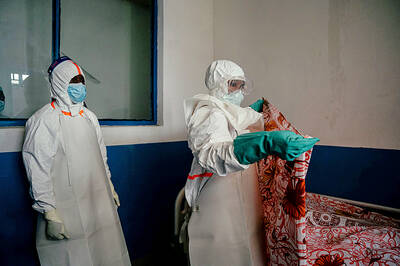
UPGRADED ALERT: The risk inside DR Congo is now considered ‘very high,’ while neighboring countries face a ‘high’ threat as the outbreak continues, the WHO said Ebola is spreading faster than responders can track it in eastern Congo, where health workers managed to follow up with barely one in five identified contacts in a single day. Authorities in the Democratic Republic of the Congo (DR Congo) reported 83 confirmed infections, 746 suspected cases and 1,603 identified contacts as of Thursday, but health workers were able to follow up on only 342 contacts that day — about 21 percent of the total under monitoring — data released by the DR Congo Ministry of Public Health on Friday showed. The figures suggest the response is falling behind the outbreak itself,

SEEKING ORDER: Rodrigo Paz said that ‘anyone who wants to destroy the nation will have to deal with this president and the full force of the constitution’ Bolivian President Rodrigo Paz on Wednesday said that the nation was at a “breaking point” after nearly a month of protests that have caused shortages of food, fuel and medicine. Paz, who took office six months ago amid the worst economic crisis there in four decades, is battling a groundswell of fury over his policies. The political capital, La Paz, has been besieged by low-income workers and members of the indigenous majority calling for his resignation. “The country needs order and is reaching breaking point,” the 58-year-old said at a public event in La Paz, renewing his appeal for dialogue. On Tuesday, the Bolivian


 RSS
RSS