

Israeli forces yesterday hammered Rafah in southern Gaza with tanks and artillery, hours after US President Joe Biden said Israel was offering a new road map toward a full ceasefire.
Shortly after Biden’s announcement, Israeli Prime Minister Benjamin Netanyahu said his country would still pursue the war until it had reached all its aims, including the destruction of Hamas.
Meanwhile, the Palestinian militant group said it “considers positively” the plan laid out by Biden.
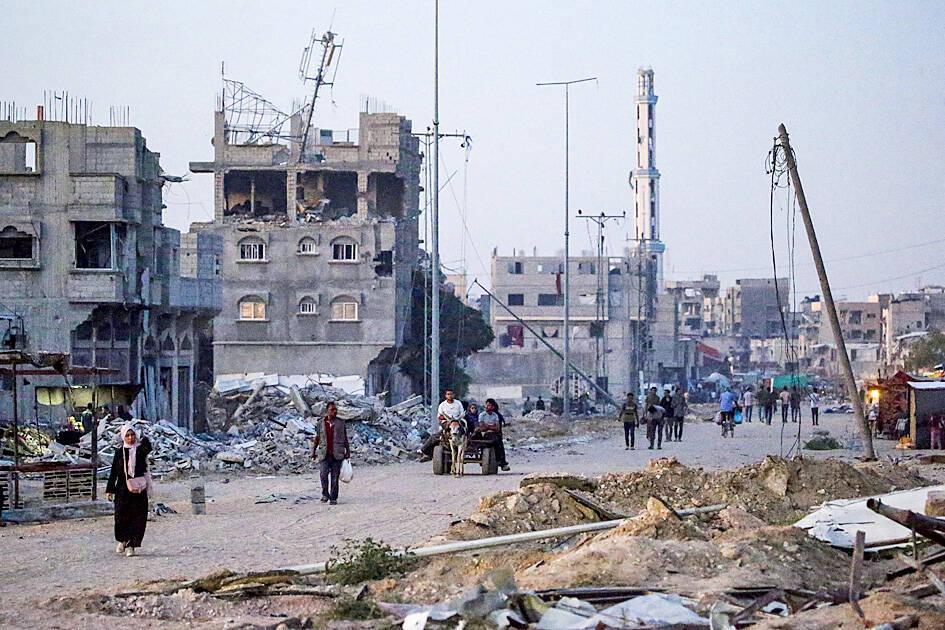
Photo: EPA-EFE
In his first major address outlining a possible end to the conflict, the US president said that Israel’s three-stage offer would begin with a six-week phase that would see Israeli forces withdraw from all populated areas of Gaza.
It would also include the “release of a number of hostages, including women, the elderly, the wounded, in exchange for [the] release of hundreds of Palestinian prisoners.”
Israel and the Palestinians would then negotiate during those six weeks for a lasting ceasefire — but the truce would continue while the talks were under way, Biden said.
The US leader urged Hamas to accept the Israeli offer.
“It’s time for this war to end, for the day after to begin,” he said, in comments echoed by British Secretary of State for Foreign, Commonwealth and Development Affairs David Cameron.
Hamas in a statement on Friday evening said it “considers positively” Biden’s speech regarding “a permanent ceasefire, the withdrawal of Israeli forces from Gaza, reconstruction and the exchange of prisoners.”
US Secretary of State Antony Blinken called his counterparts from Jordan, Saudi Arabia and Turkey on Friday to press the deal.
UN Secretary-General Antonio Guterres “strongly hopes” the latest development “will lead to an agreement by the parties for lasting peace,” his spokesman, Stephane Dujarric, said.
German Minister for Foreign Affairs Annalena Baerbock said the Israeli offer “provides a glimpse of hope and a possible path out of the war’s deadlock,” while European Commission President Ursula von der Leyen welcomed a “balanced and realistic” approach to end the bloodshed.
However, Netanyahu took issue with Biden’s presentation of what was on the table, insisting that the transition from one stage to the next in the proposed road map was “conditional” and crafted to allow Israel to maintain its war aims.
“The prime minister authorized the negotiating team to present an outline for achieving [the return of hostages], while insisting that the war will not end until all of its goals are achieved,” Netanyahu’s office said.
Those aims included “the return of all our hostages and the elimination of Hamas’ military and governmental capabilities,” it added. “The exact outline proposed by Israel, including the conditional transition from stage to stage, allows Israel to maintain these principles.”
Israel sent tanks and troops into Rafah early last month, ignoring concerns over the safety of displaced Palestinian civilians sheltering in the city on the Egyptian border.
Yesterday, residents reported tank fire in the Tal al-Sultan neighborhood in west Rafah, while witnesses in the east and center of Rafah described intense artillery shelling.
“From the early hours of the night until this morning, the aerial and artillery bombardment has not stopped for a single moment”, a resident from west Rafah said on condition of anonymity.
“There are a number of occupation [Israeli] snipers in high-rise buildings overseeing all areas of Tal al-Sultan ... making the situation very dangerous,” they added.
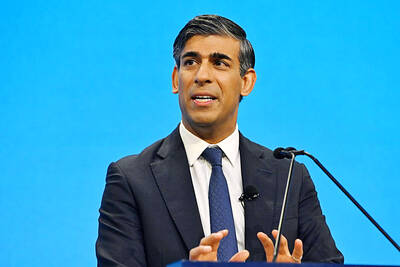
Former British prime minister Rishi Sunak on Wednesday urged so-called middle powers to become a “poisonous shrimp” to carve out strategic economic leverage in a more turbulent global environment. Sunak drew from a metaphor by former Singaporean prime minister Lee Kuan Yew (李光耀): A big fish will eat a smaller fish, and the smaller fish will eat the shrimp. Lee made the point a year after the Asian nation’s independence in 1966 that the city-state needed to build up its defense mechanisms — like a shrimp that stings — so it would be left alone by predators. “He was thinking about what Singapore’s

A 16-year-old on Thursday shot his way through locked doors to get into an elementary school in Bend, Oregon, killing three children and a teacher. He was then shot by a person at the scene who followed him inside, authorities said. The suspect was found dead inside the school minutes after the shooting was first reported, Bend Police Chief Mike Krantz said. The three children killed were aged 5, 8 and 11. Another child, 7, and a teacher, 54, were injured and taken to the hospital in critical condition, he said. The first 911 call came just before 1pm from a person in

A University of Wyoming microbiology graduate student from China has been arrested on accusations she poisoned the tea of a colleague who had pending patents and with whom she did not get along, then tried to flee the country after police questioned her. Wang Aili, 32, was arrested on Tuesday last week at Los Angeles International Airport, where prosecutors allege she sought to return to China. With her were laptops, electronic storage devices and documents now in the possession of police, who allege Wang was seen on surveillance video rummaging through the desk of the victim who specialized in technology for disease

DATA SHARING: The mission includes keeping New Zealand safe, and the wider Pacific region open, stable and resilient, the NZ Security Intelligence Service said Fiji is enlisting New Zealand’s intelligence agency to help overhaul its fragmented security sector, Suva said on Wednesday, as US warnings of suspected China-linked cyberintrusions highlight concerns about vulnerabilities in the nation. The Fijian Cabinet approved a six-month partnership with the New Zealand Security Intelligence Service (NZSIS), funded by Wellington, to assess Fiji’s intelligence structure and recommend reforms, Fiji’s government said in a statement. The review is designed to improve information-sharing and coordination across agencies, and reforms would create a more sustainable intelligence framework with clearer roles and improved support for security decisionmaking, the statement said. Fiji did not identify a specific threat


 RSS