

Rohingya mother Sofura Begum has spent years in a squalid refugee camp after fleeing Myanmar. Now her teenage son has been taken to fight alongside the troops that put her there.
Militant Rohingya groups in Bangladesh have forcibly recruited hundreds of young Rohingya men and boys to battle the Arakan Army, a rebel outfit in neighboring Myanmar that has won a string of victories against the junta there.
Those sent to fight are making common cause with the military that drove 750,000 members of the persecuted Muslim minority from their homes and into Bangladesh in a 2017 crackdown that is now the subject of an ongoing UN genocide court case.
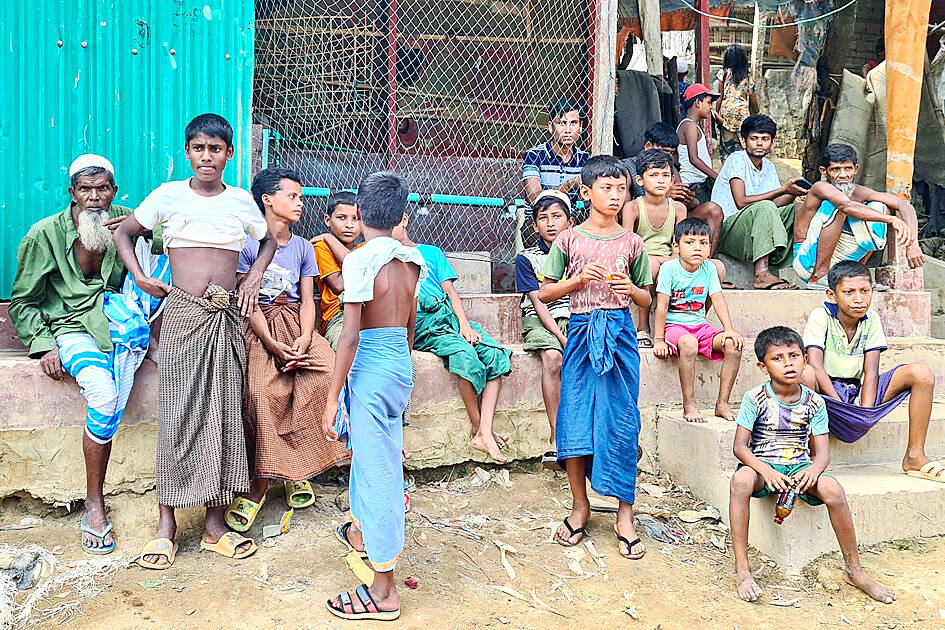
Photo: AFP
In their recruitment drive, militants say Rohingya need to ally with old enemies in the Burmese army to face a new threat.
However, the families of those dragooned into combat say that their relatives were not given a choice.
“They told us to hand him over,” Begum, 30, said after her 15-year-old son, Abdul, was picked up by armed men from her home.
“They threatened us... They said it’s our war of faith. I didn’t want my son to join the war, but we are in a dangerous situation,” she said.
Agence France-Presse spoke with six families who said men from their household had been forcibly recruited by three Rohingya armed groups with an established presence in the refugee camps.
One man, speaking on condition of anonymity for fear of retribution, said his 20-year-old son had been taken by the Arakan Rohingya Salvation Army (ARSA) and sent across the border to fight.
“I learned that he was injured in the war,” the man said. “It’s shameful my son was forcibly recruited... Every day our people are being picked up.”
Myanmar’s military has lost vast swathes of territory this year to an advance by the Arakan Army, one of several rebel groups battling the junta that took power in a 2021 coup.
The Arakan Army says it is fighting for more autonomy for the ethnic Rakhine population in the state, which is also home to about 600,000 Rohingya who remained after the 2017 crackdown.
This month, the rebel outfit took control of Buthidaung, a Rohingya-majority town not far from Bangladesh.
Several Rohingya diaspora groups said in a statement that fighters forced Rohingya to flee, then looted and burned their homes — claims the Arakan Army called “propaganda.”
Another armed group in the Bangladesh camps, the Rohingya Solidarity Organisation (RSO), said it had recruited refugees to fight.
“The Arakan Army has tortured and slaughtered our people,” said Ko Ko Linn, the RSO’s political chief. “Their only policy is the extermination of the Rohingya community, so we are recruiting Rohingyas regularly, giving them military training.”
Ko Ko Linn would not say if other groups had forcibly recruited people.
However, Arakan Army spokesperson Khaing Thu Kha accused three groups — the RSO, the ARSA and the Arakan Rohingya Army — of recruiting Rohingya from Bangladesh.
He said the conscripts were taken for training in a Myanmar army base, before “fighting alongside” the junta’s forces.
With mobile and Internet networks down across swathes of Rakhine State it is difficult to assess how any cooperation between Rohingya groups and the junta is playing out on the battlefield.
A senior UN staffer and a rights group official, both speaking on condition of anonymity due to the sensitivity of the subject, said that Rohingya armed groups had recruited “hundreds” of refugees in Bangladesh.
Rohingya armed groups working in concert with the military have recruited hundreds more men and boys in Myanmar itself.
Thomas Kean, senior consultant at the International Crisis Group think tank, said that children as young as 14 had been pressed into battle against their will.
However, he added that it appeared a small number of Rohingya had signed on to fight voluntarily after being promised “wages and even citizenship” by Myanmar’s junta.
One Rohingya man in Buthidaung, who asked not to be identified, said his brother had been “beaten and abducted by ARSA” and taken to serve alongside the military.
He said that the junta’s representatives had said at first that the recruits were being trained as a militia to defend Rohingya villages.
“But later, they began using them on the battlefields,” he said. “The junta lied from the beginning.”

Philippine Secretary of National Defense Gilberto Teodoro Jr on Tuesday hit out at China at an international forum after a memo asserting Beijing’s position over their longstanding maritime dispute was delivered to him while he was speaking on stage. The unusual incident was captured on video at the Seoul Defense Dialogue as the secretary was responding to a question about “gray zone” coercion in the South China Sea. The video shows what appears to be a conference staffer placing it on the table next to him while speaking. “I have a note here, I think this is from China,” he said, describing

Thai police yesterday said that they arrested a senior Buddhist monk on suspicion of embezzling US$2.8 million intended for his monastery, alongside a suspected female accomplice he was having sex with. The case is the latest scandal to hit the clergy in Buddhist-majority Thailand after a sex and extortion case involving senior monks last year prompted public outrage and calls for greater scrutiny of temple finances. Phra Wachirayan Wi, the 66-year-old abbot of the 14th-century Wat Phutthaisawan in the ancient capital of Ayutthaya, was arrested on Thursday on charges including embezzlement and money laundering, lead police investigator Pattanasak Bupphasuwan said. A 47-year-old woman

SECRET FOOTAGE: A 17-year-old girl told British broadcaster Channel 4 that she had been approached by a man who covertly recorded her and their interaction Calls are growing louder in Europe for action against “pervert” smart glasses after secretly filmed footage of girls and women appeared online — with a petition in Britain demanding a ban on their sale. Anyone wearing smart glasses can take photos, film videos, listen to music, make phone calls, translate text or interact with an artificial intelligence (AI) assistant, with sales now hitting millions. The devices grabbed attention this summer after a marketing tie-up between Kylie Jenner, beauty mogul and member of the Kardashian dynasty, and tech giant Meta. Since smartphones are now embedded in daily life, “big tech” is
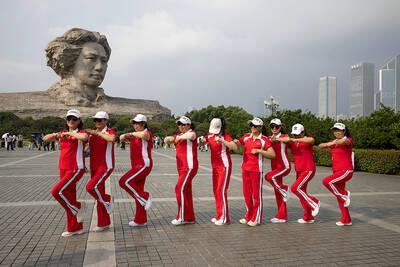
China yesterday marked half a century since the death of Mao Zedong (毛澤東), founder of the People’s Republic, who brought roughly one-quarter of the world’s population under communist rule and whose specter still haunts China’s future. Mao’s death on Sept. 9, 1976, at age 82, mourned by many and welcomed by some who suffered under his nearly three-decade rule, also hastened the end of the Cultural Revolution, a frenzied mass movement he launched in 1966. The party later condemned the Cultural Revolution as a grave error for which Mao bore primary responsibility, but still reveres him, saying his achievements outweigh his mistakes. Mao’s


 RSS
RSS