


Meet Lord Gregarious, a 76-year-old Dutchman who has single-handedly built a five-story Roman-style castle in his back garden, complete with knights, damsels and a shimmering dragon fashioned from recycled metal.
The towers of the Olt Stoutenburght Castle (“Old Naughty Citadel”) rise unexpectedly from the flat fields around the tiny village of Blesdijke in the northern Dutch countryside.
The pensioner, real name Gerry Halman, has spent 34 years on his labor of love, painstakingly sourcing materials from dozens of countries, drawing inspiration from China, the Roman Empire and ancient Egypt.
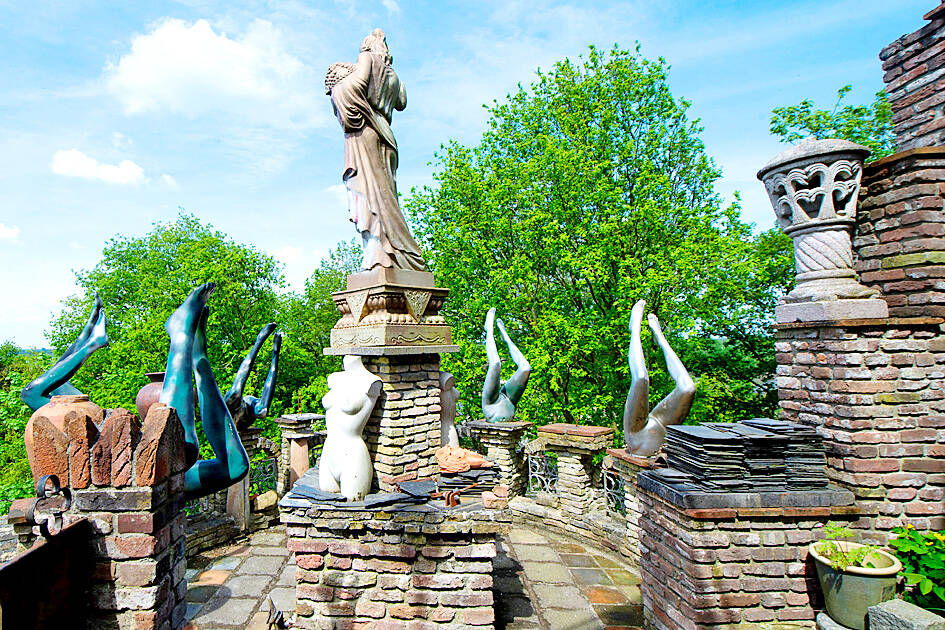
Photo: AFP
“One morning in 1990, I said to my wife: ‘I’m ready. I have a complete picture. I know what the building looks like, from the bottom to the flag,’” the moustachioed Halman said, resplendent in a jaunty fur hat.
Since then, constructing and furnishing the castle has been his “passion,” traveling all over the world to source materials that do justice to his vision.
Above the vaunted main hall hangs a metal chandelier from Istanbul and ornate Jugendstil iron railings from Libya.
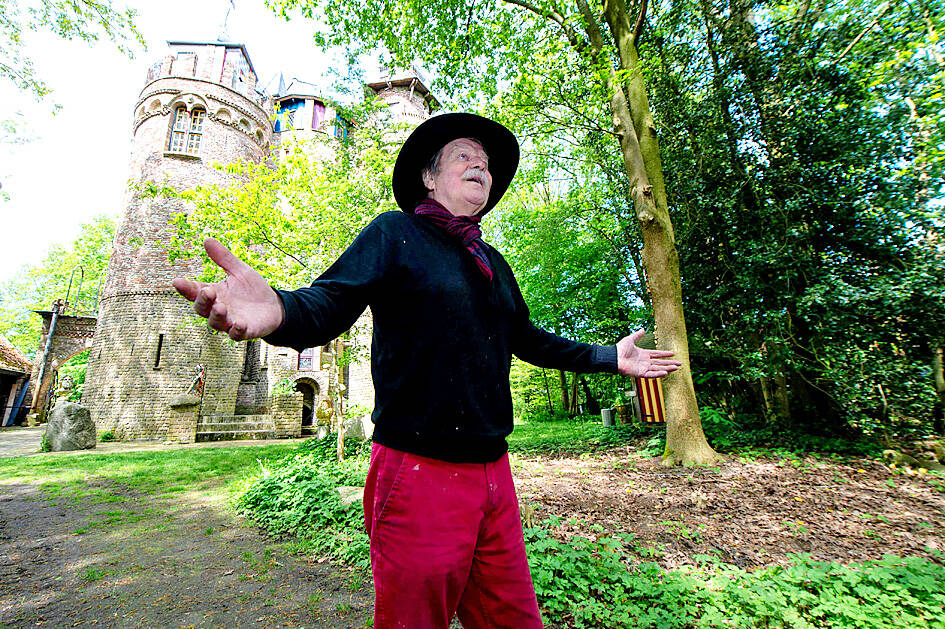
Photo: AFP
The room is equipped with a wooden bar taken from the Orient Express dining wagon, embossed with signs entreating gentlemen not to urinate on the floor.
Hundreds of books about art and history adorn the walls of the library, with a dueling pistol and Indonesian ritual suicide dagger strewn casually across the desk.
For 35 years, Halman ran a costume shop in nearby Zwolle and has populated his castle with a cast of characters including knights in shining armor, damsels in distress and a statue of the goddess Aphrodite.
On top of the 26m building coils a dragon made from hundreds of pieces of recycled metal — a nod to the Chinese tradition of protecting the home. Next to the dragon lies a cobra, also made of glittering metal and a symbol of the pharaohs of ancient Egypt.
What drives someone with no architectural or building experience to start such a project?
“What drives people to cycle for three weeks through France or go to the gym?” the good-natured Halman replied, describing the urge to create the castle as an “obligation.”
“I’ve always been a fan of the fantasy world since I was a kid, not the real world,” he said.
However, he ran up against the real world when he took his plans to the local authorities for planning permission.
“The mayor said: ‘He’s crazy. He is not a builder. He has no architecture experience and he wants to build a castle,’” Halman said.
However, he eventually won planning permission after much back-and-forth with the authorities, so long as the castle was lower than 28m. Most of the materials are recycled or sourced from Halman’s trips around Europe’s antique markets.
It is all self-financed, but he has no idea what the total bill is.
“Don’t ever ask how much it costs, otherwise you would never dare do it,” he said.
Like the Sagrada Familia basilica in Barcelona, the Olt Stoutenburght is “never finished,” he said.
“I have a motto. You can always improve on beauty,” he said.
His three children will carry on his life’s work when he dies.
His granddaughter, 16-year-old Sara van den Kamp, recalled frolicking in the castle grounds as a little girl and family Christmas feasts in the grand hall.
“It’s pretty cool. Not many people can say their grandfather owns a place like this and has built a place like this. It’s very unique,” she said.
Halman’s wife of 50 years “likes” the project, but “stays away,” he said.
“I do my own thing... This is for me. We have the perfect marriage,” he said.
Tourists come from all over to admire the castle. Monique Meijer, a 55-year-old nurse, gasped when she entered the hall.
“It’s just fantastic,” she gushed.
“I find it bizarre how he did this on his own. Very beautiful inside. Lots of arches and beautiful brickwork. Lots of imagination,” she said.
Halman said that many people walk away from a visit thinking he’s crazy, but he cites a line from Spanish artist Salvador Dali, another inspiration.
“The only difference between me and a madman is that I’m not mad,” he said.

‘CROSSING THE LINE’: China’s embassy in Seoul criticized US Forces Korea Commander General Xavier Brunson, asking if his ‘hostile’ remarks were authorized by Washington South Korea and the US are in talks over recent public remarks by the commander of US Forces Korea, Seoul’s presidential office said yesterday, after the comments drew sharp criticism from China. In a recent podcast interview, US Forces Korea Commander General Xavier Brunson described South Korea as “the dagger in the heart of Asia” from China’s east coast, prompting the Chinese embassy in Seoul to say that he had “truly crossed the line.” The interview came amid growing speculation that Washington might seek to expand the role of US Forces Korea in countering the growing regional influence of China, a key

SEEKING ORDER: Rodrigo Paz said that ‘anyone who wants to destroy the nation will have to deal with this president and the full force of the constitution’ Bolivian President Rodrigo Paz on Wednesday said that the nation was at a “breaking point” after nearly a month of protests that have caused shortages of food, fuel and medicine. Paz, who took office six months ago amid the worst economic crisis there in four decades, is battling a groundswell of fury over his policies. The political capital, La Paz, has been besieged by low-income workers and members of the indigenous majority calling for his resignation. “The country needs order and is reaching breaking point,” the 58-year-old said at a public event in La Paz, renewing his appeal for dialogue. On Tuesday, the Bolivian

Through the noise of rushing papers and whirring belts at a print factory in Kyoto, two creators watch their photo essay come to life in broadsheet form — part of an effort to win new audiences in the age of artificial intelligence (AI). Despite the decline of the publishing industry, self-publication and handmade “zine” magazines are growing in popularity in Japan, reflecting the nation’s enduring love of paper in the digital era. While speaking to Agence France-Presse at the plant, his hands black with ink, one of the creators, Kazuma Obara, said: “I think [paper] is a medium that engages all five

Australian researchers have trained lab-grown brain cells on a silicon computer chip to play the 1990s shooter game Doom and said they are just scratching the surface of what the neurons could be capable of doing. It is the science-fiction work of biotech boffins at Cortical Labs, who researched and developed the technology that harnesses the workings of the brain’s networking system. Each so-called “biological computer” contains about 200,000 living human brain cells, grown from stem cells that were harvested from blood donations. Having mastered the simple computer game Pong, where a paddle is moved up and down to send a ball


 RSS
RSS