


Human Rights Watch (HRW) yesterday said that Afghanistan’s public health system has been hit hard following a sharp reduction in foreign assistance, coupled with serious Taliban abuses against women and girls, jeopardizing the right to healthcare for millions of Afghans.
In a new report, the New York-based watchdog said this has left the “Afghan population increasingly vulnerable to severe malnutrition and illness” among other effects of inadequate medical care.
The Taliban takeover of Afghanistan in August 2021 drove millions into poverty and hunger after foreign aid stopped almost overnight. Sanctions against the Taliban rulers, a halt on bank transfers and frozen billions in Afghanistan’s currency reserves, have cut off access to global institutions and the outside money that supported the aid-dependent economy before the withdrawal of US and NATO forces.
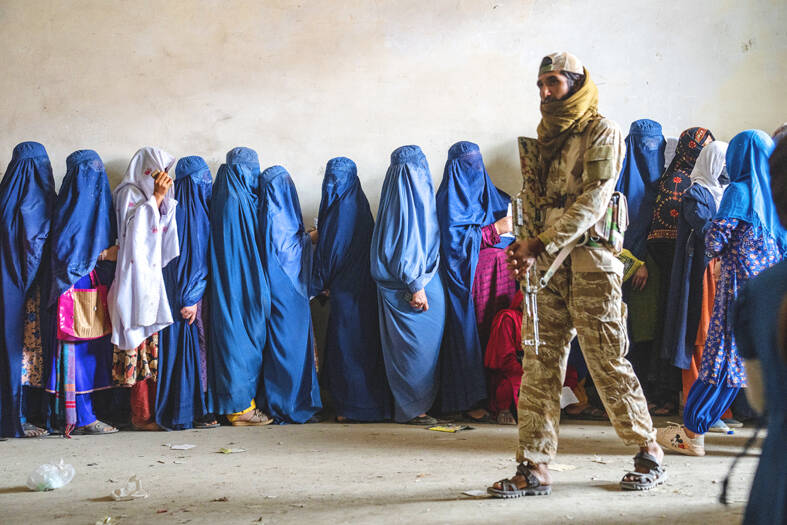
Photo: AP
Last year, the World Food Program said that malnutrition rates in Afghanistan were at a record high with half the country suffering from severe hunger throughout the year.
“Women and girls have been disproportionately affected by the healthcare crisis, particularly because of Taliban abuses,” the report said.
The Taliban have barred women from most areas of public life and work and stopped girls from going to school beyond the sixth grade as part of harsh measures they imposed after taking power.
Taliban restrictions on women’s freedom of movement and employment have gravely limited their access to health services, while bans on education have blocked almost all training of future female healthcare workers in the country, the HRW report said.
“The loss of foreign development aid and Taliban rights violations have caused a catastrophic health crisis in Afghanistan that is disproportionately harming women and girls,” the report quoted Fereshta Abbasi, Afghanistan researcher at Human Rights Watch, as saying.
“The cost of treatment and medicine has put care out of reach for many Afghans,” Abbasi said.
HRW remotely interviewed 46 Afghan and foreign aid officials, healthcare workers and people seeking healthcare in 16 of Afghanistan’s 34 provinces between February last year and last month. Fifteen of the interviewees, 12 women and three men, were with Afghans who had sought healthcare. The rights group also talked to Afghan healthcare officials: 10 women and eight men.
Taliban government spokesmen were not immediately available to comment on the report.
While Afghans living in poverty have always faced difficulties obtaining healthcare because of costs, a rising number now struggle to pay for food and are often unable to cover the price of medicines and transportation to reach health services.
“Since the Taliban took over, the price of my medications has nearly doubled,” a 54-year-old man living with a kidney infection told HRW. “This is too much for anyone who doesn’t have a job.”
The report also cited an unnamed official with the charity Mercy Corps in September as telling HRW that “the humanitarian response in Afghanistan simply cannot keep pace with the country’s worsening conditions.”
The Taliban have also imposed the women’s head-covering, or hijab, and strict regulations regarding the presence of a male guardian, known as mahram, further impeding women from traveling for work or receiving treatment, the report said.
The report cited an unnamed doctor in the town of Samangan as saying they have been told by the Taliban “not to treat any female patient who is not accompanied by a mahram or is not in full hijab.”
“The unprecedented economic crisis in Afghanistan has meant that millions are facing life-threatening conditions,” Abbasi said. “The situation demands more than humanitarian aid; it requires sustainable efforts to avert further economic decline and alleviate the immense suffering of the Afghan population.”

School bullies in Singapore are to face caning under new guidelines, but the education minister on Tuesday said it would be meted out only as a last resort with strict safeguards. Human rights groups regularly criticize Singapore for the use of corporal punishment, which remains part of the school and criminal justice systems, but authorities have defended it as a deterrent to crime and serious misconduct. Caning was discussed in the parliament after legislators asked how it would be used in relation to bullying in schools. The debate followed stricter guidelines on serious student misconduct, including bullying, unveiled by the Singaporean Ministry of

‘GROSS NEGLIGENCE?’ Despite a spleen typically being significantly smaller than a liver, the surgeon said he believed Bryan’s spleen was ‘double the size of what is normal’ A Florida surgeon who is facing criminal charges after allegedly removing a patient’s liver instead of his spleen has said he is “forever traumatized” by that person’s death. In a deposition from November last year that was recently obtained by NBC, 44-year-old Thomas Shaknovsky described the death of 70-year-old William Bryan as an “incredibly unfortunate event that I regret deeply.” Bryan died after the botched surgery; and last month, a grand jury in Tallahassee indicted Shaknovsky on a charge of manslaughter. “I’m forever traumatized by it and hurt by it,” Shaknovsky added, also saying that wrong-site surgeries can happen “during

A MESSAGE: Japan’s participation in the Balikatan drills is a clear deterrence signal to China not to attack Taiwan while the US is busy in the Middle East, an analyst said The Japan Self-Defense Forces yesterday fired a Type 88 anti-ship missile during a joint maritime exercise with US, Australian and Philippine forces, hitting a decommissioned Philippine Navy ship in waters facing the disputed South China Sea, in drills that underscore Tokyo’s rising willingness to project military power on China’s doorstep. The drill took place as Manila and Tokyo began talks on a potential defense equipment transfer, made possible by Japan’s decision to scrap restrictions on military exports. The discussions include the possible early transfer of Abukuma-class destroyers and TC-90 aircraft to the Philippines, Japanese Minister of Defense Shinjiro Koizumi said. Philippine Secretary of

A South Korean judge who last week more than doubled former South Korean first lady Kim Keon-hee’s prison sentence was found dead yesterday, police said. Shin Jong-o was found unconscious at about 1am at the Seoul High Court building, an investigator at the Seocho District Police Station in Seoul said. Shin was taken to a hospital and pronounced dead, he said. “There is no sign of foul play in the death,” the investigator added. Local media reported that Shin had left a suicide note, but the investigator said there was none. On Tuesday last week, Shin presided over 53-year-old Kim’s appeal trial, finding her guilty


 RSS
RSS