


The US is soon to launch its first spacecraft to attempt a soft lunar landing since the Apollo era, in a historic collaboration with the private sector, but not everyone is celebrating.
The Navajo Nation, the largest indigenous tribe in the US, has raised concerns over the presence of human cremated remains on the lander vehicle, calling the mission a “desecration” of the moon, which holds a sacred place in their culture.
On Monday, Pittsburgh-based Astrobotic’s Peregrine lander is set to hitch a ride on a giant United Launch Alliance Vulcan Centaur rocket making its maiden voyage under a NASA commercial partnership aimed at saving the US space agency money.

Photo: AP
Peregrine’s scientific instruments are to probe for lunar surface radiation, helping NASA better prepare for crewed missions going there later this decade under the Artemis program.
However, the boxy robot’s manifest also includes payloads from two companies — Elysium Space and Celestis — that will contain cremated remains and DNA to stay on the moon, inside the lander.
While Elysium has not offered details, Celestis has 69 individual “participants” including late Star Trek creator Gene Roddenberry, sci-fi author Arthur C. Clarke and a dog named Indica-Noodle Fabiano.
Customers paid prices starting at US$12,995, the company’s Web site said.
In a Dec. 21 letter addressed to officials at NASA and the US Department of Transportation, Navajo Nation president Buu Nygren expressed what he called “our deep concern and profound disappointment regarding a matter of utmost importance,” and called for NASA to delay the launch.
“The moon holds a sacred position in many indigenous cultures, including ours,” Nygren wrote. “The act of depositing human remains and other materials, which could be perceived as discards in any other location, on the moon is tantamount to desecration of this sacred space.”
Nygren said that the situation was reminiscent of the Lunar Prospector mission launched in 1998 by NASA, which intentionally crashed a probe into the moon’s surface. On board were the remains of geologist Eugene Shoemaker.
Then, too, the Navajo voiced objections.
NASA apologized and committed to consult with Native Americans, a contemporary report in the Spokesman-Review of Spokane, Washington said.
NASA deputy associate administrator for exploration Joel Kearns said that an intergovernmental team had arranged a meeting with the Navajo Nation, but added that the agency had no control over its private partner’s payloads.
“We take concerns expressed from the Navajo Nation very, very, seriously, and we think we’re going to be continuing on this conversation,” Kearns told reporters.
Celestis was less conciliatory.
“We respect all cultures’ right to engage in religious practices, but no single culture or religion should exercise a veto on space missions based on religious tenets,” the company said.
Denying that the mission “desecrates the moon,” it said that the material would remain aboard the lander rather than being deposited on the surface.
Kearns said NASA’s growing private partnerships could lead to “changes to how we view this” or to establishing industry standards.

An American scientist convicted of lying to US authorities about payments from China while he was at Harvard University has rebuilt his research lab in Shenzhen, China, to pursue technology the Chinese government has identified as a national priority: embedding electronics into the human brain. Charles Lieber, 67, is among the world’s leading researchers in brain-computer interfaces. The technology has shown promise in treating conditions such as amyotrophic lateral sclerosis and restoring movement in paralyzed people. It also has potential military applications: Scientists at the Chinese People’s Liberation Army have investigated brain interfaces as a way to engineer super soldiers by boosting

Indonesian police have arrested 13 people after shocking images of alleged abuse against small children at a daycare center went viral, sparking outrage across the nation, officials said on Monday. Police on Friday last week raided Little Aresha, a daycare center in Yogyakarta on Java island, following a report from a former employee. CCTV footage circulating on social media showed children, most younger than two, lying on the floor wearing only diapers, their hands and feet bound with rags. The police have confirmed that the footage is authentic. Police said they also found 20 children crammed into a room just 3m by 3m. “So
A grieving mother has ended her life at a clinic in Switzerland four years after the death of her only child. Wendy Duffy, 56, a physically healthy woman, died at the Pegasos clinic in Basel after struggling to cope with the death of her 23-year-old son, Marcus. The former care worker, from the West Midlands, England, had previously attempted to take her own life. The case comes as assisted dying would not become law in England and Wales after proposed legislation, branded “hopelessly flawed” by opponents, ran out of time. Ruedi Habegger, the founder of Pegasos, described Duffy’s death as
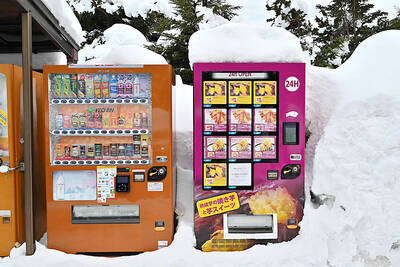
From post offices and parks to stations and even the summit of Mount Fuji, Japan’s vending machines are ubiquitous, but with the rapid pace of inflation cooling demand for their drinks, operators are being forced to rethink the business. Last month beverage giant DyDo Group Holdings announced it would remove about 20,000 vending machines — about 7 percent of their stock nationwide — by January next year, to “reconstruct a profitable network.” Pokka Sapporo Food & Beverage, based in Nagoya, also said last month it would sell its 40,000-machine operation to Osaka-based Lifedrink Co. “The strength of the vending machine


 RSS
RSS