


Every day Roeung Sorphy deftly weaves through the streets of Siem Reap, zigzagging past cars, motorbikes and the occasional stray dog as she shepherds tourists to the famed Angkor Wat temple complex.
However, on the road to becoming one of Cambodia’s tiny number of female tuk-tuk drivers, the 37-year-old who goes by the nickname Sopy has to dodge not only other road users, but also a barrage of taunts, misogyny and prejudice.
Cambodia has taken legal and practical steps toward gender equality, but it remains a conservative, patriarchal society. Women are expected to run the home and family rather than seek paid work.
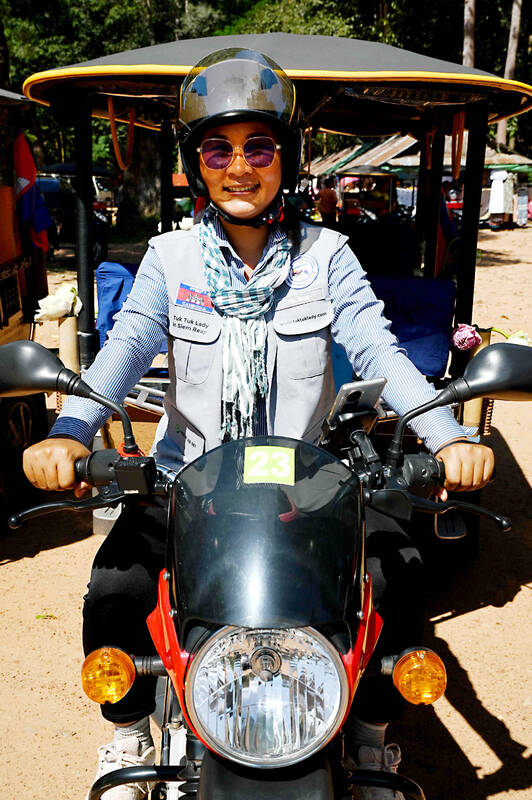
Photo: AFP
When Sopy first took to the streets, it was tough.
“At first, they [male drivers] looked down on me... They said we women should stay at home and clean dishes,” she said, describing how she was verbally harassed and assaulted when competing for fares.
“But we keep persevering,” she said after she finished cleaning her tuk-tuk, decorating it with blooming white lotus flowers.
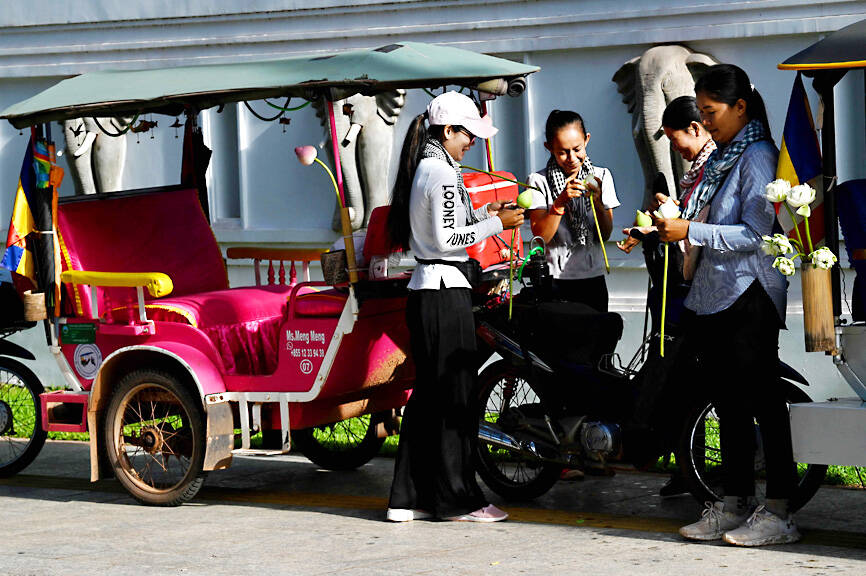
Photo: AFP
She got her start after borrowing money to buy her tuk-tuk, and has now been driving through the shaded roads of Angkor Park for more than three years.
“We cannot just rely on husbands,” she said, urging more women to join the profession.
“We will be strong like men,” said Sopy, whose husband is also a tuk-tuk driver.
After years, her male colleagues have finally accepted her.
“They think we are the same,” Sopy said. “I love the job. I think all women can do it.”
A 2020 US Agency for International Development report said women were being held back by low wages, poor working conditions, a lack of childcare and limited access to finance and training.
To help women in the male-dominated field, well-known driver Kim Sokleang — better known as Tuk-Tuk Lady — last year founded the Siem Reap Remorque Driver Association.
Her group includes 20 female drivers, six of whom, like her, are single mothers.
“Discrimination against Cambodian women still exists,” Kim said while waiting for passengers at the Bayon temple.
After getting a divorce in 2013, Kim began driving a rickshaw in the capital Phnom Penh to feed her two sons.
“On the first day, I did not have any passengers,” Kim said, recalling how one woman refused to ride with her.
Finding Phnom Penh tough, the 39-year-old moved to Siem Reap in 2015 to drive tourists.
Initially it was rough, Kim said, describing how she would sob in her tuk-tuk when she failed to get a fare.
“They think women are too weak to hold the steering wheel, and women cannot work like others,” said Kim.
However, her perseverance paid off: Tuk-Tuk Lady is now lauded by local and foreign tourists visiting Cambodia’s top tourism destination.
Norwegian visitor Stine Solheim and a friend said they felt “safe” with Kim driving them, and were impressed with her efforts to stand up for women.
“They are really passionate about what they do and they really enjoy it and feel proud,” she said.
Two-wheeled carriages pulled by a motorbike, tuk-tuks are one of Cambodia’s most famous means of transport.
No official statistics exist, but non-governmental organization Independent Democracy of Informal Economy Association, estimates there are tens of thousands of tuk-tuk drivers working across Cambodia.
“At first, as a woman, it was difficult to accept myself being a tuk-tuk driver. I never thought I could do it,” said Sieng Meng, 36.
Part of that is down to the lack of government support, said Kim.
“If Cambodian leaders come and ride Tuk Tuks,” it would help fight prejudices, she said.
ROCKY RELATIONS: The figures on residents come as Chinese tourist numbers drop following Beijing’s warnings to avoid traveling to Japan The number of Chinese residents in Japan has continued to rise, even as ties between the two countries have become increasingly fractious, data released on Friday showed. As of the end of December last year, the number of Chinese residents had increased by 6.5 percent from the previous year to 930,428. Chinese people accounted for 22.6 percent of all foreign residents in Japan, making them by far the largest group, Japanese Ministry of Justice data showed. Beijing has criticized Tokyo in increasingly strident terms since Japanese Prime Minister Sanae Takaichi last year suggested that a military conflict around Taiwan could

A pro-Iran hacking group claimed to breach FBI Director Kash Patel’s personal e-mail inbox and posted some of the contents online. The e-mails provided by the hacking group include travel details, correspondence with leasing agents in Washington and global entry, and loyalty account numbers. The e-mail address the hackers claim to have compromised has been previously tied to Patel’s personal details, and the leaked e-mails contain photos of Patel and others, in addition to correspondence with family members and colleagues. “The FBI is aware of malicious actors targeting Director Patel’s personal email information,” the agency said in a statement on

RIVALRY: ‘We know that these are merely symbolic investigations initiated by China, which is in fact the world’s most profligate disrupter of supply chains,’ a US official said China has started a pair of investigations into US trade practices, retaliating against similar probes by US President Donald Trump’s administration as the superpowers stake out positions before an expected presidential summit in May. The move, announced by the Chinese Ministry of Commerce on Friday, is a direct mirror of steps Trump took to revive his tariff agenda after the US Supreme Court last month struck down some of his duties. “China expresses its strong dissatisfaction and firm opposition to these actions,” a ministry spokesperson said in a statement, referring to the so-called Section 301 investigations initiated on March 11.

When a hiker fell from a 55m waterfall in wild New Zealand bush, rescuers were forced to evacuate the badly hurt woman without her dog, which could not be found. After strangers raised thousands of dollars for a search, border collie Molly was flown to safety by a helicopter pilot who was determined to reunite the pet and the owner. A week earlier, an emergency rescue helicopter found the woman with bruises and lacerations after a fall at a rocky spot at the waterfall on the South Island’s West Coast. She was airlifted on March 24, but they were forced to


 RSS
RSS