


Hundreds of people on Monday blocked key roads to demand the resignation of top prosecutors, whom they accuse of trying to block the newly elected president from taking office.
Guatemalan Prosecutor Rafael Curruchiche on Friday and Saturday sent security forces to seize boxes of voting records from this year’s presidential election, won by Bernardo Arevalo, 64.
Observers say that Arevalo’s vow to clamp down on graft has alarmed a corrupt elite.
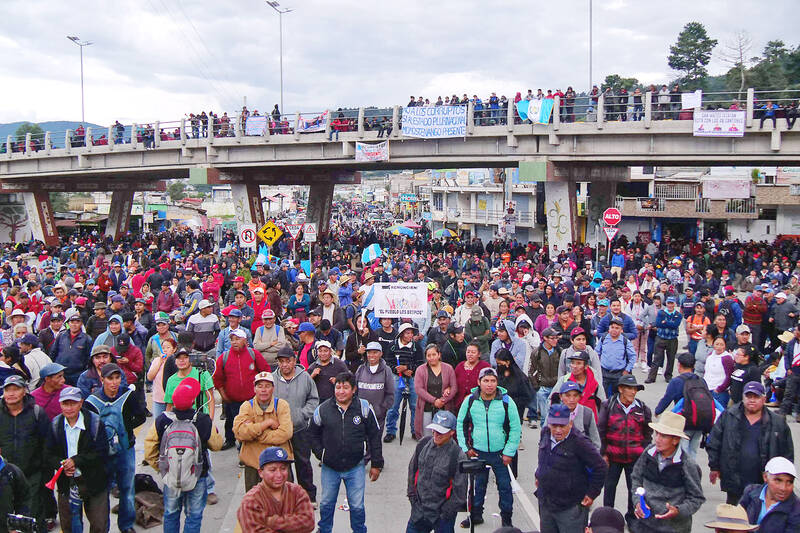
Photo: AFP
Arevalo is due to take office in January next year and the international community has raised the alarm over efforts to challenge the election outcome.
Protesters on Monday blocked key highways such as the Inter-American Highway and routes leading to the borders of Mexico, El Salvador and Honduras, transportation authorities said.
“Guatemala demands the respect of its democracy,” a sign held by protesters read.
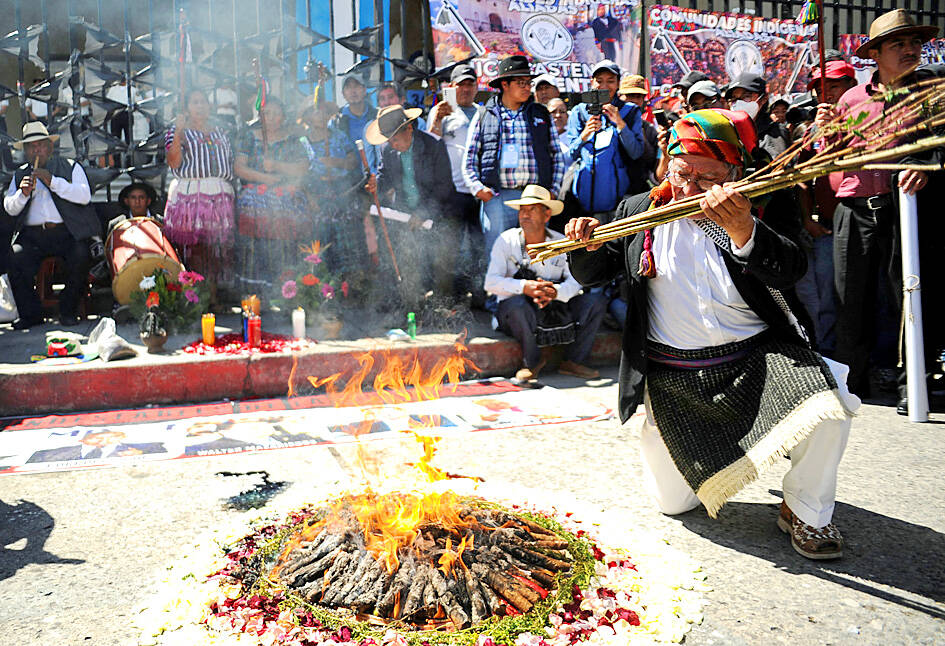
Photo: Reuters
Others demanded the resignation of Curruchiche, Attorney General Consuelo Porras and Judge Fredy Orellana, who have backed several raids against electoral authorities.
All three officials have been described as “corrupt” and “undemocratic” by the US Department of Justice.
Arevalo has asked the Guatemalan Supreme Court to remove them from their roles, accusing them of plotting a “coup d’etat” to prevent him from taking office.
The president-elect wrote on social media on Monday that he had held a video call with US Secretary of State Antony Blinken who expressed “his country’s concern about the situation in Guatemala.”
UN High Commissioner for Human Rights Volker Turk on Sunday said that the raid was “the latest in a long list of very worrying actions ... which — taken together — appear designed to undermine the integrity of the electoral process.”
The seized records came from the June first-round election that put Social Democrat Arevalo en route to a runoff victory in August, magistrate Gabriel Aguilera said.
His performance in that vote prompted a flurry of legal actions against his Semilla party, led by Curruchiche, who alleged irregularities in its formation in 2017.
Arevalo is to replace Guatemalan President Alejandro Giammattei, who has been accused by rights groups of overseeing a crackdown on anti-graft prosecutors and journalists, many of whom have been detained or forced to flee into exile.
FAKE NEWS? ‘When the government demands the press become a state mouthpiece under the threat of punishment, something has gone very wrong,’ a civic group said The top US broadcast regulator on Saturday threatened media outlets over negative coverage of the Middle East war, after US President Donald Trump slammed critical headlines from the “Fake News Media.” The US president since his first term has derided mainstream media as “fake news” and has sued major outlets over what he sees as unfair coverage. Brendan Carr, head of the US Federal Communications Commission — which oversees the nation’s radio, television and Internet media — said broadcasters risked losing their licenses over news coverage. “The law is clear. Broadcasters must operate in the public interest, and they will
INFLUTENTIAL THEORIST: Habermas was particularly critical of the ‘limited interest’ shown by German politicians in ‘shaping a politically effective Europe Jurgen Habermas, whose work on communication, rationality and sociology made him one of the world’s most influential philosophers and a key intellectual figure in his native Germany, has died. He was 96. Habermas’ publisher, Suhrkamp, said he died on Saturday in Starnberg, near Munich. Habermas frequently weighed in on political matters over several decades. His extensive writing crossed the boundaries of academic and philosophical disciplines, providing a vision of modern society and social interaction. His best-known works included the two-volume Theory of Communicative Action. Habermas, who was 15 at the time of Nazi Germany’s defeat, later recalled the dawn of
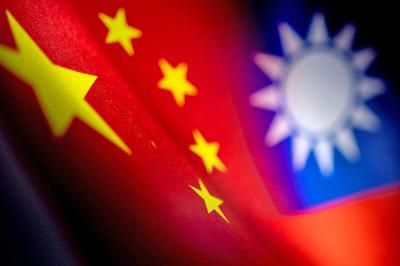
The Chinese public maintains relatively warm sentiments toward Taiwan and strongly prefers non-military paths to improving cross-strait relations, a recent survey conducted by the Atlanta, Georgia-based Carter Center and Emory University showed. The “China Pulse” research project, which polled 2,506 adults between Oct. 27 last year and Jan. 1 this year, found that 86 percent of respondents support strengthening cultural ties, while 81 percent favor deepening economic interaction. The report, co-authored by political scientists at Emory University and advisors at the Carter Center, indicates that the Chinese public views Taiwan’s importance through a lens of shared history and culture rather than geopolitical

Cannabis-based medicines have shown little evidence of effectiveness for treating most mental health and substance-use disorders, according to a large review of past studies published in a major medical journal on Monday. Medical use of cannabinoids has been expanding, including in the US, Canada and Australia, where many patients report using cannabis products to manage conditions such as anxiety, post-traumatic stress disorder and sleep problems. Researchers reviewed data from 54 randomized clinical trials conducted between 1980 and May last year involving 2,477 participants for their analysis published in The Lancet. The studies assessed cannabinoids as a primary treatment for mental disorders or substance-use


 RSS
RSS