


The administration of US President Joe Biden is in talks with Vietnam over an agreement for the largest arms transfer in history between the ex-Cold War adversaries, said two people familiar with a deal that could irk China and sideline Russia.
A package, which could come together within the next year, could consummate the newly upgraded partnership between Washington and Hanoi with the sale of a fleet of US F-16 jets as the Southeast Asian nation faces tensions with Beijing in the disputed South China Sea, one of the people said.
The deal is still in its early stages, with exact terms yet to be worked out, and might not come together, but it was a key topic of Vietnamese-US official talks in Hanoi, New York and Washington over the past month.
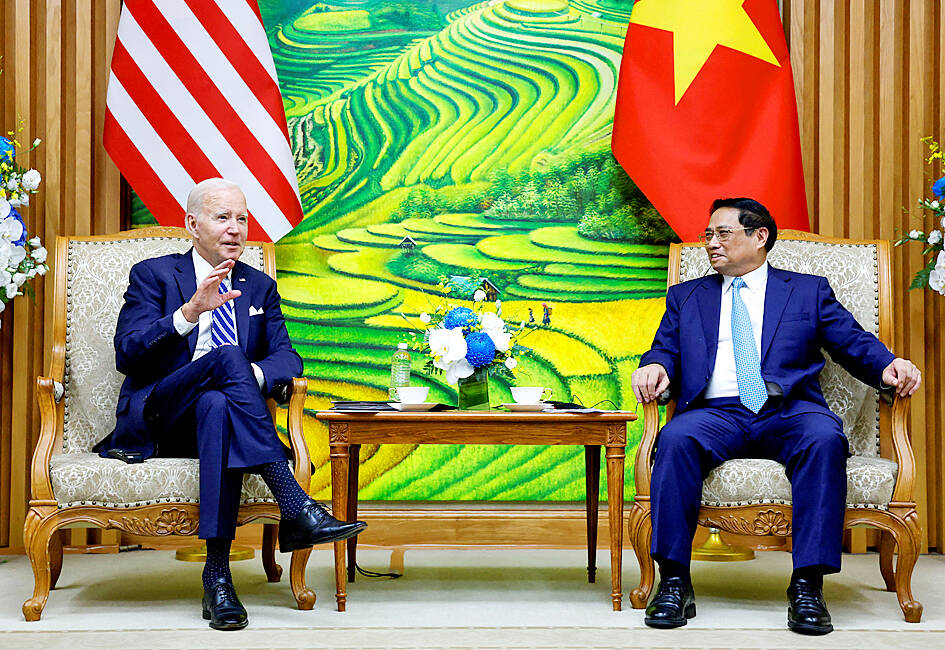
Photo: Reuters
The US is considering structuring special financing terms for the pricey equipment that could help cash-strapped Hanoi steer away from its traditional reliance on lower-cost, Russian-made arms, said the other source, who declined to be named.
Spokespersons for the White House and the Vietnamese Ministry of Foreign Affairs did not respond to requests for comment.
“We have a very productive and promising security relationship with the Vietnamese and we do see interesting movement from them in some US systems, in particular anything that can help them better monitor their maritime domain, perhaps transport aircraft and some other platforms,” a US official said.
“Part of what we’re working on internally as the US government is being creative about how we could try to provide better financing options to Vietnam to get them things that might be really useful to them,” they said.
A major US-Vietnam arms deal could aggravate China, Vietnam’s larger neighbor, which is wary of Western efforts to box in Beijing.
A long-simmering territorial dispute between Vietnam and China is heating up in the South China Sea and explains why Vietnam is looking to build up maritime defenses.
“They are developing asymmetric defensive capabilities, but [want] to do so without triggering a response from China,” said Jeffrey Ordaniel, associate professor of international security studies at Tokyo International University and director for maritime security at think tank Pacific Forum International. “It is a delicate balancing act.”
Ordaniel said that Washington should shift funds set aside for financing militaries in the Middle East to the Indo-Pacific region “so partners like Vietnam, the Philippines and Taiwan can afford the weapons they need to resist Beijing.”
The Biden administration has said it is trying to balance geopolitical competition with China, including in the Pacific and responsibly managing the two superpowers’ relationship.


Kehinde Sanni spends his days smoothing out dents and repainting scratched bumpers in a modest autobody shop in Lagos. He has never left Nigeria, yet he speaks glowingly of Burkina Faso military leader Ibrahim Traore. “Nigeria needs someone like Ibrahim Traore of Burkina Faso. He is doing well for his country,” Sanni said. His admiration is shaped by a steady stream of viral videos, memes and social media posts — many misleading or outright false — portraying Traore as a fearless reformer who defied Western powers and reclaimed his country’s dignity. The Burkinabe strongman swept into power following a coup in September 2022
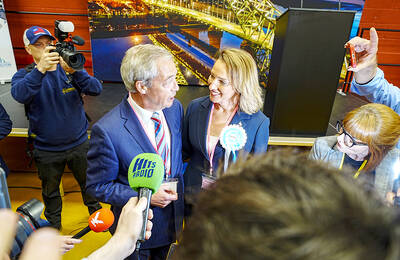
‘FRAGMENTING’: British politics have for a long time been dominated by the Labor Party and the Tories, but polls suggest that Reform now poses a significant challenge Hard-right upstarts Reform UK snatched a parliamentary seat from British Prime Minister Keir Starmer’s Labor Party yesterday in local elections that dealt a blow to the UK’s two establishment parties. Reform, led by anti-immigrant firebrand Nigel Farage, won the by-election in Runcorn and Helsby in northwest England by just six votes, as it picked up gains in other localities, including one mayoralty. The group’s strong showing continues momentum it built up at last year’s general election and appears to confirm a trend that the UK is entering an era of multi-party politics. “For the movement, for the party it’s a very, very big
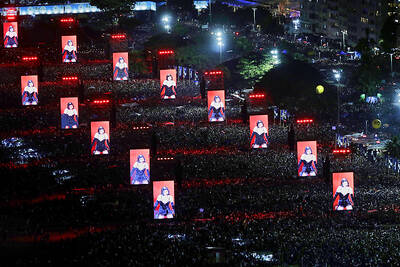
ENTERTAINMENT: Rio officials have a history of organizing massive concerts on Copacabana Beach, with Madonna’s show drawing about 1.6 million fans last year Lady Gaga on Saturday night gave a free concert in front of 2 million fans who poured onto Copacabana Beach in Rio de Janeiro for the biggest show of her career. “Tonight, we’re making history... Thank you for making history with me,” Lady Gaga told a screaming crowd. The Mother Monster, as she is known, started the show at about 10:10pm local time with her 2011 song Bloody Mary. Cries of joy rose from the tightly packed fans who sang and danced shoulder-to-shoulder on the vast stretch of sand. Concert organizers said 2.1 million people attended the show. Lady Gaga

SUPPORT: The Australian prime minister promised to back Kyiv against Russia’s invasion, saying: ‘That’s my government’s position. It was yesterday. It still is’ Left-leaning Australian Prime Minister Anthony Albanese yesterday basked in his landslide election win, promising a “disciplined, orderly” government to confront cost-of-living pain and tariff turmoil. People clapped as the 62-year-old and his fiancee, Jodie Haydon, who visited his old inner Sydney haunt, Cafe Italia, surrounded by a crowd of jostling photographers and journalists. Albanese’s Labor Party is on course to win at least 83 seats in the 150-member parliament, partial results showed. Opposition leader Peter Dutton’s conservative Liberal-National coalition had just 38 seats, and other parties 12. Another 17 seats were still in doubt. “We will be a disciplined, orderly


 RSS
RSS