


The sound of hammers and chisels striking stone rings out on most Sundays in the cemetery of ancient Xochiaca, a village swallowed up decades ago by the urban sprawl of Mexico City.
It is the sound of the stone carvers of Chimalhuacan — as the borough is known — who still pursue a craft passed down for generations, even after the local source of quarry stone was exhausted.
The village cemetery is filled with meter-high statues of saints and a knot of men who coax flower garlands and flowers out of the blocks of stone with their chisels.
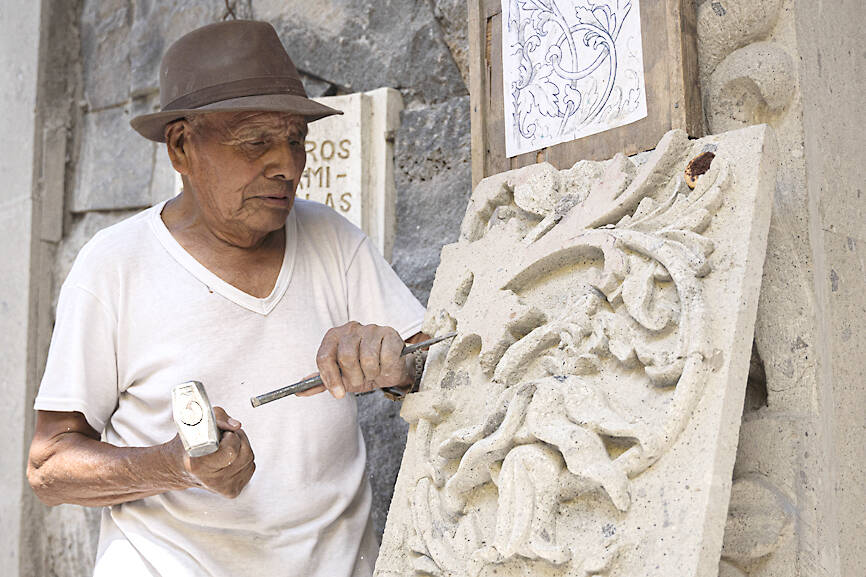
Photo: AP
Generations of stone carvers in Chimalhuacan, on Mexico’s City’s far east side, also created much of the stonework that adorns buildings and parks in the capital’s downtown.
While carvers in other areas long ago turned to mechanical cutters and polishers, the craftspeople here use only hammers, mallets and a variety of chisels and gouges.
Many are self-taught, but some, like Tomas Ugarte, 86, learned in the traditional way handed down by fathers and grandfathers, dating back about five generations.
The group skews to an older demographic these days. There were about 600 registered stone carvers a decade ago, but Carolina Montesinos Mendoza, director of the Mexico State office that supports artisans, said there are probably only about 300 now. The carvers are dying off and their children generally do not want to take up the trade.
With Xochiaca now lost in a labyrinth of city streets, they keep the old traditions alive. Many residents use stone mortars and pestles made by the stone carvers. Known as “molcajetes” in Spanish, these bowl-like grinders are the basic tool for making salsas.
“They are the backbone of the community,” said Reverend Alberto Sandoval, who has known them since 1990, when he served as a parish priest in Xochiaca.
Most of the carvers have individual workshops at home, which provide them with some income. They sell carvings for US$500 to US$2,000, but they often do not sell much.
Unlike many craftspeople who want to see their works displayed in museums, the carvers here work free of charge to create and maintain carvings to decorate the local cemetery.
Among those are an imposing, 6m stone Christ figure, as well as European-inspired sculptures of the 12 apostles.
They also work for free at decorating and maintaining the stonework at the 250-year-old parish church, Santa Maria de Guadalupe.
They have made altar screens, columns, and the Christ and Virgin Mary statues that are 3m tall.
One of the earliest signs of their predecessors’ work is a carved stone in the floor of the churchyard reading “Xochiaca, home of the stone carvers.” It does not bear a date.
However, it refers to a time when the lake that once covered much of the valley still lapped at the shores of Xochiaca. Builders would come looking for carvings, and ship them to Mexico City on barges over the lake.
Juan Alfaro Bastidas, 75, is a carver, just as his father and grandfather were. He recalls going into the quarries by candlelight to get blocks of stone.
However, the quarries are just a memory now.
Largely played out, the land where they stood was sold for housing lots. Some of the newcomers considered it quaint, and used the sides of the quarry as walls in their homes.
Now, the carvers truck in stone from other states to the north and to the west, but sometimes from as far away as the southern state of Yucatan.
They get some help from donations from the local government and local residents.
“The neighbors have helped us out with donations of 100 or 200 pesos [US$6 to US$12]. The people of the town buy the stone,” Bastidas said.
Asked if the trade will survive, carver Mario Olivares recited a poem etched by the artisans in the church wall: “Your art, your tradition, your culture and the nobility of the people keep the soul of this town alive.”
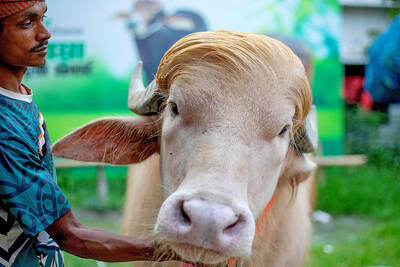
Crowds in Bangladesh are flocking to snap photographs with an unlikely social media star — an albino buffalo with flowing blond hair nicknamed “Donald Trump” that is due to be sacrificed within days. Owner Zia Uddin Mridha, 38, said his brother named the 700kg bull over its flowing helmet of hair resembling the signature look of the US president. “My younger brother picked this name because of the buffalo’s extraordinary hair,” he said at his farm in Narayanganj, just outside the capital, Dhaka. Mridha said that a constant stream of curious visitors — social media fans, onlookers and children — have come throughout

It began as a satirical online project. Now millions of young people in India are flocking to it as an outlet for their frustration. A parody political party called the Cockroach Janta Party, with the insect as its symbol, has exploded across India’s social media by turning absurdist humor into protest. Memes and short videos mocking corruption, joblessness and political dysfunction have flooded social media sites, where millions of users are embracing the cockroach — known for its ability to survive harsh conditions — as a tongue-in-cheek symbol of endurance. The online movement’s rise has been unusually rapid. The Cockroach Janta Party (CJP)
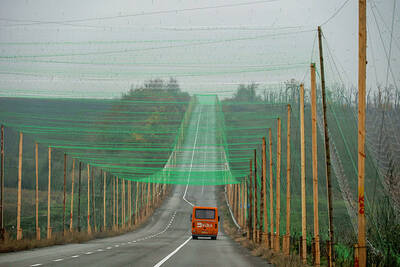
BIGGER ROLE: Beijing has said it maintains an impartial stance on the war in Ukraine, but by training Russian troops, China is far more involved than previously known China’s armed forces secretly trained about 200 Russian military personnel in China late last year, and some have since returned to fight in Ukraine, according to three European intelligence agencies and documents seen by Reuters. While China and Russia have held a number of joint military exercises since Moscow’s full-scale invasion of Ukraine in 2022, Beijing has repeatedly said that it is neutral in the conflict and presents itself as a peace mediator. The covert training sessions, which predominantly focused on the use of drones, were outlined in a dual-language Russian-Chinese agreement signed by senior Russian and Chinese officers in Beijing on
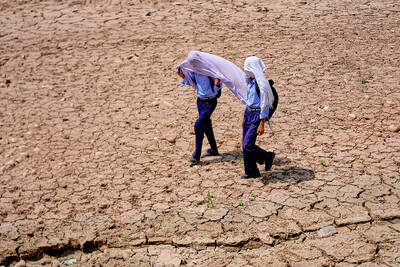
HOTTER: While Indians are accustomed to summer heat, climate change has caused northwestern India to warm faster than other parts of the country, an academic said Roads and markets have emptied during afternoons and some farmers have switched to nighttime work to avoid scorching temperatures as a heat wave grips large parts of India. The India Meteorological Department forecast maximum temperatures for yesterday of about 45°C in the capital, New Delhi, where authorities have opened temporary “cooling zones” to help people cope. The weather department warned that conditions would likely persist across several northern regions in the coming days, with temperatures staying well above seasonal averages. Authorities urged people to stay indoors during the hottest hours and take precautions against heat-related illnesses. India declares a heat wave whenever maximum temperatures


 RSS
RSS