


Jimmy Lai (黎智英), a former newspaper publisher and one of Hong Kong’s most prominent democracy activists, spends about 23 hours a day in solitary confinement in a maximum-security facility while he awaits a trial that could send him to prison for life.
In exclusive photographs taken by The Associated Press in the past few weeks, the 75-year-old Lai can be seen with a book in his hands wearing shorts and sandals and accompanied by two guards at Stanley Prison. He looks thinner than when he was last photographed in February 2021.
Lai is allowed out for 50 minutes per day to exercise. Unlike most other inmates, who play soccer or exercise in groups, Lai walks alone in what appears to be a 5m-by-10m enclosure surrounded by barbed wire under Hong Kong’s punishing summer sun before returning to his un-air-conditioned cell in the prison.
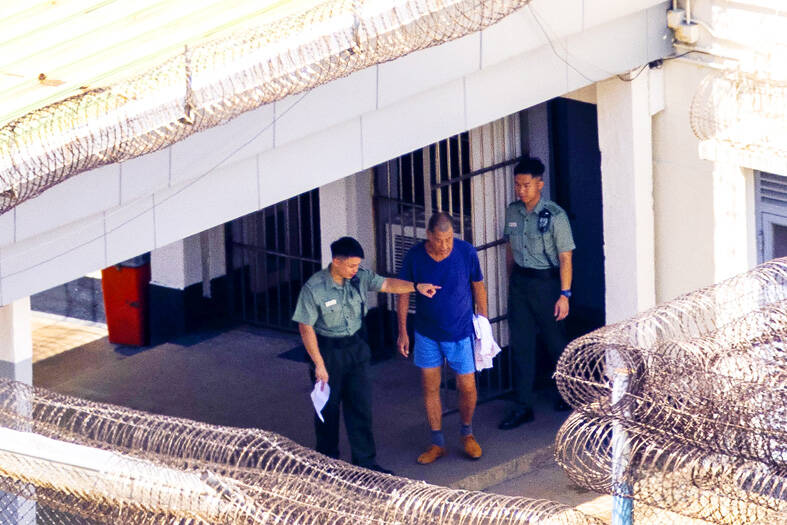
Photo: AP
The publisher of the now-defunct Apple Daily newspaper disappeared from public view in December 2020 following his arrest under the Beijing imposed Hong Kong Security Law to crush a massive democracy movement that started in 2019 and brought hundreds of thousands onto the streets. More than 250 activists have been arrested under the law and vanished into the Hong Kong legal system.
Photographers used to be able to catch a glimpse of activists in remand at another detention center in Lai Chi Kok as they were taken to and from court. Authorities started blocking this view in 2021 by making the detainees walk through a covered pathway.
In a separate case, an appeals court is today to rule on a challenge that Lai and six other activists filed against their conviction and sentencing on charges of organizing and taking part in an unauthorized assembly nearly four years ago.
Lai, a British national, is accused of colluding with foreign forces to endanger national security and conspiring to call for sanctions or blockades against Hong Kong or China. He also faces a charge of conspiracy to print seditious publications under a colonial-era law increasingly used to crush dissent.
He was scheduled to go on trial in December last year, but it was postponed to September, while the Hong Kong government appealed to Beijing to block his attempt to hire a British defense lawyer.
“My father is in prison because he spoke truth to power for decades,” Lai’s son, Sebastien Lai (黎崇恩), said in a May statement to the US Congressional-Executive Commission on China.
“He is still speaking truth to power and refusing to be silenced, even though he has lost everything and he may die in prison,” Sebastien Lai said. “I am very proud to be his son.”
Lai is allowed two 30-minute visits by relatives or friends each month. They are separated by glass and communicate by phone.
Lai, who has diabetes and was diagnosed with high blood pressure in 2021 while in detention, is treated as a Category A prisoner, a status for inmates who have committed the most serious crimes such as murder.

Kouri Richins, a Utah mother who published a children’s book about grief after the death of her husband is to serve a life sentence for his murder without the possibility of parole, a judge ruled on Wednesday. Richins was convicted in March of aggravated murder for lacing a cocktail given to her husband, Eric Richins, with five times the lethal dose of fentanyl at their home near Park City in 2022. A jury also found her guilty of four other felonies, including insurance fraud, forgery and attempted murder for trying to poison her husband weeks earlier on Feb. 14, 2022, with a

DELA ROSA CASE: The whereabouts of the senator, who is wanted by the ICC, was unclear, while President Marcos faces a political test over the senate situation Philippine authorities yesterday were seeking confirmation of reports that a top politician wanted by the International Criminal Court (ICC) had fled, a day after gunfire rang out at the Philippine Senate where he had taken refuge fearing his arrest. Senator Ronald “Bato” dela Rosa, the former national police chief and top enforcer of former Philippine president Rodrigo Duterte’s “war on drugs,” has been under Senate protection and is wanted for crimes against humanity, the same charges Duterte is accused of. “Several sources confirmed that the senator, Senator Bato, is no longer in the Senate premises, but we are still getting confirmation,” Presidential

HELP DENIED? The US Department of State said that the Cuban leadership refuses to allow the US to provide aid to Cubans, ‘who are in desperate need of assistance’ US Secretary of State Marco Rubio on Wednesday said that Cuba’s leadership must change, as Washington renewed an offer of US$100 million in aid if the communist nation agrees to cooperate. Cuba has been suffering severe economic tumult led by an energy shortage that plunged 65 percent of the country into darkness on Tuesday. Cuba’s leaders have blamed US sanctions, but Rubio, a Cuban American and critic of the government established by Fidel Castro, said the system was to blame, including corruption by the military. “It’s a broken, nonfunctional economy, and it’s impossible to change it. I wish it were different,” he told
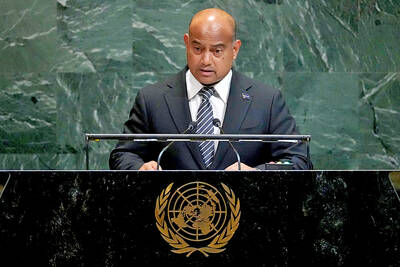
Nauru said it would hold a referendum to change its official name, described as a colonial relic from a time when “foreign tongues” mangled the native language. Nauru would change its name to Naoero to “more faithfully honor our nation’s heritage, our language and our identity,” Nauruan President David Adeang said in a statement on Tuesday. The Pacific island nation’s native language is Dorerin Naoero, which is spoken by the vast majority of its approximately 10,000 inhabitants. “Nauru emerged because Naoero could not be properly pronounced by foreign tongues, and was changed not by our choice, but for convenience,” the government said in


 RSS
RSS