


European Commission President Ursula von der Leyen yesterday said that Europe would not tolerate aggression in Ukraine or the Indo-Pacific region, as she renewed in a speech the EU’s recognition of a 2016 arbitration decision that invalidated China’s expansive claims in the disputed South China Sea.
Von der Leyen spoke at a joint news conference with Philippine President Ferdinand Marcos Jr after holding talks in Manila that aimed to bolster trade, economic and security relations. The leaders announced the 27-nation bloc would resume negotiations with the Philippines for a free-trade agreement that stalled in 2017 under Marcos’ predecessor, former Philippine president Rodrigo Duterte.
She underscored the need for security cooperation, citing Russia’s invasion of Ukraine, which showed how authoritarian leaders “are willing to act on their threats.”
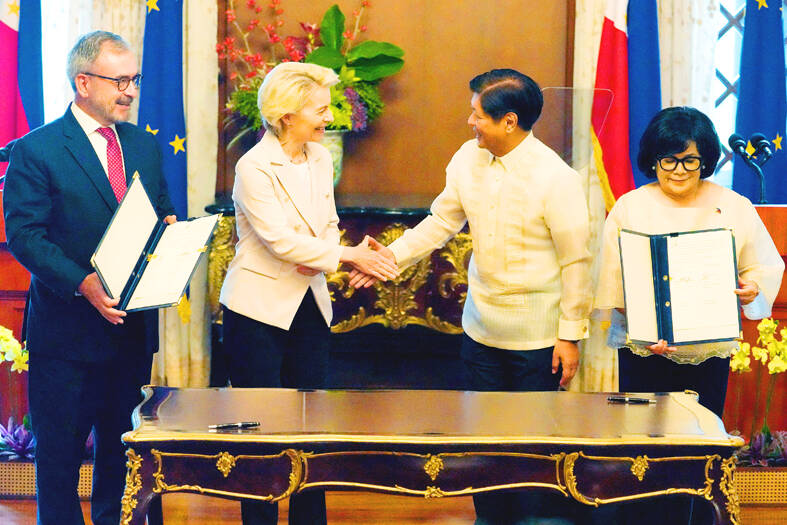
Photo: AFP
“Russia’s war of aggression against Ukraine shakes the foundation of the international order. It is in violation of the UN charter and the fundamental principles of international law, such as territorial integrity and sovereignty,” she said. “This is why Europe supports Ukraine’s brave fight against the aggressor because the illegal use of force cannot be tolerated, not in Ukraine, not in the Indo-Pacific. Security in Europe and security in the Indo-Pacific is indivisible. Challenges to the rules-based order in our interconnected world affect all of us.”
“This is why we are concerned about the rising tensions in the Indo-Pacific,” Von der Leyen said, adding that the EU backs a free and open Indo-Pacific region “because an Indo-Pacific free of the threats of coercion is key to all our stability to our peace, and to the prosperity of our people.”
Her veiled rhetoric echoed that of US leaders, who have raised alarms over China’s increasingly aggressive actions in the disputed South China Sea.
Without naming China, Von der Leyen renewed the EU’s recognition of a decision by a UN-backed tribunal that invalidated China’s territorial claims in virtually the entire waterway on historical grounds. China has rejected the arbitration decision as a sham and continues to defy it.
The award “is legally binding” and provides the basis for a peaceful resolution of the disputes, she said.
The EU is ready to boost cooperation with the Philippines to foster regional maritime security by sharing information, carrying out threat assessments and bolstering the Philippine coast guard, she said.
China has warned the US and its allies from meddling in what it says is a purely Asian dispute. It has turned seven disputed reefs into missile-protected island bases in the past decade, further alarming Western governments and rival claimants, including Taiwan, the Philippines, Vietnam, Malaysia and Brunei.
Von der Leyen’s visit to the Philippines is a sign of improving ties after a stormy period between the EU and Duterte over human rights. It is the first such top-level visit in nearly six decades of relations with the Philippines.
The visit came at a time when the EU is assessing whether to extend special trade incentives, including slashed tariffs for a wide variety of products, to the Philippines.
The EU trade incentives under the so-called Generalized Scheme of Preferences for the Philippines and seven other developing nations are anchored on their adherence to more than two dozen international conventions on human and labor rights, environmental protection and good governance, but the Philippines came under intense EU criticism during Duterte’s six-year term, mainly because of a bloody anti-drugs crackdown he oversaw that left more than 6,000 mostly petty suspects dead. Marcos succeeded Duterte in June last year.
The killings sparked an International Criminal Court investigation as a possible crime against humanity.
Duterte withdrew the Philippines from the court in 2018, but its prosecutor has proceeded to investigate the widespread deaths that occurred in the years when the nation was still part of the court based in The Hague, Netherlands.
Duterte often lashed out at the EU’s criticisms of his brutal anti-drugs crackdown with profanity-laced outbursts.

‘CROSSING THE LINE’: China’s embassy in Seoul criticized US Forces Korea Commander General Xavier Brunson, asking if his ‘hostile’ remarks were authorized by Washington South Korea and the US are in talks over recent public remarks by the commander of US Forces Korea, Seoul’s presidential office said yesterday, after the comments drew sharp criticism from China. In a recent podcast interview, US Forces Korea Commander General Xavier Brunson described South Korea as “the dagger in the heart of Asia” from China’s east coast, prompting the Chinese embassy in Seoul to say that he had “truly crossed the line.” The interview came amid growing speculation that Washington might seek to expand the role of US Forces Korea in countering the growing regional influence of China, a key

SEEKING ORDER: Rodrigo Paz said that ‘anyone who wants to destroy the nation will have to deal with this president and the full force of the constitution’ Bolivian President Rodrigo Paz on Wednesday said that the nation was at a “breaking point” after nearly a month of protests that have caused shortages of food, fuel and medicine. Paz, who took office six months ago amid the worst economic crisis there in four decades, is battling a groundswell of fury over his policies. The political capital, La Paz, has been besieged by low-income workers and members of the indigenous majority calling for his resignation. “The country needs order and is reaching breaking point,” the 58-year-old said at a public event in La Paz, renewing his appeal for dialogue. On Tuesday, the Bolivian

Through the noise of rushing papers and whirring belts at a print factory in Kyoto, two creators watch their photo essay come to life in broadsheet form — part of an effort to win new audiences in the age of artificial intelligence (AI). Despite the decline of the publishing industry, self-publication and handmade “zine” magazines are growing in popularity in Japan, reflecting the nation’s enduring love of paper in the digital era. While speaking to Agence France-Presse at the plant, his hands black with ink, one of the creators, Kazuma Obara, said: “I think [paper] is a medium that engages all five

Australian researchers have trained lab-grown brain cells on a silicon computer chip to play the 1990s shooter game Doom and said they are just scratching the surface of what the neurons could be capable of doing. It is the science-fiction work of biotech boffins at Cortical Labs, who researched and developed the technology that harnesses the workings of the brain’s networking system. Each so-called “biological computer” contains about 200,000 living human brain cells, grown from stem cells that were harvested from blood donations. Having mastered the simple computer game Pong, where a paddle is moved up and down to send a ball


 RSS
RSS