


It is almost midnight, and above a semi-abandoned Bangkok shopping center, Ghost Radio is on air.
Rapid-fire comments ping across the studio’s screens as thousands tune in online to hear callers describe their encounters with Thailand’s supernatural.
Belief in spirits runs deep in the kingdom, which has a celebrated canon of ghosts from individuals such as Mae Nak, a woman who haunted her village after dying during childbirth, to more sinister creatures such as Krasue — bodyless women who float through the night looking to devour flesh.
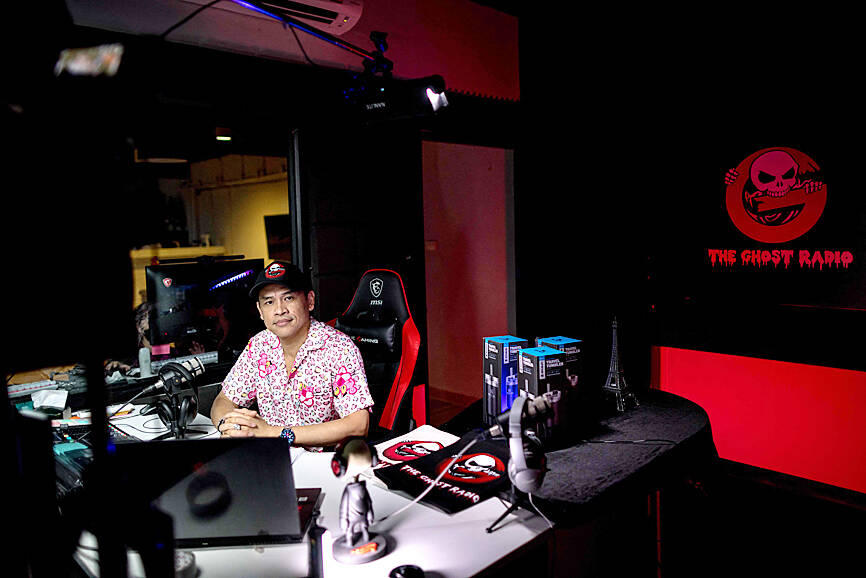
Photo: AFP
Now these ancient tales are being reinvigorated through online platforms such as YouTube, TikTok, WhatsApp and even delivery app Grab.
“She met a man in a white suit who told her that her time was up, and that she had to go with him,” the first caller recounts, her voice quavering. “But when she turned back, she could see her body lying in bed.”
In the studio, host Watcharapol Fukjaidee listens patiently, gently prying out details.
The charismatic 46-year-old, also known by his nickname Jack, films two live episodes per week from 11pm to dawn, fielding calls from spooked Thais as millions tune in and thousands comment online.
“When there is more technology, the chance to see ghosts increases,” he told Agence France-Presse. “Ghosts come with apps, chat lines, phone calls. Technology becomes the channel where they can contact people.”
Watcharapol recounted a caller who was contacted by a distant friend, asking him to meet at a temple, but when he got there he made a chilling discovery.
“It turns out that his friend had died and his phone was put into the coffin,” he says, raising his eyebrows, a mischievous chuckle lurking.
The host got his break 20 years ago under Thailand’s “godfather of ghosts,” Kapol Thongplub, whose late-night call show was a favorite among the capital’s taxi drivers.
It is now food delivery riders rather than cabbies who frequently encounter the supernatural as they crisscross Bangkok at all hours, Watcharapol said.
Unlike Kapol’s show, which was dominated by the host’s larger-than-life reactions, Watcharapol is more low-key and a little tongue-in-cheek.
“Now with the influence of Twitter and TikTok, more young people call,” Ghost Radio worker Khemjira Jongkolsapapron said.
“This isn’t a matter of still believing or not,” said cultural anthropologist Andrew Alan Johnson, whose book Ghosts of the New City examines how recent events have reshaped Thai beliefs.
“Ghosts become a way to tell stories that are denied elsewhere,” he said.
This is especially true in rapidly changing Bangkok, Johnson said, where ghost tales help preserve local memory — explaining unlucky locations, or feelings of alienation.
“Folk belief is incredibly adaptable, in that it seeks to speak to people’s everyday experiences,” he said.
The Ghost Radio YouTube channel has almost 3 million subscribers and is sponsored by local firms as well as pulling income from the themed cafe on the ground floor.
Watched over by an eclectic collection of ghost-themed toys, Khemjira sifts through scores of submissions, weeding out political stories or anything that might touch on the kingdom’s tough laws against insulting the monarchy.
Not every tale makes it on air, but Khemjira is confident that the people telling them believe them to be true.
“I think people meet ghosts a lot. We hardly ever hear the same story,” she says.
As Watcharapol listens upstairs, downstairs his cafe is raucous with young fans and families.
Munching on a tombstone-shaped brownie, 25-year-old policeman and regular caller Chalwat Thungood explained how he shares his colleagues’ tales.
His spooky experience came on a call out to a house. As he arrived he glimpsed the shadow of an overweight man walk into a bathroom.
He struggled to open the door — until suddenly it gave way.
“I found a big man who had been dead for at least five hours. It proved to me that I saw a spirit of the big man walking into the bathroom,” he said. “I 100 percent believe that ghosts exist.”
Watcharapol refuses to be drawn on whether he actually believes, stating he has to maintain an open mind, before admitting he is “scared to death” of hospital ghosts.
People tune in to his show to find a like-minded community, “because sometimes they can’t speak to their family about their ghostly experiences,” he said.
“No one can prove it is real except the caller,” he added.

Through the noise of rushing papers and whirring belts at a print factory in Kyoto, two creators watch their photo essay come to life in broadsheet form — part of an effort to win new audiences in the age of artificial intelligence (AI). Despite the decline of the publishing industry, self-publication and handmade “zine” magazines are growing in popularity in Japan, reflecting the nation’s enduring love of paper in the digital era. While speaking to Agence France-Presse at the plant, his hands black with ink, one of the creators, Kazuma Obara, said: “I think [paper] is a medium that engages all five

‘CROSSING THE LINE’: China’s embassy in Seoul criticized US Forces Korea Commander General Xavier Brunson, asking if his ‘hostile’ remarks were authorized by Washington South Korea and the US are in talks over recent public remarks by the commander of US Forces Korea, Seoul’s presidential office said yesterday, after the comments drew sharp criticism from China. In a recent podcast interview, US Forces Korea Commander General Xavier Brunson described South Korea as “the dagger in the heart of Asia” from China’s east coast, prompting the Chinese embassy in Seoul to say that he had “truly crossed the line.” The interview came amid growing speculation that Washington might seek to expand the role of US Forces Korea in countering the growing regional influence of China, a key

Australian researchers have trained lab-grown brain cells on a silicon computer chip to play the 1990s shooter game Doom and said they are just scratching the surface of what the neurons could be capable of doing. It is the science-fiction work of biotech boffins at Cortical Labs, who researched and developed the technology that harnesses the workings of the brain’s networking system. Each so-called “biological computer” contains about 200,000 living human brain cells, grown from stem cells that were harvested from blood donations. Having mastered the simple computer game Pong, where a paddle is moved up and down to send a ball

France experienced its hottest spring on record, the French weather service said on Tuesday, after an exceptional early heat wave that also broke highs for the season in England and Wales. Meteo-France said the average nationwide temperature over March to May was 13.8°C — about 1.7°C above the norm, and surpassing records set in 2011 and 2020. “The warmest spring since records began in 1900,” it said in a bulletin. All three months were warmer than average, but the onset of an “unprecedented heatwave” late last month pushed the mercury to highs typically seen at the height of the summer. “Our country had never


 RSS
RSS