


North Korea yesterday test-fired two short-range ballistic missiles in another show of force, a day after the US and South Korea began military drills that Pyongyang views as an invasion rehearsal.
The missiles launched from the southwestern coastal town of Jangyon flew across North Korea before landing in the sea off the east coast, the South Korean Joint Chiefs of Staff said in a statement. It said both missiles traveled about 620km.
The reported flight distances suggest the missiles target South Korea, which hosts about 28,000 US troops.
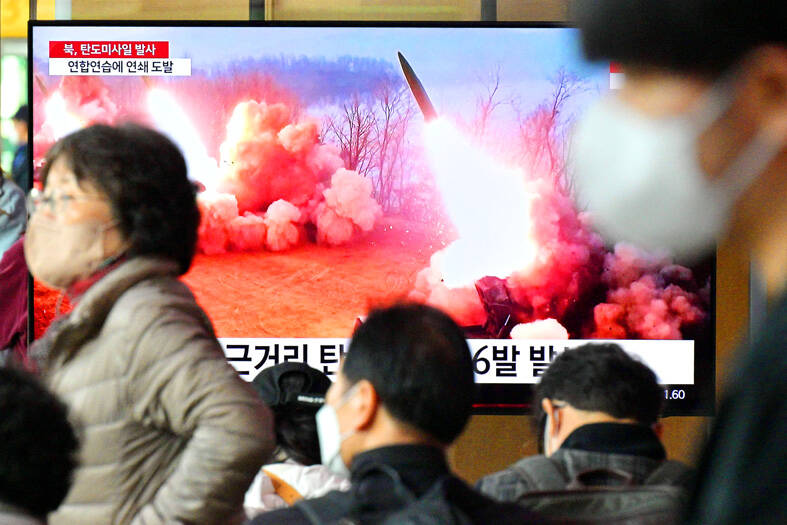
Photo: AFP
South Korea’s military called the launches “a grave provocation” that undermines stability on the Korean Peninsula.
The US Indo-Pacific Command said the launches did not pose an immediate threat to its allies, but it said North Korea’s recent tests highlight the “destabilizing impact” of its unlawful weapons programs, and that the US security commitment to South Korea and Japan remains “ironclad.”
Japanese Prime Minister Fumio Kishida told reporters that officials were still gathering details of the North Korean launches and there were no immediate reports of damage in Japanese waters.
Pyongyang could further escalate its weapons tests over the coming days in a tit-for-tat response to the allies’ military drills, which are planned to run until Thursday next week.
North Korean leader Kim Jong-un last week ordered his troops to be ready to repel what he called the “frantic war preparations moves” by his nation’s rivals.
Worries about North Korea’s nuclear program have grown sharply after it test-fired more than 70 missiles last year, many of them nuclear-capable weapons, and openly threatened to use them in potential conflicts with the US and South Korea.
North Korea appears to be using long-stalled talks with Washington and the expanding US-South Korean drills as a chance to enlarge its weapons arsenals to increase its leverage in future dealings with the US.
The North Korean threats, along with China’s increasing assertiveness, have pushed the US to seek to reinforce its alliances with South Korea and Japan, but some experts say a solidified Washington-Seoul-Tokyo cooperation could prompt Pyongyang, Beijing and Moscow to strengthen their own trilateral ties.
China and Russia, embroiled in separate confrontations with the US, have repeatedly blocked the US and its allies’ bids to toughen UN sanctions on North Korea.
Yesterday’s launches were North Korea’s second weapons test this week. North Korea on Monday said that it had test-fired two cruise missiles from a submarine the previous day. It implied the cruise missiles were being developed to carry nuclear warheads, though outside experts debate whether Pyongyang possesses functioning nuclear-armed missiles.
Submarine-launched missile systems are harder to detect and would provide North Korea retaliatory second attack capability, but experts say it would take years, extensive resources and major technological improvements for the heavily sanctioned nation to build a fleet of submarines that could travel quietly and reliably execute strikes.
US National Security Adviser Jake Sullivan on Monday said that North Korea has been refining its submarine-launch capabilities since its first test in 2016 and the US was studying Sunday’s launches to assess its capabilities.
“But of course, we’re not going to let any steps North Korea takes deter us or constrain us from the actions that we feel are necessary to safeguard stability on the Korean Peninsula,” Sullivan said.
The US-South Korean joint exercises that started on Monday include computer simulations involving North Korean aggression, other security scenarios and field exercises.
The US-South Korea drills would proceed normally, regardless of whether “North Korea tries to disrupt them with provocations like missile launches,” South Korean Ministry of National Defense spokesperson Jeon Ha-gyu said.
US Department of State spokesman Ned Price on Monday said that the US has made it clear it harbors no hostile intent toward North Korea and that the allies’ longstanding exercises are “purely defensive in nature.”


Kehinde Sanni spends his days smoothing out dents and repainting scratched bumpers in a modest autobody shop in Lagos. He has never left Nigeria, yet he speaks glowingly of Burkina Faso military leader Ibrahim Traore. “Nigeria needs someone like Ibrahim Traore of Burkina Faso. He is doing well for his country,” Sanni said. His admiration is shaped by a steady stream of viral videos, memes and social media posts — many misleading or outright false — portraying Traore as a fearless reformer who defied Western powers and reclaimed his country’s dignity. The Burkinabe strongman swept into power following a coup in September 2022
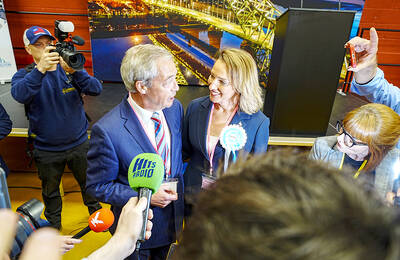
‘FRAGMENTING’: British politics have for a long time been dominated by the Labor Party and the Tories, but polls suggest that Reform now poses a significant challenge Hard-right upstarts Reform UK snatched a parliamentary seat from British Prime Minister Keir Starmer’s Labor Party yesterday in local elections that dealt a blow to the UK’s two establishment parties. Reform, led by anti-immigrant firebrand Nigel Farage, won the by-election in Runcorn and Helsby in northwest England by just six votes, as it picked up gains in other localities, including one mayoralty. The group’s strong showing continues momentum it built up at last year’s general election and appears to confirm a trend that the UK is entering an era of multi-party politics. “For the movement, for the party it’s a very, very big
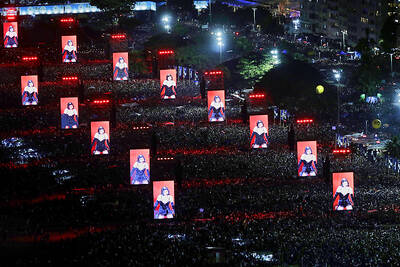
ENTERTAINMENT: Rio officials have a history of organizing massive concerts on Copacabana Beach, with Madonna’s show drawing about 1.6 million fans last year Lady Gaga on Saturday night gave a free concert in front of 2 million fans who poured onto Copacabana Beach in Rio de Janeiro for the biggest show of her career. “Tonight, we’re making history... Thank you for making history with me,” Lady Gaga told a screaming crowd. The Mother Monster, as she is known, started the show at about 10:10pm local time with her 2011 song Bloody Mary. Cries of joy rose from the tightly packed fans who sang and danced shoulder-to-shoulder on the vast stretch of sand. Concert organizers said 2.1 million people attended the show. Lady Gaga

SUPPORT: The Australian prime minister promised to back Kyiv against Russia’s invasion, saying: ‘That’s my government’s position. It was yesterday. It still is’ Left-leaning Australian Prime Minister Anthony Albanese yesterday basked in his landslide election win, promising a “disciplined, orderly” government to confront cost-of-living pain and tariff turmoil. People clapped as the 62-year-old and his fiancee, Jodie Haydon, who visited his old inner Sydney haunt, Cafe Italia, surrounded by a crowd of jostling photographers and journalists. Albanese’s Labor Party is on course to win at least 83 seats in the 150-member parliament, partial results showed. Opposition leader Peter Dutton’s conservative Liberal-National coalition had just 38 seats, and other parties 12. Another 17 seats were still in doubt. “We will be a disciplined, orderly


 RSS
RSS