


As a Philippine Coast Guard plane carrying journalists flew over the Spratly Islands (Nansha Islands, 南沙群島) in the South China Sea, a Chinese voice issued a command over the radio: “Leave immediately.”
The order came from a radio operator on a Chinese Coast Guard vessel 1,066m below — one of dozens of ships seen in the area.
Agence France-Presse was one of several media firms given an opportunity on Thursday to fly over some of the dozens of tiny islands and reefs where Taiwan, the Philippines, China and other nations have claims.
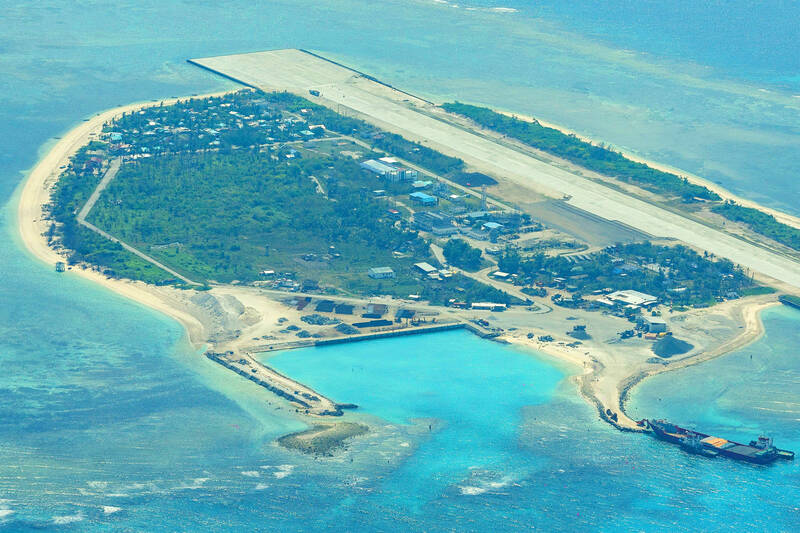
Photo: Reuters
To assert its claims, hundreds of Chinese Coast Guard and maritime militia vessels patrol the waters, swarming reefs, and harassing and attacking fishing and other boats.
They also try expel planes that are not Chinese from the airspace overhead.
“You have entered [waters around] a Chinese reef and constituted a security threat,” the Chinese radio operator said, in one of seven messages issued in Chinese and English as the plane flew over a Philippine-occupied island and shoal. “To avoid misunderstanding, leave immediately.”
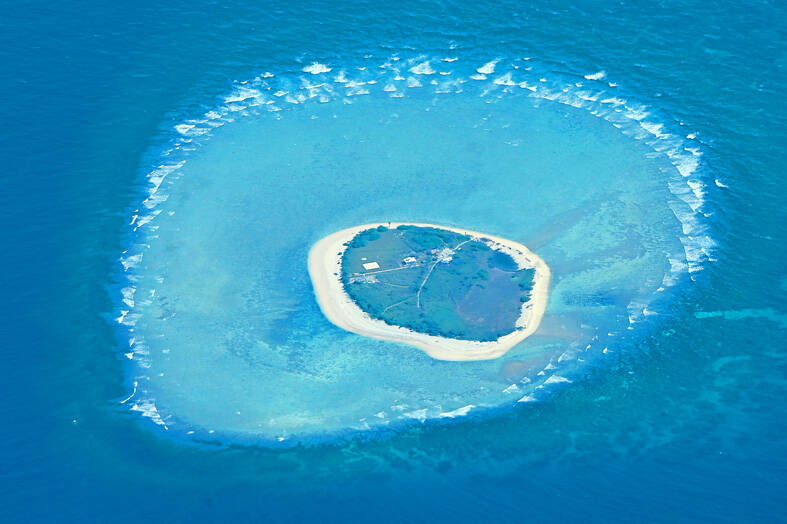
Photo: AFP
The pilot responded that they were flying within Philippine territory.
During the four-hour flight in the Cessna Caravan, Philippine Coast Guard personnel identified nearly 20 Chinese vessels, including suspected maritime militia boats, in waters around some of the nine islands and reefs occupied by the Philippines.
Seventeen Chinese maritime militia boats were also spotted by the Philippine Coast Guard near Sabina Shoal (Sianbin Shoal, 仙濱暗吵), which is claimed by Manila.
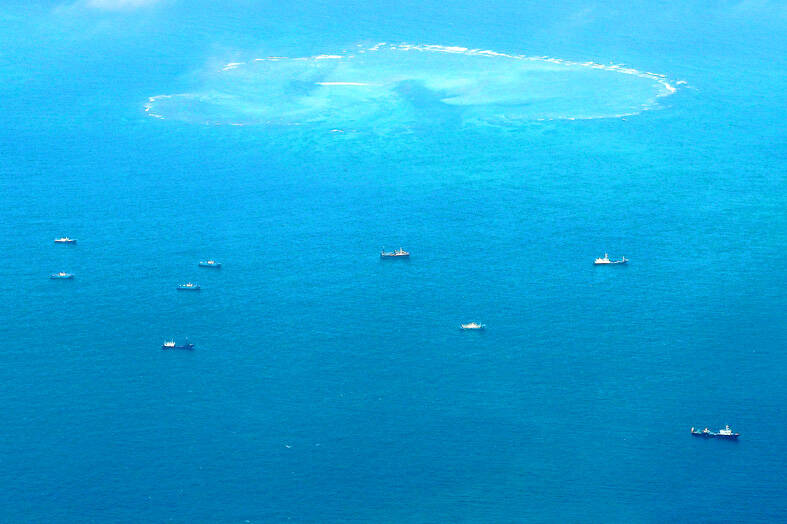
Photo: AFP
Fifteen Chinese maritime militia boats were seen in the vicinity of Thitu Island (Jhongye Island, 中業島) — the largest Philippine-occupied island — which lies about 430km from the major Philippine island of Palawan.
A Chinese navy ship was 15km from Thitu, while a Chinese Coast Guard vessel was half that distance away, according to estimates provided by the Philippine Coast Guard.
At Second Thomas Shoal (Renai Shoal, 仁愛暗沙), where Philippine marines are stationed in a derelict navy ship grounded to assert Manila’s territorial claim in the waters, a Chinese Coast Guard vessel was about 11km away, the Philippine authorities said.
Last month, a Chinese Coast Guard boat was nearly 20km from Second Thomas Shoal when it allegedly used a military-grade laser light against a Philippine patrol boat.
That was the latest major maritime incident between the Philippines and China. It sparked a fresh diplomatic row and prompted Philippine President Ferdinand Marcos Jr to confront the Chinese ambassador to Manila.
Marcos has said that he would not let China trample on the Philippines’ maritime rights.
Manila’s new strategy was to call out China’s “bullying behavior and aggressive actions,” Commodore Jay Tarriela, the Philippine Coast Guard spokesman for the West Philippine Sea, told a forum in the capital, Manila, on Wednesday.
Manila refers to waters immediately to its west as the West Philippine Sea.
The Philippine Coast Guard is regularly publishing information, including photographs and videos, about Chinese vessels in the waters around Philippine-occupied features.
This helps inform the public and enables other countries to criticize China over its activities, Tarriela said.
And it forces Beijing “to come out in the open to explain or to completely lie,” he said.

‘CROSSING THE LINE’: China’s embassy in Seoul criticized US Forces Korea Commander General Xavier Brunson, asking if his ‘hostile’ remarks were authorized by Washington South Korea and the US are in talks over recent public remarks by the commander of US Forces Korea, Seoul’s presidential office said yesterday, after the comments drew sharp criticism from China. In a recent podcast interview, US Forces Korea Commander General Xavier Brunson described South Korea as “the dagger in the heart of Asia” from China’s east coast, prompting the Chinese embassy in Seoul to say that he had “truly crossed the line.” The interview came amid growing speculation that Washington might seek to expand the role of US Forces Korea in countering the growing regional influence of China, a key

Through the noise of rushing papers and whirring belts at a print factory in Kyoto, two creators watch their photo essay come to life in broadsheet form — part of an effort to win new audiences in the age of artificial intelligence (AI). Despite the decline of the publishing industry, self-publication and handmade “zine” magazines are growing in popularity in Japan, reflecting the nation’s enduring love of paper in the digital era. While speaking to Agence France-Presse at the plant, his hands black with ink, one of the creators, Kazuma Obara, said: “I think [paper] is a medium that engages all five

Australian researchers have trained lab-grown brain cells on a silicon computer chip to play the 1990s shooter game Doom and said they are just scratching the surface of what the neurons could be capable of doing. It is the science-fiction work of biotech boffins at Cortical Labs, who researched and developed the technology that harnesses the workings of the brain’s networking system. Each so-called “biological computer” contains about 200,000 living human brain cells, grown from stem cells that were harvested from blood donations. Having mastered the simple computer game Pong, where a paddle is moved up and down to send a ball

France experienced its hottest spring on record, the French weather service said on Tuesday, after an exceptional early heat wave that also broke highs for the season in England and Wales. Meteo-France said the average nationwide temperature over March to May was 13.8°C — about 1.7°C above the norm, and surpassing records set in 2011 and 2020. “The warmest spring since records began in 1900,” it said in a bulletin. All three months were warmer than average, but the onset of an “unprecedented heatwave” late last month pushed the mercury to highs typically seen at the height of the summer. “Our country had never


 RSS
RSS