


Philippine transport groups yesterday launched a nationwide strike to protest a government program drivers fear would phase out traditional jeepneys, which have become a cultural icon, and other aging public transport vehicles.
However, officials braced with contingencies and deployed government vehicles to transport passengers stranded in some areas. Other groups refused to join the week-long strike that could keep more than 40,000 passenger jeepneys and vans off the streets in the Manila metropolis alone.
Protesting drivers and supporters held a noisy rally in suburban Quezon City in the capital region, then proceeded in a convoy to a government transport regulatory office to press their protest.

Photo: EPA-EFE
“We’re calling on the public to support the transport strike in any way possible,” said Renato Reyes, secretary-general of the Bayan political alliance, which is backing the strike.
“The inconvenience of the transport stoppage is temporary, but the loss of livelihood of drivers and operators would be long-term,” Reyes said.
At almost noon, Philippine Secretary of Transportation Jaime Bautista said that no major transport disruption had been monitored.
Morning rush-hour traffic was heavy as usual in major roads in Manila and nearby cities.
“There is no disruption except in a handful of routes in the national capital region,” Philippine President Ferdinand Marcos Jr’s office said by noon, citing reports from law enforcers.
Bautista said that protesting drivers who resort to violence and coercion to stop passenger vehicles not joining the strike would face criminal charges.
Philippine Vice President Sara Duterte, who also serves as education secretary, drew criticism after saying the strike is a communist rebel-inspired action that could inconvenience students.
The government transport modernization program, first launched in 2017, aims to replace dangerously dilapidated and old passenger jeepneys and vans with modern vehicles, which have safety features and conform with carbon emissions standards. Vehicle owners have to join transport cooperatives and corporations by the end of the year for better transport management.
Opponents say most poor drivers cannot afford to purchase new passenger jeepneys, even with promised government financial aid.
“It’s OK to have modernization for those who have money, but for us jeepney drivers and operators, we cannot afford,” jeepney driver Benito Garcia said.
Others said the program would mean the demise of the gaudily decorated and brightly colored jeepneys, which have been regarded as Manila’s “King of the Road” and a showcase of Philippine culture on wheels.
The diesel-powered jeepneys evolved from military jeeps that US forces left behind after World War II. The vehicles were modified and then reproduced, many with second-hand truck chassis, and for decades were the most popular form of land transport among the working class, even though they cough out dark fumes that have been blamed for Manila’s notoriously polluted air.

An American scientist convicted of lying to US authorities about payments from China while he was at Harvard University has rebuilt his research lab in Shenzhen, China, to pursue technology the Chinese government has identified as a national priority: embedding electronics into the human brain. Charles Lieber, 67, is among the world’s leading researchers in brain-computer interfaces. The technology has shown promise in treating conditions such as amyotrophic lateral sclerosis and restoring movement in paralyzed people. It also has potential military applications: Scientists at the Chinese People’s Liberation Army have investigated brain interfaces as a way to engineer super soldiers by boosting

Indonesian police have arrested 13 people after shocking images of alleged abuse against small children at a daycare center went viral, sparking outrage across the nation, officials said on Monday. Police on Friday last week raided Little Aresha, a daycare center in Yogyakarta on Java island, following a report from a former employee. CCTV footage circulating on social media showed children, most younger than two, lying on the floor wearing only diapers, their hands and feet bound with rags. The police have confirmed that the footage is authentic. Police said they also found 20 children crammed into a room just 3m by 3m. “So

A grieving mother has ended her life at a clinic in Switzerland four years after the death of her only child. Wendy Duffy, 56, a physically healthy woman, died at the Pegasos clinic in Basel after struggling to cope with the death of her 23-year-old son, Marcus. The former care worker, from the West Midlands, England, had previously attempted to take her own life. The case comes as assisted dying would not become law in England and Wales after proposed legislation, branded “hopelessly flawed” by opponents, ran out of time. Ruedi Habegger, the founder of Pegasos, described Duffy’s death as
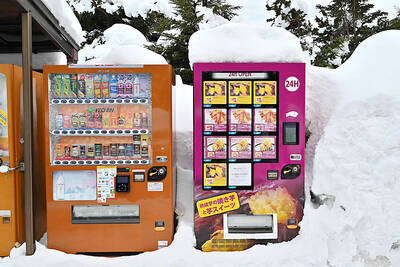
From post offices and parks to stations and even the summit of Mount Fuji, Japan’s vending machines are ubiquitous, but with the rapid pace of inflation cooling demand for their drinks, operators are being forced to rethink the business. Last month beverage giant DyDo Group Holdings announced it would remove about 20,000 vending machines — about 7 percent of their stock nationwide — by January next year, to “reconstruct a profitable network.” Pokka Sapporo Food & Beverage, based in Nagoya, also said last month it would sell its 40,000-machine operation to Osaka-based Lifedrink Co. “The strength of the vending machine


 RSS
RSS