


South Korean President Yoon Suk-yeol yesterday called Japan “a partner that shares the same universal values” and renewed hopes to repair ties frayed over Japan’s colonial rule of the Korean Peninsula.
Since taking office in May last year, Yoon has been pushing to mend the historical grievance with Japan and boost Seoul-Tokyo-Washington security cooperation to better cope with increasing North Korean nuclear threats.
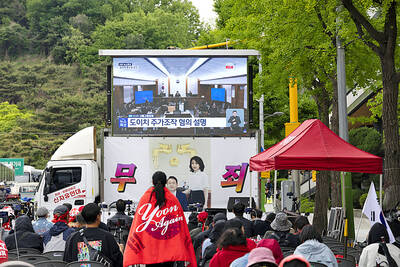
In a televised speech marking the 1919 uprising against the Japanese colonizers, Yoon urged South Koreans to remember what he called “patriotic martyrs who gave their all for our country’s freedom and independence during the dark days.”
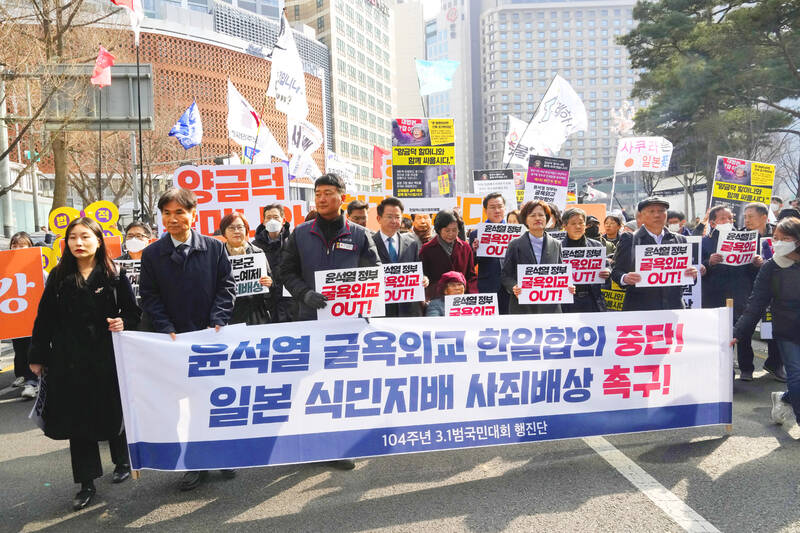
Photo: AP
However, he avoided mentioning any specific colonial wrongdoing as he explained why greater cooperation with Japan is needed.
“Now, a century after the March 1 Independence Movement, Japan has transformed from a militaristic aggressor of the past into a partner that shares the same universal values with us, and cooperates on issues of security, economy and global agendas,” Yoon said.
“In particular, the trilateral cooperation among the Republic of Korea, the United States and Japan has become more important than ever to overcome the serious nuclear threats posed by North Korea and global polycrisis,” Yoon said.
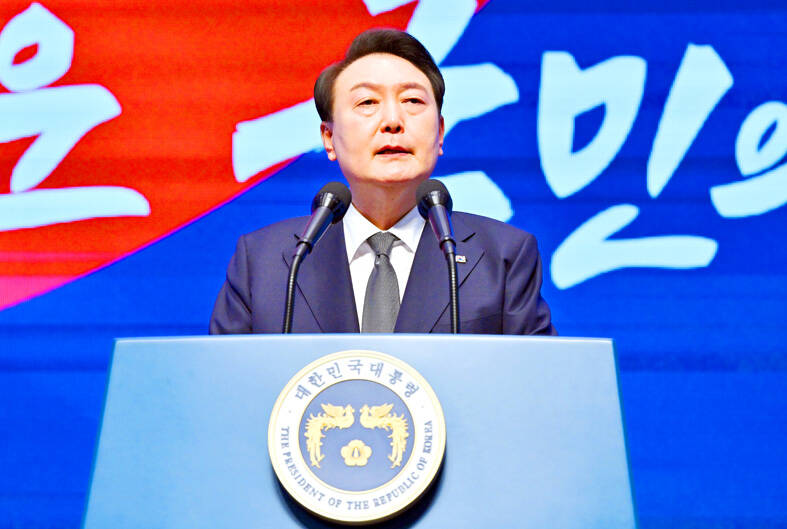
Photo: EPA-EFE
Leif-Eric Easley, a professor at Ewha Womans University in Seoul, said Yoon’s address “offers hopeful signs not only for Seoul’s relations with Tokyo, but also for South Korea‘s role in the world.”
“Emphasizing shared values is much more than rhetoric if backed up by a foreign policy that deepens trilateral cooperation with the US and Japan while increasing contributions to global efforts, such as supporting Ukraine, strengthening supply chains and countering climate change,” Easley said.
South Korea and Japan are closely linked economically and culturally, and are key US allies in the Indo-Pacific region.
However, they often bicker over issues stemming from Japan’s 1910-45 occupation of the Korean Peninsula.
At the center of their current dispute are South Korean court rulings in 2018 that ordered two Japanese companies — Nippon Steel and Mitsubishi Heavy Industries — to compensate Koreans who had been forced to work in their factories during the Japanese colonial period.
The companies and the Japanese government have dismissed the rulings, saying that all compensation issues were settled in a 1965 treaty that normalized bilateral ties and included Tokyo’s provision of hundreds of millions of US dollars to Seoul in economic assistance and loans.
The dispute prompted the two governments to downgrade each other’s trade status and Seoul to threaten to abandon an intelligence-sharing deal.
School bullies in Singapore are to face caning under new guidelines, but the education minister on Tuesday said it would be meted out only as a last resort with strict safeguards. Human rights groups regularly criticize Singapore for the use of corporal punishment, which remains part of the school and criminal justice systems, but authorities have defended it as a deterrent to crime and serious misconduct. Caning was discussed in the parliament after legislators asked how it would be used in relation to bullying in schools. The debate followed stricter guidelines on serious student misconduct, including bullying, unveiled by the Singaporean Ministry of

As evening falls in Fiji’s capital, a steady stream of people approaches a makeshift clinic that is a first line of defense against one of the world’s fastest-growing HIV epidemics. In the South Pacific nation — a popular tourist destination of just under a million people — more than 2,000 new HIV cases were recorded last year, a 26 percent increase from 2024. The government has declared an HIV outbreak and described it as a national crisis. “It’s spreading like wildfire,” said Siteri Dinawai, 46, who came to be tested. The Moonlight Clinic, a converted minibus parked in a suburban cul-de-sac in Suva, is
A MESSAGE: Japan’s participation in the Balikatan drills is a clear deterrence signal to China not to attack Taiwan while the US is busy in the Middle East, an analyst said The Japan Self-Defense Forces yesterday fired a Type 88 anti-ship missile during a joint maritime exercise with US, Australian and Philippine forces, hitting a decommissioned Philippine Navy ship in waters facing the disputed South China Sea, in drills that underscore Tokyo’s rising willingness to project military power on China’s doorstep. The drill took place as Manila and Tokyo began talks on a potential defense equipment transfer, made possible by Japan’s decision to scrap restrictions on military exports. The discussions include the possible early transfer of Abukuma-class destroyers and TC-90 aircraft to the Philippines, Japanese Minister of Defense Shinjiro Koizumi said. Philippine Secretary of
A South Korean judge who last week more than doubled former South Korean first lady Kim Keon-hee’s prison sentence was found dead yesterday, police said. Shin Jong-o was found unconscious at about 1am at the Seoul High Court building, an investigator at the Seocho District Police Station in Seoul said. Shin was taken to a hospital and pronounced dead, he said. “There is no sign of foul play in the death,” the investigator added. Local media reported that Shin had left a suicide note, but the investigator said there was none. On Tuesday last week, Shin presided over 53-year-old Kim’s appeal trial, finding her guilty


 RSS
RSS