


The Polisario movement, which seeks independence in disputed Western Sahara, on Friday started meeting for leadership elections in the shadow of mounting tensions between host Algeria and Morocco, which controls most of the territory.
More than 2,200 members of the movement and 370 foreign guests are attending the five-day congress deep in Algeria’s desert, at a Sahrawi refugee camp named after Dakhla, an Atlantic port city in what is Moroccan-controlled Western Sahara.
The Polisario’s current head, Brahim Ghali, 73, appears to have the backing of Algeria and is expected to be re-elected at the gathering, which comes at a critical time for the movement.
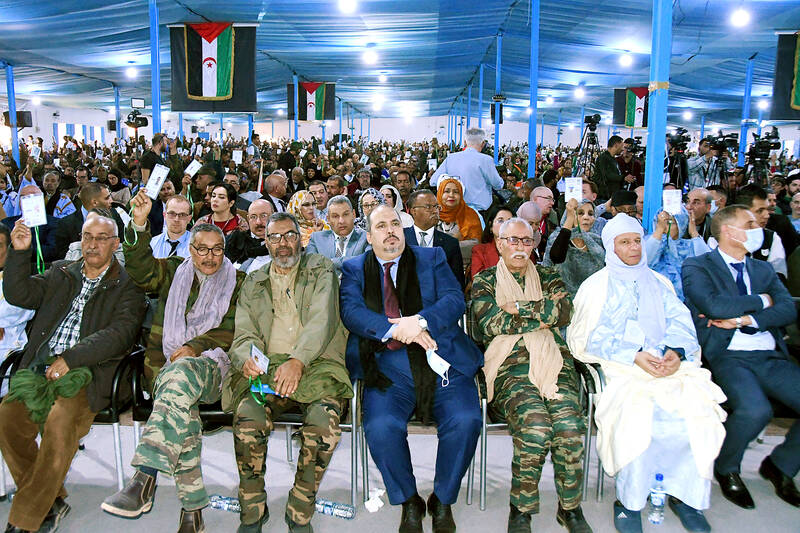
Photo: EPA-EFE
“It’s the first congress since the armed struggle resumed,” said Islam Beissat, the movement’s representative in South Africa.
The conflict dates back to 1975, when colonial occupier Spain withdrew from Western Sahara, sparking a 15-year war between the Polisario and Morocco for control of the territory.
That ended in a 1991 ceasefire deal with the north African kingdom in control of 80 percent of the resource-rich desert territory and the Polisario clinging to hopes of a UN-supervised referendum on independence provided for in the deal.
The referendum has never taken place.
The truce broke down in November 2020 after Morocco sent troops to the far south of the Western Sahara to disperse Sahrawi protesters who were blocking the sole highway to Mauritania and the rest of Africa, which the Polisario says was built after 1991 in violation of the agreement.
A string of deadly incidents since has sparked fears of a return to full-blown conflict.
Morocco sees the entire Western Sahara, home to abundant phosphates and fisheries, and the strategically vital highway to west Africa, as its sovereign territory, and has offered limited autonomy.
Since late 2020, the Polisario says it has been in “a war of legitimate defense” and has declared the entire Western Sahara, including its land, sea and airspace, a “war zone.”
The congress comes as tensions spiral between Morocco and Algeria, which cut all diplomatic ties with its neighbour in August 2021 over “hostile actions.”
The administration of former US president Donald Trump recognized Morocco’s sovereignty over the vast Western Sahara desert territory. Emboldened by that support, Rabat has stepped up the pressure on other countries to back its position.
The Polisario is holding its 16th congress under the slogan “stepping up the campaign to make the occupier withdraw and to impose total sovereignty” in the self-proclaimed Sahrawi Arab Democratic Republic.
The conference marks the end of mandates for the movement’s national secretariat, and for Ghali. He is a founding member and the republic’s president.
“Sahrawi people will have their final word during this congress,” said Oumeima Abdeslam, the movement’s delegate to the UN in Geneva, who denied reports of an internal struggle over Ghali’s successor.
“The post of secretary-general is not the monopoly of anyone,” Abdeslam said. “So far there is no list of candidates for the post. These are just rumors.”
Algerian professor and international law expert Tahar Eddine Ammari said that Ghali would be elected for another term, as “if the congress decides to replace him, the Sahrawi representation would be weakened.”
His continued rule is therefore “a logical choice for the Sahrawi fight to continue,” Ammari said.
However, the movement needs “to adapt to the new international context,” he said, pointing to Spain’s declaration of support early last year for the Moroccan autonomy plan.
In late October, the UN Security Council called on the parties to resume negotiations without preconditions and in good faith “with a view to achieving a just, lasting and mutually acceptable political solution.”
This solution should provide for the self-determination of the people of Western Sahara, it said.
Its envoy to the region, Staffan de Mistura, has traveled several times to meet with the parties since he was appointed in late 2021, but has made little visible progress.

An American scientist convicted of lying to US authorities about payments from China while he was at Harvard University has rebuilt his research lab in Shenzhen, China, to pursue technology the Chinese government has identified as a national priority: embedding electronics into the human brain. Charles Lieber, 67, is among the world’s leading researchers in brain-computer interfaces. The technology has shown promise in treating conditions such as amyotrophic lateral sclerosis and restoring movement in paralyzed people. It also has potential military applications: Scientists at the Chinese People’s Liberation Army have investigated brain interfaces as a way to engineer super soldiers by boosting

Indonesian police have arrested 13 people after shocking images of alleged abuse against small children at a daycare center went viral, sparking outrage across the nation, officials said on Monday. Police on Friday last week raided Little Aresha, a daycare center in Yogyakarta on Java island, following a report from a former employee. CCTV footage circulating on social media showed children, most younger than two, lying on the floor wearing only diapers, their hands and feet bound with rags. The police have confirmed that the footage is authentic. Police said they also found 20 children crammed into a room just 3m by 3m. “So

A grieving mother has ended her life at a clinic in Switzerland four years after the death of her only child. Wendy Duffy, 56, a physically healthy woman, died at the Pegasos clinic in Basel after struggling to cope with the death of her 23-year-old son, Marcus. The former care worker, from the West Midlands, England, had previously attempted to take her own life. The case comes as assisted dying would not become law in England and Wales after proposed legislation, branded “hopelessly flawed” by opponents, ran out of time. Ruedi Habegger, the founder of Pegasos, described Duffy’s death as

From post offices and parks to stations and even the summit of Mount Fuji, Japan’s vending machines are ubiquitous, but with the rapid pace of inflation cooling demand for their drinks, operators are being forced to rethink the business. Last month beverage giant DyDo Group Holdings announced it would remove about 20,000 vending machines — about 7 percent of their stock nationwide — by January next year, to “reconstruct a profitable network.” Pokka Sapporo Food & Beverage, based in Nagoya, also said last month it would sell its 40,000-machine operation to Osaka-based Lifedrink Co. “The strength of the vending machine


 RSS
RSS