


Troops battle through burning streets, missiles take down fighter jets and drones pulverize tanks in dramatic visuals that have the trappings of real-life combat, but are clips from video games that are fueling misinformation.
Footage from the war-themed Arma 3 video game, often marked “live” or “breaking news” to make it appear genuine, has been used repeatedly in the past few months in fake videos about the Russian offensive in Ukraine.
The frequency and ease with which gaming footage is mistaken as real, even by some media broadcasters, and shared as authentic news on social media highlight what researchers call its serious potential to spread misinformation.
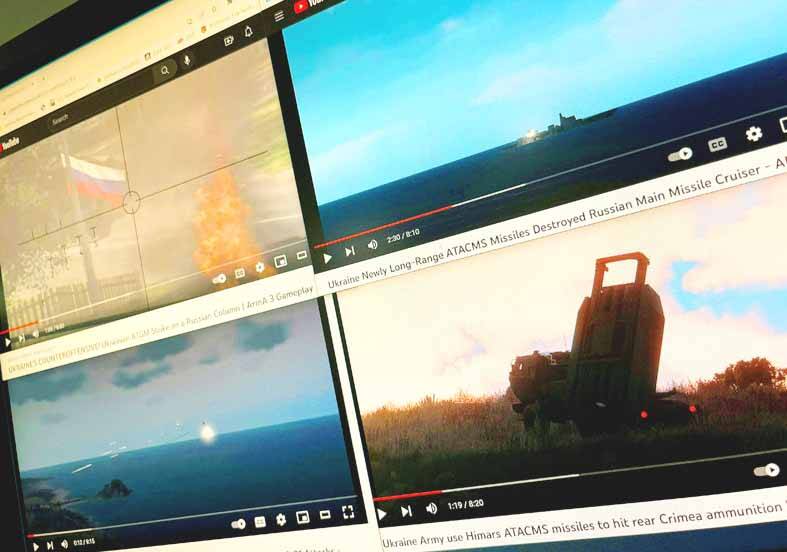
Photo: AFP
“The fact that it keeps happening is a reminder of how easy it is to fool people,” said Claire Wardle, codirector of the Information Futures Lab at Brown University in Providence, Rhode Island. “As video game visuals get more sophisticated, CGI can, at a quick glance, look real. People need to know how to verify imagery, including looking at metadata so that these mistakes don’t get made, especially by newsrooms.”
Arma 3, whose Czech-based developers promise “true combat game play in a massive military sandbox,” allows players to create battlefield scenarios using aircraft, tanks and a host of weapons.
Players often upload hours of gaming footage on platforms such as YouTube and researchers blame its easy availability for its misuse.
In the comments under one Arma 3 video titled “Ukraine’s counteroffensive!” — which simulated a missile strike on a column of tanks — a user, who apparently took it as real, wrote: “We must ask Ukraine after this war to train NATO forces how to fight.”
“While it’s flattering that Arma 3 simulates modern war conflicts in such a realistic way, we are certainly not pleased that it can be mistaken for real-life combat footage and used as war propaganda,” a representative of Bohemia Interactive, the game’s creator, said in a statement. “We’ve been trying to fight against such content by flagging these videos to platform providers, but it’s very ineffective. With every video taken down, 10 more are uploaded each day.”
In the past few years, Arma 3 videos have been used in false depictions of other conflicts, including Syria, Afghanistan and Palestine.
Bohemia Interactive said that the misleading videos have recently “gained traction” in regard to the conflict in Ukraine.
Dubbed by observers as the “first TikTok war,” it is a conflict like no other as a steady stream of visuals from the front lines — some of it misleading or false — pour onto social media platforms.
Given the unsophisticated nature of the Arma 3 misinformation, researchers say it is unlikely to be the work of state actors.
“I suspect that the people posting this content are just trolls doing it to see how many people they can fool,” said Nick Waters, from the digital forensics firm Bellingcat. “Secondary disseminators will be gullible people who pick up this content and circulate it in an attempt to garner fake Internet points.”
Bohemia Interactive said that the false videos were “massively shared” by social media users, many of whom seek what researchers call engagement bait — eye-catching posts that generate more interaction through likes, shares and comments.
The Arma 3 videos, which its creator acknowledged are “quite capable of spreading fake news,” were also shared by mainstream media and government institutions worldwide, Bohemia Interactive said.
In a live broadcast in November, Romania TV wrongly presented an old Arma 3 video as battle footage from Ukraine, and a former Romanian minister of defense and a former intelligence chief offered their analysis of the footage as if it were real.
This occurred after another Romanian news channel, Antena 3, made the same error in February last year — among the experts invited by the broadcaster to analyze its video taken from Arma 3 was the spokesman of the Romanian Ministry of Defense.
Bohemia Interactive has urged users to use gaming footage responsibly, refrain from using clickbait video titles and clearly state that it was derived from a video game.
Researchers say their videos are relatively easier to debunk compared with “deepfakes” — fabricated images, audio and videos created using technology that experts warn is frighteningly sophisticated and gaining ground in the criminal underworld.
“If you know what you’re looking for, these [Arma 3] videos aren’t actually difficult to identify as fakes,” Waters said. “As good as Arma 3 looks, it’s still significantly different from reality.”
That many are unable to do so points to another stark reality in the age of misinformation.
“It shows that some people don’t have the skills to navigate the current information environment,” Waters said.

An American scientist convicted of lying to US authorities about payments from China while he was at Harvard University has rebuilt his research lab in Shenzhen, China, to pursue technology the Chinese government has identified as a national priority: embedding electronics into the human brain. Charles Lieber, 67, is among the world’s leading researchers in brain-computer interfaces. The technology has shown promise in treating conditions such as amyotrophic lateral sclerosis and restoring movement in paralyzed people. It also has potential military applications: Scientists at the Chinese People’s Liberation Army have investigated brain interfaces as a way to engineer super soldiers by boosting

Indonesian police have arrested 13 people after shocking images of alleged abuse against small children at a daycare center went viral, sparking outrage across the nation, officials said on Monday. Police on Friday last week raided Little Aresha, a daycare center in Yogyakarta on Java island, following a report from a former employee. CCTV footage circulating on social media showed children, most younger than two, lying on the floor wearing only diapers, their hands and feet bound with rags. The police have confirmed that the footage is authentic. Police said they also found 20 children crammed into a room just 3m by 3m. “So
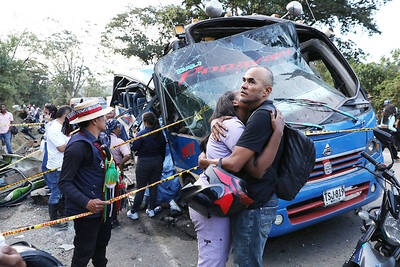
A highway bomb attack in a restive region of southwestern Colombia on Saturday killed 14 people and injured at least 38, the latest spate of violence ahead of next month’s presidential election. Authorities blamed the attack in the Cauca department — a conflict-ridden, coca-growing region — on dissidents of the now-disbanded FARC guerrilla army, who have been sowing violence across the country. “Those who carried out this attack ... are terrorists, fascists and drug traffickers,” Colombian President Gustavo Petro said on social media. “I want our very best soldiers to confront them,” he added. The leftist leader blamed the bombing

From post offices and parks to stations and even the summit of Mount Fuji, Japan’s vending machines are ubiquitous, but with the rapid pace of inflation cooling demand for their drinks, operators are being forced to rethink the business. Last month beverage giant DyDo Group Holdings announced it would remove about 20,000 vending machines — about 7 percent of their stock nationwide — by January next year, to “reconstruct a profitable network.” Pokka Sapporo Food & Beverage, based in Nagoya, also said last month it would sell its 40,000-machine operation to Osaka-based Lifedrink Co. “The strength of the vending machine


 RSS
RSS