


Indian Minister of Defence Rajnath Singh yesterday accused China of trying to “unilaterally change the status quo” on their disputed Himalayan border last week when clashes left troops on both sides injured.
Beijing said the situation was now calm and called on India to help China “together uphold the peace and tranquility of the ... border region.”
The incident is thought to be the most serious on the nuclear-armed Asian giants’ disputed frontier since 2020, when 20 Indian troops and four Chinese soldiers died in brawling.
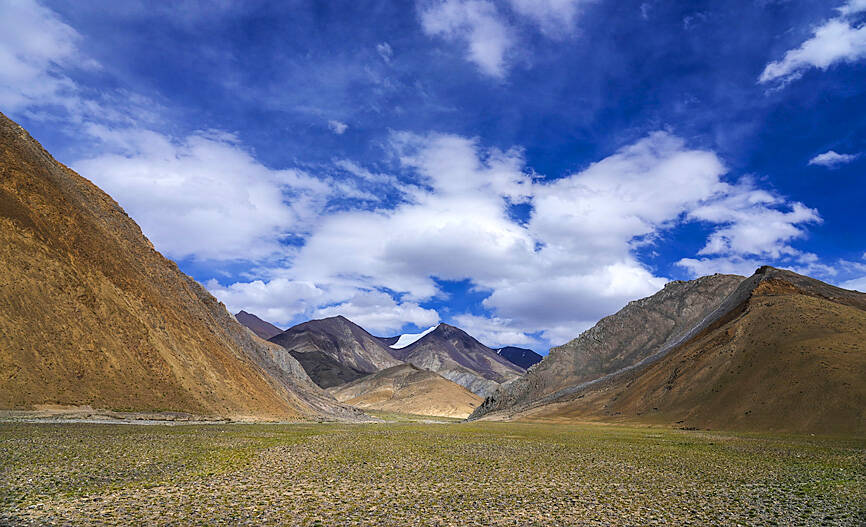
Photo: AP
Singh confirmed in parliament that Indian and Chinese troops engaged in the fresh confrontation on Friday in the northeastern Indian state Arunachal Pradesh.
China and India fought a full-scale war in 1962 over control of Arunachal Pradesh, which Beijing claims in its entirety and considers part of Tibet.
“On 09 December 2022, [Chinese] PLA [People’s Liberation Army] troops attempted to unilaterally change the status quo by encroaching on the Line of Actual Control, in the Yangtze area of Tawang sector,” Singh said.
The face-off, which followed recent joint US-India military exercises near the border that angered Beijing, led to “injuries to soldiers on both sides,” he added.
“A scuffle ensued in this face-off. The Indian Army bravely prevented the PLA from encroaching on our territory, and forced them to withdraw to their posts. Some soldiers from both sides were injured in the skirmish,” he said.
A military source said that at least six Indian soldiers were injured.
In Beijing, Chinese Ministry of Foreign Affairs spokesman Wang Wenbin (汪文斌) said that he believed the situation was now calm, but gave no details of what happened or whether Chinese troops were injured.
“As far as we understand, the China-India border situation is stable overall,” Wang said, adding that the two sides “maintained unobstructed dialogue on the border issue through diplomatic and military channels.”
“It is hoped that the Indian side will advance in the same direction as China, earnestly implement the important consensus reached by both leaders, strictly abide by the spirit of the agreements and accords signed by both sides [and] together uphold the peace and tranquility of the China-India border region,” he said.
Singh said that local commanders from both sides held a flag meeting on Sunday and the incident was discussed.
Singh added that in the latest incident “none of our soldiers have died, nor has anyone been seriously injured.”
The military source said that there was another “face-off” between Indian and Chinese troops in the final week of last month in the Demchok region of Ladakh, to the northwest, near where the June 2020 incident took place.
It was unclear if there were any injuries resulting from that incident, which was the most serious since September 2020.
The army source said that there had been increased activity in Ladakh by the Chinese military, as well as a “possible” airspace violation by the Chinese air force in the same area.


Through the noise of rushing papers and whirring belts at a print factory in Kyoto, two creators watch their photo essay come to life in broadsheet form — part of an effort to win new audiences in the age of artificial intelligence (AI). Despite the decline of the publishing industry, self-publication and handmade “zine” magazines are growing in popularity in Japan, reflecting the nation’s enduring love of paper in the digital era. While speaking to Agence France-Presse at the plant, his hands black with ink, one of the creators, Kazuma Obara, said: “I think [paper] is a medium that engages all five
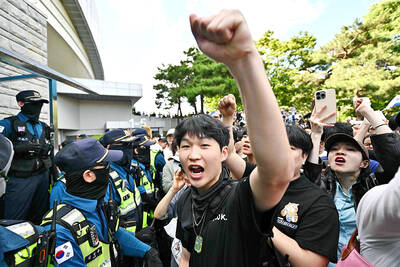
‘ABSURD MISTAKE’: The election commission said that there had been a failure to anticipate turnout after 14 polling stations ran short of ballot papers South Korean riot police yesterday cleared protesters from a Seoul polling station after a 35-hour blockade sparked by a shortage of ballot papers during local elections earlier this week. Wednesday’s election was the first nationwide vote since South Korean President Lee Jae-myung took office following the ouster of Yoon Suk-yeol over his short-lived martial law declaration. Lee’s ruling Democratic Party swept most races, but failed to flip the crucial Seoul mayoral seat. The South Korean National Election Commission apologized, blaming a failure to anticipate turnout after 14 polling stations in Seoul ran short of ballot papers. Some polling stations stayed open until 10pm to

France experienced its hottest spring on record, the French weather service said on Tuesday, after an exceptional early heat wave that also broke highs for the season in England and Wales. Meteo-France said the average nationwide temperature over March to May was 13.8°C — about 1.7°C above the norm, and surpassing records set in 2011 and 2020. “The warmest spring since records began in 1900,” it said in a bulletin. All three months were warmer than average, but the onset of an “unprecedented heatwave” late last month pushed the mercury to highs typically seen at the height of the summer. “Our country had never
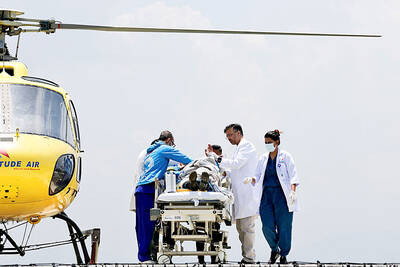
A Sherpa guide was found crawling to base camp on Mount Everest a week after he went missing and was reunited with his family, who had given up hope he would return. Dawa Sherpa was last seen on Friday last week descending the mountain, but he did not reach base camp even though his client did. The pair were among the last climbers on the mountain as the climbing season came to an end and the route was dismantled. Dawa was located by a cleaning crew on Thursday morning as he was crawling down the snowy slopes around the Khumbu Icefall, just above


 RSS
RSS