


The US Navy yesterday dismissed Beijing’s objections over a “freedom of navigation operation” conducted near the Spratly Islands (Nansha Islands, 南沙群島) in the latest incident drawing new attention to one of the world’s potential military flashpoints.
In an unusual move, the US Navy’s 7th Fleet issued a rebuttal to China’s objections to yesterday’s mission, calling it “the latest in a long string of [Chinese] actions to misrepresent lawful US maritime operations and assert its excessive and illegitimate maritime claims” in the South China Sea.
China claims the area virtually in its entirety.
The navy said that China’s sweeping maritime claims pose a serious threat to the freedom of navigation and overflight, free trade and unimpeded commerce, and freedom of economic opportunity for South China Sea littoral nations.
“As long as some countries continue to claim and assert limits on rights that exceed their authority under international law, the United States will continue to defend the rights and freedoms of the sea guaranteed to all,” it said.
The Navy said its guided missile cruiser USS Chancelorsville yesterday “asserted navigational rights and freedoms in the South China Sea near the Spratly Islands, consistent with international law.”
China called the action illegal and said it mobilized naval and air asserts to issue warnings and drive off the ship.
“The US military’s actions have seriously violated China’s sovereignty and security, which is further ironclad evidence of its pursuit of navigational hegemony and militarization of the South China Sea,” said Tian Junli (田軍里), spokesman for the Southern Theater Command of the Chinese People’s Liberation Army.
“China has indisputable sovereignty over the South China Sea islands and their adjacent waters,” Tian said.
The long-seething South China Sea territorial conflicts involving Taiwan, China, the Philippines, Vietnam, Malaysia and Brunei have long been regarded as a delicate fault line in the US-China rivalry in the region.
While the US lays no claims to the strategic waterway, where an estimated US$5 trillion in global trade transits each year, it has said that freedom of navigation and overflight is in the US’ national interest. The sea is also home to rich fishing stocks and a potential wealth of energy and mineral resources.
In March, US Indo-Pacific commander Admiral John C. Aquilino said that China has fully militarized at least three of several islands it built in the disputed waters with anti-ship and anti-aircraft missile systems, laser and jamming equipment.
He described it as an increasingly aggressive move that threatens all nations operating nearby.
Then in July, US Secretary of State Antony Blinken called on China to comply with a 2016 arbitration ruling that invalidated Beijing’s vast claims on historical grounds in the South China Sea.
On a visit to the area earlier this month, US Vice President Kamala Harris reaffirmed Washington’s commitment to defend the Philippines under the 1951 Mutual Defense Treaty.
She also announced an additional aid of US$7.5 million to Philippine maritime law enforcement agencies.
That came shortly after the Philippine navy alleged a Chinese coast guard vessel had forcibly seized Chinese rocket debris as Filipino sailors were towing it to their island.


Through the noise of rushing papers and whirring belts at a print factory in Kyoto, two creators watch their photo essay come to life in broadsheet form — part of an effort to win new audiences in the age of artificial intelligence (AI). Despite the decline of the publishing industry, self-publication and handmade “zine” magazines are growing in popularity in Japan, reflecting the nation’s enduring love of paper in the digital era. While speaking to Agence France-Presse at the plant, his hands black with ink, one of the creators, Kazuma Obara, said: “I think [paper] is a medium that engages all five
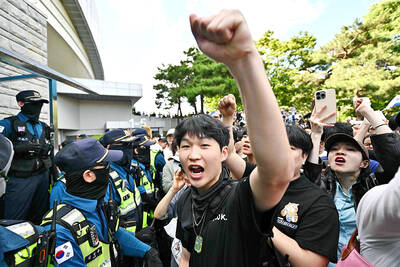
‘ABSURD MISTAKE’: The election commission said that there had been a failure to anticipate turnout after 14 polling stations ran short of ballot papers South Korean riot police yesterday cleared protesters from a Seoul polling station after a 35-hour blockade sparked by a shortage of ballot papers during local elections earlier this week. Wednesday’s election was the first nationwide vote since South Korean President Lee Jae-myung took office following the ouster of Yoon Suk-yeol over his short-lived martial law declaration. Lee’s ruling Democratic Party swept most races, but failed to flip the crucial Seoul mayoral seat. The South Korean National Election Commission apologized, blaming a failure to anticipate turnout after 14 polling stations in Seoul ran short of ballot papers. Some polling stations stayed open until 10pm to

France experienced its hottest spring on record, the French weather service said on Tuesday, after an exceptional early heat wave that also broke highs for the season in England and Wales. Meteo-France said the average nationwide temperature over March to May was 13.8°C — about 1.7°C above the norm, and surpassing records set in 2011 and 2020. “The warmest spring since records began in 1900,” it said in a bulletin. All three months were warmer than average, but the onset of an “unprecedented heatwave” late last month pushed the mercury to highs typically seen at the height of the summer. “Our country had never

A Sherpa guide was found crawling to base camp on Mount Everest a week after he went missing and was reunited with his family, who had given up hope he would return. Dawa Sherpa was last seen on Friday last week descending the mountain, but he did not reach base camp even though his client did. The pair were among the last climbers on the mountain as the climbing season came to an end and the route was dismantled. Dawa was located by a cleaning crew on Thursday morning as he was crawling down the snowy slopes around the Khumbu Icefall, just above


 RSS
RSS