


Ukraine’s Russian-occupied city of Kherson on Sunday was cut off from water and electricity supplies after an airstrike and a key dam in the region was also damaged, local officials said.
It was the first time that Kherson — which fell to Moscow’s forces within days of their February offensive — had seen such a power cut.
“In Kherson and a number of other areas in the region, there is temporarily no electricity or water supply,” the city’s Moscow-installed administration wrote on Telegram.
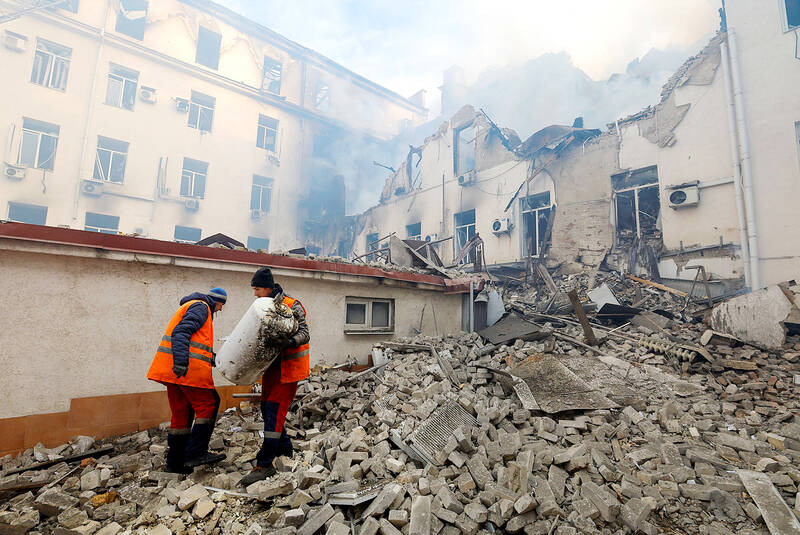
Photo: Reuters
It said it was the “result of an attack organized by the Ukrainian side on the Berislav-Kakhovka highway that saw three concrete poles of high-voltage power lines damaged.”
Energy specialists were working to “quickly” resolve the issue, the Russian-backed authorities said, as they called on people to “remain calm.”
However, the head of the regional administration, Yaroslav Yanushevych, blamed Russia for the power outages.
He said that in Beryslav about 1.5km of electric power lines had been destroyed — cutting off power entirely because the “damage is quite extensive.”
“Probably, there will be no light in Beryslav until the city is completely de-occupied,” he wrote on Telegram. “It is impossible to promptly repair the lines — there is a lack of specialists, equipment, and the Russian invaders will not allow this to be done.”
News of the outage followed reports that the Kakhovka dam in the Russian-controlled region of Kherson was “damaged” by a Ukrainian strike.
“Today at 10:00 there was a hit of six HIMARS rockets. Air defense units shot down five missiles, one hit a lock of the Kakhovka dam, which was damaged,” Russian news agencies quoted local emergency services as saying.
The RIA Novosti news agency quoted a local Moscow-backed official saying that the damage was not “critical.”
Ukraine had warned that Moscow’s forces intended to blow up the strategic facility to cause flooding. The Kakhovka hydroelectric dam in southern Ukraine was captured by Moscow’s forces at the start of their offensive. It supplies Russian-annexed Crimea with water.
For weeks, Russian forces have rained missiles and explosive drones onto Ukraine’s infrastructure, as a major Ukrainian ground offensive — propelled by Western arms deliveries — has pushed Russian troops back in swathes of the nation.
“We are also aware of the fact that the terrorist state is concentrating forces and means for a possible repetition of massive attacks on our infrastructure, primarily energy,” Ukrainian President Volodymyr Zelenskiy said in his evening speech, referring to Russia.
“In particular, Russia needed Iranian missiles for this. We are getting ready to respond,” Zelenskiy said.
Kyiv Mayor Vitali Klitschko said he does not rule out a full blackout in Ukraine’s capital.
“We are calculating various scenarios in order to withstand this and be prepared,” he said.
Russian strikes over the past month have destroyed about one-third of Ukraine’s power stations and the government has urged Ukrainians to conserve electricity as much as possible, but until now, Ukraine had only rarely struck Russian-held civilian energy infrastructure in territory annexed by Moscow, preferring to target Russian army supply lines.
As Ukraine presses a counteroffensive in the south, Moscow’s occupational forces in Kherson have vowed to turn the city into a “fortress.”
Russian forces have for weeks organized a civilian pullout from the Kherson region as Ukrainian troops advance, which Kyiv has called “deportations.”
Moscow-installed Kherson Governor Vladimir Saldo said he was moving people further into the region or to Russia because of the risks of a “massive missile attack.”
The dam’s destruction would lead to flooding of the left bank of the Dnipro River, he said.
Zelenskiy last month said that Russian forces had mined the Kakhovka hydroelectric power plant with the intent of blowing it up.
Its destruction could cause flash flooding for hundreds of thousands of people, he said.
He said cutting water supplies to the south could also impact the cooling systems of the Zaporizhzhia nuclear power plant — the largest in Europe.

An American scientist convicted of lying to US authorities about payments from China while he was at Harvard University has rebuilt his research lab in Shenzhen, China, to pursue technology the Chinese government has identified as a national priority: embedding electronics into the human brain. Charles Lieber, 67, is among the world’s leading researchers in brain-computer interfaces. The technology has shown promise in treating conditions such as amyotrophic lateral sclerosis and restoring movement in paralyzed people. It also has potential military applications: Scientists at the Chinese People’s Liberation Army have investigated brain interfaces as a way to engineer super soldiers by boosting

Indonesian police have arrested 13 people after shocking images of alleged abuse against small children at a daycare center went viral, sparking outrage across the nation, officials said on Monday. Police on Friday last week raided Little Aresha, a daycare center in Yogyakarta on Java island, following a report from a former employee. CCTV footage circulating on social media showed children, most younger than two, lying on the floor wearing only diapers, their hands and feet bound with rags. The police have confirmed that the footage is authentic. Police said they also found 20 children crammed into a room just 3m by 3m. “So

A highway bomb attack in a restive region of southwestern Colombia on Saturday killed 14 people and injured at least 38, the latest spate of violence ahead of next month’s presidential election. Authorities blamed the attack in the Cauca department — a conflict-ridden, coca-growing region — on dissidents of the now-disbanded FARC guerrilla army, who have been sowing violence across the country. “Those who carried out this attack ... are terrorists, fascists and drug traffickers,” Colombian President Gustavo Petro said on social media. “I want our very best soldiers to confront them,” he added. The leftist leader blamed the bombing
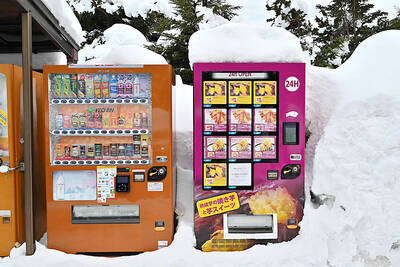
From post offices and parks to stations and even the summit of Mount Fuji, Japan’s vending machines are ubiquitous, but with the rapid pace of inflation cooling demand for their drinks, operators are being forced to rethink the business. Last month beverage giant DyDo Group Holdings announced it would remove about 20,000 vending machines — about 7 percent of their stock nationwide — by January next year, to “reconstruct a profitable network.” Pokka Sapporo Food & Beverage, based in Nagoya, also said last month it would sell its 40,000-machine operation to Osaka-based Lifedrink Co. “The strength of the vending machine


 RSS
RSS