


If rising seas engulf the Maldives and Tuvalu, will those countries be wiped off the map? And what happens to their citizens?
The prospect is no longer science fiction as global warming gathers pace, posing an unprecedented challenge to the international community, and threatening entire peoples with the loss of their land and identity.
“This is the biggest tragedy that a people, a country, a nation can face,” former Maldives president Mohamed Nasheed told reporters.

Photo: Reuters
According to UN climate experts, sea levels have already risen 15cm to 25cm since 1900, and the pace of rise is accelerating, especially in some tropical areas.
If warming trends continue, the oceans could rise by nearly one additional meter around the Pacific and Indian Ocean islands by the end of the century.
This is still below the highest point of the smallest, flattest island states, but rising seas will be accompanied by an increase in storms and tidal surges: Salt contamination to water and land will make many atolls uninhabitable long before they are covered over by the sea.
According to a study cited by the UN’s Intergovernmental Panel on Climate Change, five nations — the Maldives, Tuvalu, the Marshall Islands, Nauru and Kiribati — might become uninhabitable by 2100, creating 600,000 stateless climate refugees.
It is an unprecedented situation. States have, of course, been wiped off the map by wars.
However, “we haven’t had a situation where existing states have completely lost territory due to a physical event, or events, like sea-level rise, or severe weather events,” said Sumudu Atapattu, of the University of Wisconsin in Madison.
However, the 1933 Montevideo Convention on the Rights and Duties of States, a reference on the subject, is clear: A state consists of a defined territory, a permanent population, a government and the capacity to interact with other states. So if the territory is swallowed up, or no one can live on what is left of it, at least one of the criteria falls.
“The other thing that I argue is that statehood is a fiction, legal fiction we created for purposes of international law. So we should be able to come up with another fiction to encompass these deterritorialized states,” Atapattu added.
That is the idea behind the “Rising Nations” initiative launched last month by several Pacific governments: “Convince members of the UN to recognize our nation, even if we are submerged under water, because that is our identity,” Tuvaluan Prime Minister Kausea Natano told reporters.
Some people are already thinking about how these “Nation-States 2.0” might work.
“You could have land somewhere, people somewhere else and government in the third place,” Kamal Amakrane, managing director of the Global Center for Climate Mobility at Columbia University, told reporters.
This would first require a “political declaration” by the UN, then a “treaty” between the threatened state and a “host state,” ready to receive the government-in-exile in a kind of permanent embassy. The population, which might be in that state or even a different one, would then have dual nationality.
Amakrane, a former UN official, also draws attention to an ambiguity in the Montevideo Convention: “When you speak about territory, is it dry or wet territory?”
With 33 islands scattered over 3.5 million square kilometers in the Pacific, Kiribati, tiny in terms of land area, has one of the largest exclusive economic zones (EEZs) in the world.
If this maritime sovereignty were preserved, then a state would not disappear, some experts say.
While some islets are already being engulfed as shorelines recede, freezing the EEZs would preserve access to vital resources.
In a declaration in August last year, the members of the Pacific Islands Forum, including Australia and New Zealand, proclaimed that their maritime zones “shall continue to apply, without reduction, notwithstanding any physical changes connected to climate change-related sea level rise.”
However, even with rising ocean levels, some would simply not consider leaving their threatened country.
“Human beings are so ingenious, they will find floating ways ... to live exactly in this location,” Nasheed said, suggesting people could resort to floating cities.

With the midday sun blazing, an experimental orange and white F-16 fighter jet launched with a familiar roar that is a hallmark of US airpower, but the aerial combat that followed was unlike any other: This F-16 was controlled by artificial intelligence (AI), not a human pilot, and riding in the front seat was US Secretary of the Air Force Frank Kendall. AI marks one of the biggest advances in military aviation since the introduction of stealth in the early 1990s, and the US Air Force has aggressively leaned in. Even though the technology is not fully developed, the service is planning
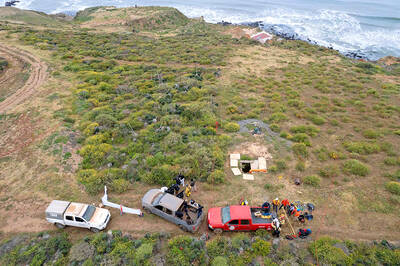
INTERNATIONAL PROBE: Australian and US authorities were helping coordinate the investigation of the case, which follows the 2015 murder of Australian surfers in Mexico Three bodies were found in Mexico’s Baja California state, the FBI said on Friday, days after two Australians and an American went missing during a surfing trip in an area hit by cartel violence. Authorities used a pulley system to hoist what appeared to be lifeless bodies covered in mud from a shaft on a cliff high above the Pacific. “We confirm there were three individuals found deceased in Santo Tomas, Baja California,” a statement from the FBI’s office in San Diego, California, said without providing the identities of the victims. Australian brothers Jake and Callum Robinson and their American friend Jack Carter

Le Tuan Binh keeps his Moroccan soldier father’s tombstone at his village home north of Hanoi, a treasured reminder of a man whose community in Vietnam has been largely forgotten. Mzid Ben Ali, or “Mohammed” as Binh calls him, was one of tens of thousands of North Africans who served in the French army as it battled to maintain its colonial rule of Indochina. He fought for France against the Viet Minh independence movement in the 1950s, before leaving the military — as either a defector or a captive — and making a life for himself in Vietnam. “It’s very emotional for me,”
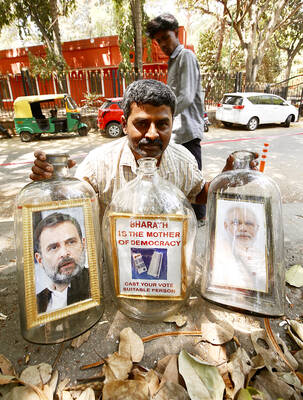
Indian Prime Minister Narendra Modi reaffirmed his pledge to replace India’s religion-based marriage and inheritance laws with a uniform civil code if he returns to office for a third term, a move that some minority groups have opposed. In an interview with the Times of India listing his agenda, Modi said his government would push for making the code a reality. “It is clear that separate laws for communities are detrimental to the health of society,” he said in the interview published yesterday. “We cannot be a nation where one community is progressing with the support of the Constitution while the other


 RSS
RSS