


African countries are expected to use the COP27 climate talks in Egypt next month to advocate for a common energy position that sees fossil fuels as necessary to expanding economies and electricity access, the continent’s top energy official said on Tuesday.
The African position, criticized by environmental groups, could overshadow global climate talks in Sharm El-Sheikh seeking to build on the previous Glasgow, Scotland, summit and make good on financing targets by rich nations to poorer countries that have fallen far short of the promised US$100 billion a year by 2020.
“We recognize that some countries may have to use fossil fuels for now, but it’s not one solution fits all,” African Union (AU) Commissioner for Infrastructure and Energy Amani Abou-Zeid said.
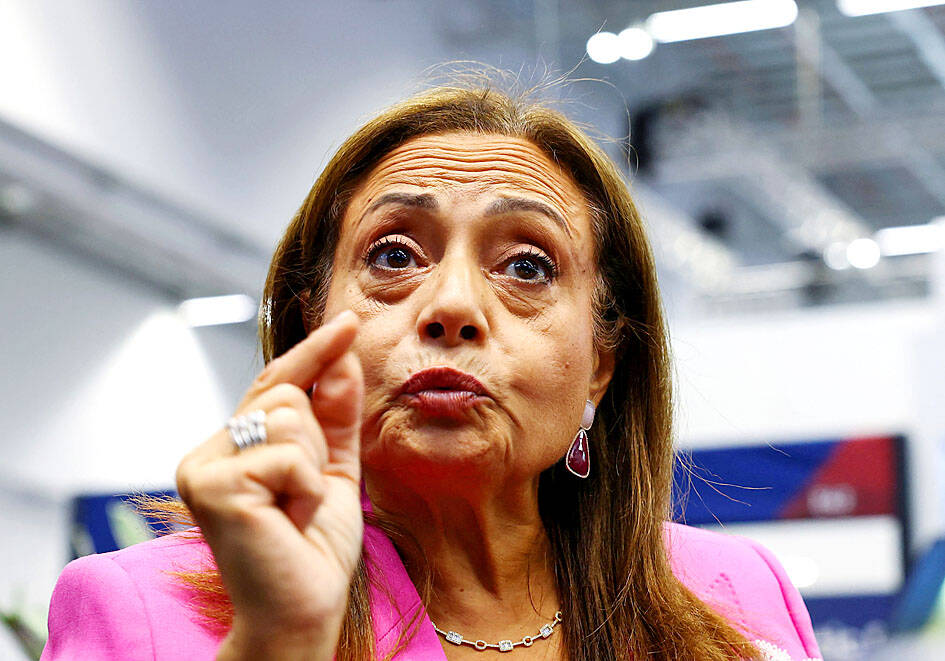
Photo: REUTERS
“It is not time to exclude, but it is the time to tailor solutions for a context,” she told Reuters on the sidelines of an oil and gas conference in South Africa.
An AU technical study attended by 45 African countries on June 16 seen by Reuters outlined that oil and coal would play a “crucial role” in expanding modern energy access over the short to medium term.
In tandem with renewable sources, Africa also sees key roles for natural gas and nuclear energy.
“Our ambition is to have fast-growing economies, competitive and industrialized,” Abou-Zeid said.
Seen as a renewables hub given its vast solar, wind and hydrogen potential, Africa also has about 600 million people in its sub-Saharan region living without electricity and almost 1 billion people without access to clean energy for cooking.
However, critics say that in African countries with large fossil fuel reserves, proceeds have mostly been used to feather the nests of corrupt political elites and have not helped alleviate general poverty or energy poverty.
In Angola and Nigeria, Africa’s leading oil producers for decades, access to electricity for the population was just 40 percent and 57 percent respectively last year, the World Bank said.
Top producer Nigeria has the world’s largest energy access deficit, it added.
Fast-growing Africa produces less than 4 percent of total global emissions, and is looking to monetize new gas and oil finds, some of the largest this decade, to help plug European demand after major supplier Russia invaded Ukraine and subsequently turned off gas supplies to EU economies.
“Africa has woken up and we are going to exploit our natural resources,” Ugandan Minister of Energy and Mineral Development Ruth Nankabirwa Ssentamu said.
“There is no way you can develop any economy, any society without energy,” African Petroleum Producers’ Organization secretary-general Omar Farouk Ibrahim said. “We are talking about coal, we are talking oil and we are talking about gas. At this time we are not discriminating.”
Outside the conference venue at the Cape Town International Convention Center, a handful of Extinction Rebellion members poured a reddish, oily mixture over their heads to protest.
“We believe the fossil fuel industry is killing us,” group spokeswoman Judy Scott-Goldman told reporters.


Through the noise of rushing papers and whirring belts at a print factory in Kyoto, two creators watch their photo essay come to life in broadsheet form — part of an effort to win new audiences in the age of artificial intelligence (AI). Despite the decline of the publishing industry, self-publication and handmade “zine” magazines are growing in popularity in Japan, reflecting the nation’s enduring love of paper in the digital era. While speaking to Agence France-Presse at the plant, his hands black with ink, one of the creators, Kazuma Obara, said: “I think [paper] is a medium that engages all five
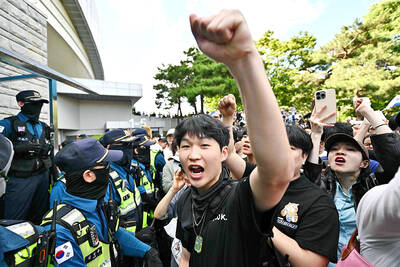
‘ABSURD MISTAKE’: The election commission said that there had been a failure to anticipate turnout after 14 polling stations ran short of ballot papers South Korean riot police yesterday cleared protesters from a Seoul polling station after a 35-hour blockade sparked by a shortage of ballot papers during local elections earlier this week. Wednesday’s election was the first nationwide vote since South Korean President Lee Jae-myung took office following the ouster of Yoon Suk-yeol over his short-lived martial law declaration. Lee’s ruling Democratic Party swept most races, but failed to flip the crucial Seoul mayoral seat. The South Korean National Election Commission apologized, blaming a failure to anticipate turnout after 14 polling stations in Seoul ran short of ballot papers. Some polling stations stayed open until 10pm to

France experienced its hottest spring on record, the French weather service said on Tuesday, after an exceptional early heat wave that also broke highs for the season in England and Wales. Meteo-France said the average nationwide temperature over March to May was 13.8°C — about 1.7°C above the norm, and surpassing records set in 2011 and 2020. “The warmest spring since records began in 1900,” it said in a bulletin. All three months were warmer than average, but the onset of an “unprecedented heatwave” late last month pushed the mercury to highs typically seen at the height of the summer. “Our country had never

A Sherpa guide was found crawling to base camp on Mount Everest a week after he went missing and was reunited with his family, who had given up hope he would return. Dawa Sherpa was last seen on Friday last week descending the mountain, but he did not reach base camp even though his client did. The pair were among the last climbers on the mountain as the climbing season came to an end and the route was dismantled. Dawa was located by a cleaning crew on Thursday morning as he was crawling down the snowy slopes around the Khumbu Icefall, just above


 RSS
RSS