


Protesters on Saturday attacked the French embassy in Burkina Faso’s capital, after supporters of the West African nation’s new coup leader accused France of harboring the ousted interim president, a charge French authorities denied.
A group of soldiers appearing on state television late on Friday announced that Lieutenant-Colonel Paul-Henri Sandaogo Damiba had been overthrown less than nine months after he mounted a coup.
While his whereabouts remained unknown late on Saturday, a new statement attributed to Damiba was posted on the Burkinabe presidency’s Facebook account directed at the newly declared leader, Captain Ibrahim Traore.
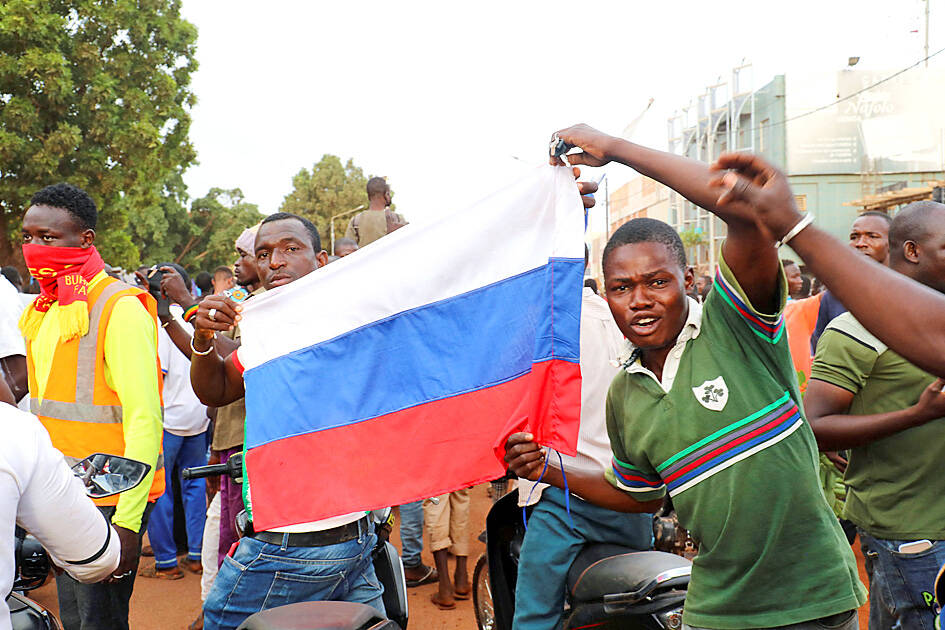
Photo: Reuters
“I call on Captain Traore and company to come to their senses to avoid a fratricidal war that Burkina Faso does not need,” said the statement attributed to Damiba, who unlike other ousted West African leaders has yet to tender a resignation.
Earlier on Saturday, comments by a junta spokesman set an outburst of anger in Ouagadougou into motion.
“Damiba has tried to retreat to the Kamboinsin French military base to prepare a counteroffensive in order to sow divide amongst our defense and security forces,” said Lieutenant Jean Baptiste Kabre, a spokesman of the new leadership.
Video on social media showed residents with lit torches outside the perimeter of the French embassy and other images showed part of the compound ablaze.
In Burkina Faso’s second-largest city, Bobo-Dioulasso, crowds also vandalized the French institute.
France has denied any role in the events unfolding in its former colony, and warned its citizens to stay at home amid a “confusing” situation in Ouagadougou.
“We condemn in the strongest terms the violence against our diplomatic presence in Burkina Faso,” the Ministry for Europe and Foreign Affairs said in a statement. “Any attack on our diplomatic facilities is unacceptable.”
In an earlier statement, the ministry said that “the camp where the French forces are based has never hosted Paul Henri Sandaogo Damiba nor has our embassy.”
Traore, 34, who was named in charge after the Friday evening coup was announced on state television, said in interviews on Saturday that he and his followers did not seek to harm Damiba.
“If we wanted, we would take him within five minutes of fighting and maybe he would be dead, the president. But we don’t want this catastrophe,” Traore told the Voice of America. “We don’t want to harm him, because we don’t have any personal problem with him. We’re fighting for Burkina Faso.”
He later told Radio Omega: “We have no intention to bring Damiba to justice. We only wish that he would go rest because he is tired, and as for us we are going to continue to do the work.”
As uncertainty prevailed, the international community widely condemned the ouster of Damiba, who himself overthrew the country’s democratically elected president in January.
US Department of State spokesman Ned Price said the US “is deeply concerned by events in Burkina Faso.”
“We call on those responsible to de-escalate the situation, prevent harm to citizens and soldiers, and return to a constitutional order,” he said.
After taking power in January, Damiba promised to end militant violence that has forced 2 million people to flee their homes in Burkina Faso.
However, the group of officers led by Traore said on Friday that Damiba had failed.
The new junta leadership said it would commit “all fighting forces to refocus on the security issue and the restoration of the integrity of our territory.”
It remains to be seen whether the junta can turn around the crisis. Concerns were mounting on Saturday that the latest political volatility would further distract the military and allow the militants to fasten their grip on the once-peaceful country.
Some in Burkina Faso’s military saw Damiba as too cozy with France, which maintains a military presence in Africa’s Sahel region to help countries fight militants. Some who support the new coup leader have called on the Burkinabe government to seek Russian support instead.

‘CROSSING THE LINE’: China’s embassy in Seoul criticized US Forces Korea Commander General Xavier Brunson, asking if his ‘hostile’ remarks were authorized by Washington South Korea and the US are in talks over recent public remarks by the commander of US Forces Korea, Seoul’s presidential office said yesterday, after the comments drew sharp criticism from China. In a recent podcast interview, US Forces Korea Commander General Xavier Brunson described South Korea as “the dagger in the heart of Asia” from China’s east coast, prompting the Chinese embassy in Seoul to say that he had “truly crossed the line.” The interview came amid growing speculation that Washington might seek to expand the role of US Forces Korea in countering the growing regional influence of China, a key

Through the noise of rushing papers and whirring belts at a print factory in Kyoto, two creators watch their photo essay come to life in broadsheet form — part of an effort to win new audiences in the age of artificial intelligence (AI). Despite the decline of the publishing industry, self-publication and handmade “zine” magazines are growing in popularity in Japan, reflecting the nation’s enduring love of paper in the digital era. While speaking to Agence France-Presse at the plant, his hands black with ink, one of the creators, Kazuma Obara, said: “I think [paper] is a medium that engages all five

Australian researchers have trained lab-grown brain cells on a silicon computer chip to play the 1990s shooter game Doom and said they are just scratching the surface of what the neurons could be capable of doing. It is the science-fiction work of biotech boffins at Cortical Labs, who researched and developed the technology that harnesses the workings of the brain’s networking system. Each so-called “biological computer” contains about 200,000 living human brain cells, grown from stem cells that were harvested from blood donations. Having mastered the simple computer game Pong, where a paddle is moved up and down to send a ball

France experienced its hottest spring on record, the French weather service said on Tuesday, after an exceptional early heat wave that also broke highs for the season in England and Wales. Meteo-France said the average nationwide temperature over March to May was 13.8°C — about 1.7°C above the norm, and surpassing records set in 2011 and 2020. “The warmest spring since records began in 1900,” it said in a bulletin. All three months were warmer than average, but the onset of an “unprecedented heatwave” late last month pushed the mercury to highs typically seen at the height of the summer. “Our country had never


 RSS
RSS