


The US’ top envoy to China yesterday called on the nation to reopen dialogue it halted after US House of Representatives Speaker Nancy Pelosi’s visit to Taiwan almost two months ago.
“Our message to the Chinese is: Let’s talk, open these dialogues and let’s move forward,” US Ambassador to China Nicholas Burns told the Milken Institute Asia Summit in Singapore via videoconference.
The US needs to work with China on issues such as climate change and health, even as they compete on technology, Burns said.
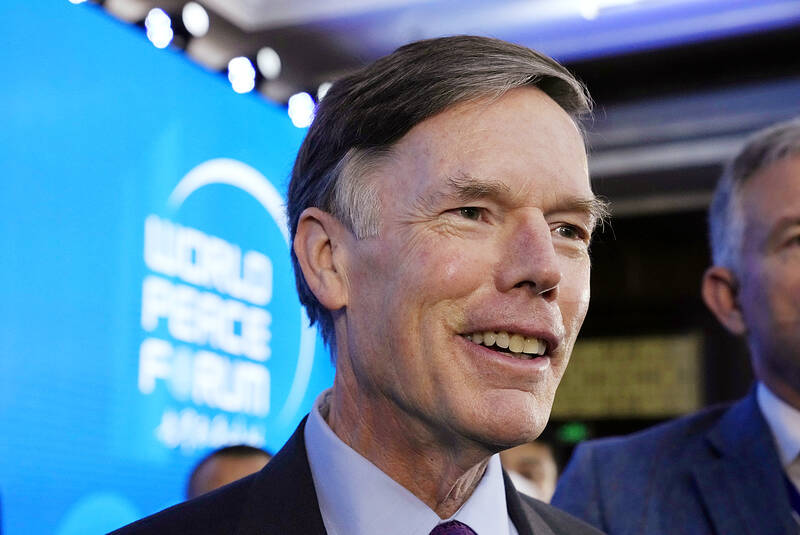
Photo: AP
Washington views Beijing as trying to change the “status quo” regarding Taiwan, he said, adding: “We’ve warned them that we won’t agree to that — we don’t accept it.”
The comments mark an effort by Washington to soothe tensions with Beijing that spiked when Pelosi became the first sitting US House speaker in 25 years to visit Taiwan.
China warned Pelosi not to visit, and when she did, it responded with unprecedented military drills and by firing ballistic missiles over Taiwan.
It also cut off talks with the US on defense and climate change.
At the time, US National Security Council spokesman John Kirby called China’s cutting of military talks with the US “an irresponsible act,” but added that “not all channels of communication between our military leaders are shut down.”
Kirby also said that China’s ending of climate change talks amounted to “punishing the whole world.”
US Special Presidential Envoy for Climate John Kerry last week said there was still room for progress on climate talks with China even though they had been suspended.
“I really hope China will decide sometime in the next days,” he said. “It is worth coming back to this, because we owe it to humankind.”
Burns also said that the US was monitoring China’s ties with Russia closely, although it has not seen any sign that Beijing has supported Moscow militarily or with help evading sanctions imposed after it invaded Ukraine.
China has refrained from endorsing the invasion, although earlier this month Chinese President Xi Jinping (習近平) called Russian President Vladimir Putin “an old friend” and said his nation is ready to work with Moscow.
“We’ve been very clear with the Chinese privately and publicly in saying that we’re watching that very carefully here, that China should not provide military support or support to help Russia evade sanctions,” Burns said.
He also highlighted China’s diverging stance on the Ukraine conflict, underscoring its neutrality at a recent UN meeting, but telling its own people that the US and NATO instigated the fighting.
Burns also spoke about other matters at the gathering.
“We reject what the People’s Republic of China has done in Hong Kong. It’s a shadow of what it was. There aren’t political freedoms now of a type that people just enjoyed a couple of years ago,” he said.
Burns also highlighted human rights concerns in Tibet and Xinjiang, particularly a lack of religious freedoms.
The US does not want to decouple from China, he said, pointing to the US$1.2 trillion that Americans hold in Chinese equities and debt securities.
“We’re encouraging Americans to invest here as long as it doesn’t cross our national security lines,” he said.


Through the noise of rushing papers and whirring belts at a print factory in Kyoto, two creators watch their photo essay come to life in broadsheet form — part of an effort to win new audiences in the age of artificial intelligence (AI). Despite the decline of the publishing industry, self-publication and handmade “zine” magazines are growing in popularity in Japan, reflecting the nation’s enduring love of paper in the digital era. While speaking to Agence France-Presse at the plant, his hands black with ink, one of the creators, Kazuma Obara, said: “I think [paper] is a medium that engages all five
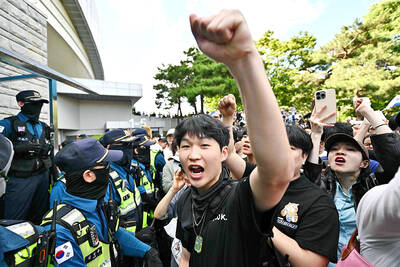
‘ABSURD MISTAKE’: The election commission said that there had been a failure to anticipate turnout after 14 polling stations ran short of ballot papers South Korean riot police yesterday cleared protesters from a Seoul polling station after a 35-hour blockade sparked by a shortage of ballot papers during local elections earlier this week. Wednesday’s election was the first nationwide vote since South Korean President Lee Jae-myung took office following the ouster of Yoon Suk-yeol over his short-lived martial law declaration. Lee’s ruling Democratic Party swept most races, but failed to flip the crucial Seoul mayoral seat. The South Korean National Election Commission apologized, blaming a failure to anticipate turnout after 14 polling stations in Seoul ran short of ballot papers. Some polling stations stayed open until 10pm to

France experienced its hottest spring on record, the French weather service said on Tuesday, after an exceptional early heat wave that also broke highs for the season in England and Wales. Meteo-France said the average nationwide temperature over March to May was 13.8°C — about 1.7°C above the norm, and surpassing records set in 2011 and 2020. “The warmest spring since records began in 1900,” it said in a bulletin. All three months were warmer than average, but the onset of an “unprecedented heatwave” late last month pushed the mercury to highs typically seen at the height of the summer. “Our country had never

A Sherpa guide was found crawling to base camp on Mount Everest a week after he went missing and was reunited with his family, who had given up hope he would return. Dawa Sherpa was last seen on Friday last week descending the mountain, but he did not reach base camp even though his client did. The pair were among the last climbers on the mountain as the climbing season came to an end and the route was dismantled. Dawa was located by a cleaning crew on Thursday morning as he was crawling down the snowy slopes around the Khumbu Icefall, just above


 RSS
RSS