


Chinese dissident and artist Ai Weiwei (艾未未) has warned against hubris in what he calls “such a troublesome time” with his first glass sculpture, made on the Venetian island of Murano, with the foreboding subtitle: “Memento Mori,” Latin for “Remember You Must Die.”
Russian bombs fall on Ukraine. China is flexing its military muscle in the Taiwan Strait. Migrants die repeatedly at sea as smugglers’ boats sink. The Earth warms, creating drought, collapsing glaciers and triggering violent storms. The COVID-19 pandemic lingers.
“We are talking about many, many things. We are talking about immigrants, about deaths, about the war, about many, many issues,” Ai said in an interview in Venice on Friday.
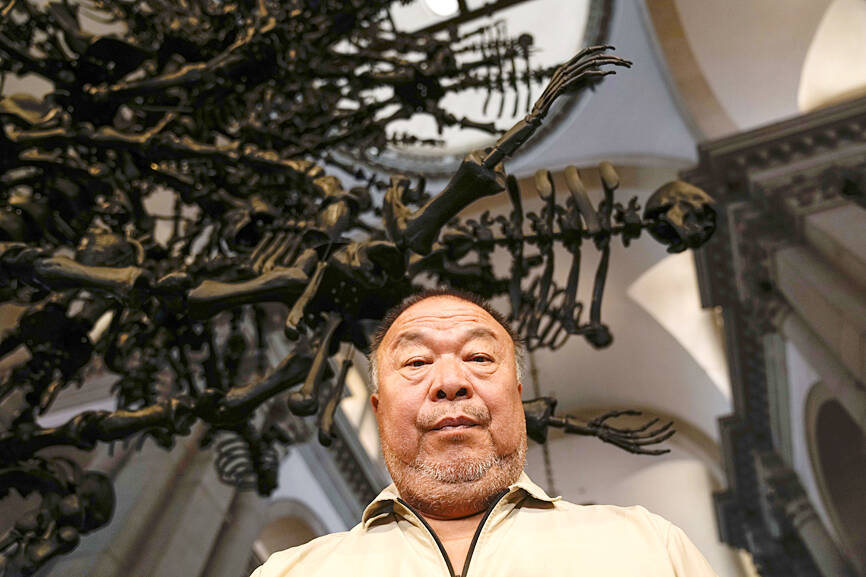
Photo: AP
He stands by his 9m, nearly 3-tonne black glass sculpture, which is suspended over the central nave of the deconsecrated church of San Giorgio Maggiore, located opposite Venice’s St Mark’s Square.
Titled The Human Comedy: Memento Mori, the sculpture is the centerpiece of Ai’s exhibition at the church and opens today.
The huge hanging artwork is part chandelier, part ossuary, with intricately hung molded glass skeletons and skulls, both human and animal, balanced with glass-blown human organs and scattered likenesses of the Twitter bird logo and surveillance cameras, hinting at the darker side of technology.
“We see the environment completely disappearing, being destroyed by humans’ effort ... and that will create a much bigger disaster or famine. Or war, there’s a possible political struggle between China and the West as China asserts greater control over Hong Kong and threatens control over Taiwan,” Ai said.
“We have to rethink about humans and legitimacy in the environment. Do we really deserve this planet, or are we just being so short-sighted and racist? And very, very just self-demanding, selfishness,” he said.
The exhibit also features smaller glass sculptures. One depicts Ai himself as a prisoner, a reference to his months in a Chinese prison in 2011. Another imposes his distorted face on a replica of an 18th-century statue titled Allegory of Envy.
A wooden sculpture of a tree trunk fills a sacristy. Colored glass hard hats save places in the choir. Lego-brick portrait replicas of famous paintings and the Chinese zodiac line walls of adjacent rooms.
Ai said he thinks Russia’s invasion of Ukraine gave Chinese authorities a “potential model” to understand how such an operation might play out in Taiwan, without serving either as encouragement or warning.
“I think China is part of the global power struggle that reflects our modern understanding, and the classic notion about territory and who has the right to do what,” he said. “What what happens in the Russian and Ukraine conflict gives China a clear, maybe mental exercise about what they want to do in Taiwan, if it is needed.”
Ai said any Chinese invasion of Taiwan would be a mistake and a misunderstanding of Taiwan’s history.
“The Chinese think that Taiwan belongs to China, but in reality China and Taiwan have been apart for over 70 years. They have their own social structure, which is more democratic and more peaceful than in China,” he said.
Any moves by China to claim Taiwan by force will result “in the ultimate struggle.”
He sees the struggle in China as one for legitimacy of authorities’ control, while the challenge in the West is the continual need to defend democracy, and with it freedom of speech.
The West’s Achilles’ heel is its economic dependency on China’s cheap manufacturing, he said.
“That is why China is so confident. They know the West cannot live without China,” Ai said.
He cited instances of Western hypocrisy, including the rejection by festivals in Europe and the US of films he made during the COVID-19 pandemic depicting Wuhan’s first lockdown and the struggles in Hong Kong.
After praising the films, festivals ultimately said: “We cannot show it,” out of fear of losing access to the Chinese market, Ai said.
His artworks travel more smoothly because his artistic language is harder to interpret, he said.
“My work is about a new vocabulary, so it is difficult for somebody who has completely no knowledge. It requires study,” Ai said. “I don’t make some piece to please the audience, but I always want to say something that is necessary.”
Tourists wandering in from the water bus were delighted that they had stumbled into an exhibit by the renowned dissident artist.
“It is metal? When I first saw this I thought it represented hell,” said Kenneth Cheung, a Hong Kong native now living in Toronto, as he checked out the imposing glass sculpture. “Being in a church, it is even stronger, more powerful.”
The main sculpture took three years to realize with assistance from artists at a glass studio on Murano employing three techniques: traditional Murano blown glass, wax molds and injection molds.
Studio owner Adriano Berengo said he pursued a collaboration for his strong political beliefs.
“He shows his face. He doesn’t hide. He is ready to risk his life, and he did in China,” Berengo said.
The exhibition runs through Nov. 27 in Venice. From there, the hanging sculpture is scheduled to be displayed at the Design Museum in London and then, hopefully, to a buyer, Berengo said.
“It has to be a big museum. Otherwise, how can you keep an artwork like that?” he said.
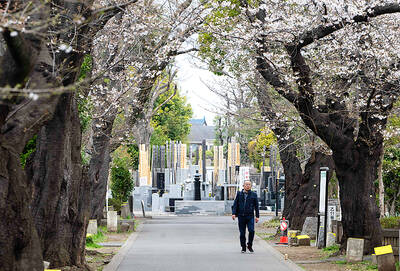
ROCKY RELATIONS: The figures on residents come as Chinese tourist numbers drop following Beijing’s warnings to avoid traveling to Japan The number of Chinese residents in Japan has continued to rise, even as ties between the two countries have become increasingly fractious, data released on Friday showed. As of the end of December last year, the number of Chinese residents had increased by 6.5 percent from the previous year to 930,428. Chinese people accounted for 22.6 percent of all foreign residents in Japan, making them by far the largest group, Japanese Ministry of Justice data showed. Beijing has criticized Tokyo in increasingly strident terms since Japanese Prime Minister Sanae Takaichi last year suggested that a military conflict around Taiwan could

A retired US colonel behind a privately financed rocket launch site in the Dominican Republic sees the project as a response to China’s dominance of the space race in Latin America. Florida-based Launch on Demand is slated to begin building a US$600 million facility in a remote region near the border with Haiti late this year. The project is designed to meet surging demand for the heavy-lift rockets needed to put clusters of satellites into orbit. It is also an answer to China’s growing presence in the region, said CEO Burton Catledge, a former commander of the US Air Force’s 45th Operations
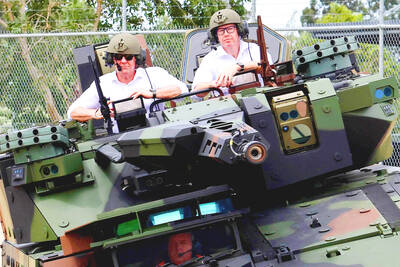
Germany is considering Australia’s Ghost Bat robot fighter as it looks to select a combat drone to modernize its air force, German Minister of Defense Boris Pistorius said yesterday. Germany has said it wants to field hundreds of uncrewed fighter jets by 2029, and would make a decision soon as it considers a range of German, European and US projects developing so-called “collaborative combat aircraft.” Australia has said it will integrate the Ghost Bat, jointly developed by Boeing Australia and the Royal Australian Air Force, into its military after a successful weapons test last year. After inspecting the Ghost Bat in Queensland yesterday,
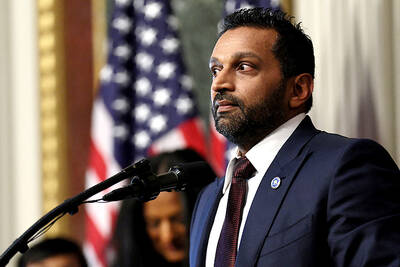
A pro-Iran hacking group claimed to breach FBI Director Kash Patel’s personal e-mail inbox and posted some of the contents online. The e-mails provided by the hacking group include travel details, correspondence with leasing agents in Washington and global entry, and loyalty account numbers. The e-mail address the hackers claim to have compromised has been previously tied to Patel’s personal details, and the leaked e-mails contain photos of Patel and others, in addition to correspondence with family members and colleagues. “The FBI is aware of malicious actors targeting Director Patel’s personal email information,” the agency said in a statement on


 RSS
RSS