


Strapped in tight, the prone poodle nervously eyes the vet, who gently sticks fine needles into its back and paws, summoning the ancient art of acupuncture to treat the pet’s aches and pains.
Duniu is just one of a growing number of animals being signed up for traditional medicine in China — care their masters have said is less invasive and comes with fewer side effects than conventional treatments.
In one Beijing practice, pets of all shapes and sizes come for treatments.
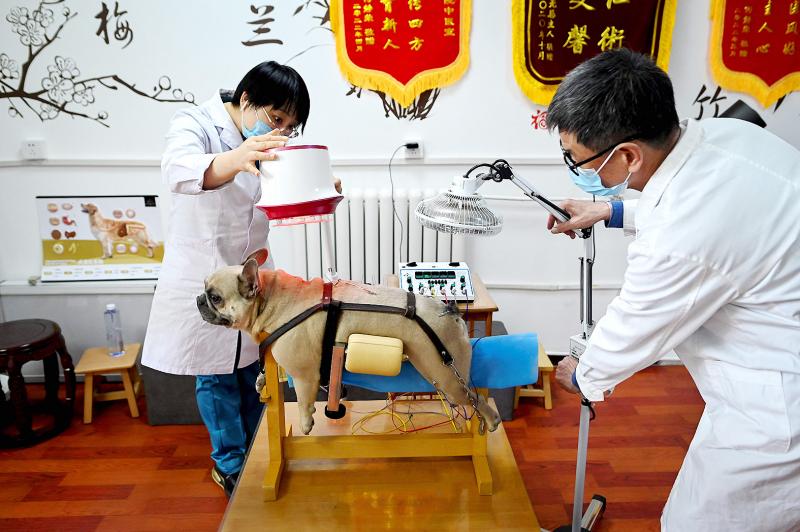
Photo: AFP
“The advantage of traditional Chinese medicine is that there is no surgery,” 38-year-old Zhai Chunyu said, accompanied by Duniu, his poodle. “The animal’s suffering is reduced.”
At just three years old, Duniu suffers from Legg-Calve-Perthes disease, which affects the thigh bone and can lead to painful osteoarthritis.
“He was in so much pain that he could no longer put his paw on the ground” and “had no appetite,” said Zhai, who works in finance.
“A doctor advised me to have the head of the femur removed, but I didn’t want to because I have another poodle who has been there and he suffered a lot from the operation and the after-effects,” Zhai said.
A friend advised him to try acupuncture.
“After five to six sessions, we saw the results. Duniu manages to walk and even run a little now,” Zhai said.
Animal acupuncture is centuries old in China, said veterinarian Li Wen, who founded his practice in 2016.
“Traditional Chinese medicine is not intended to replace conventional medicine” because “both have their strengths” and are complementary, he said.
Before starting the treatment, the vet first checks the animal’s body, examines its eyesight and the color of its tongue, takes its pulse and asks its owner questions.
He then plants his needles at acupuncture points specific to dogs and cats.
“Out of the 10 animals that I receive on average every day, there are always one or two who rebel,” Li said. “You have to communicate with them, treat them gently, reassure them that you’re not here to hurt them.”
Recordings of soft bamboo flute music and the chirping of birds are played at the clinic to help the animals relax.
Li mainly deals with cases of paralysis, limb weakness, epilepsy, pain and urinary retention.
However, acupuncture can also be used for ailments when no other treatment is available.
That was the case with Xiaomei, a 12-year-old male Labrador suffering from nerve compression in his lower back.
“Last September, after swimming, he was unable to get back on his feet. A veterinarian then told us that it was impossible to treat and that he would become paralyzed,” his owner, Ma Li, said.
“Thanks to acupuncture, he still has difficulties, but can walk normally and even run.”
“The first time, he was scared,” said Yang Lihua, a 65-year-old retiree accompanied by her Pekingese Niannian, who has a herniated disc.
“Now he loves it! After the session, he is so relaxed that he sleeps in the car on the way home,” Yang said.
The acupuncture market for animals remains limited for the moment, Li said, adding that “since 2016, it has been gaining popularity.”
“As education levels, living conditions improve and incomes rise, more and more people are realizing the benefits of this medicine,” Li said.
Ma’s Labrador jumps into the back seat of his owner’s car after his session, looking content.
“Doesn’t he look happy?” she exclaimed.

Four contenders are squaring up to succeed Antonio Guterres as secretary-general of the UN, which faces unprecedented global instability, wars and its own crushing budget crisis. Chile’s Michelle Bachelet, Argentina’s Rafael Grossi, Costa Rica’s Rebeca Grynspan and Senegal’s Macky Sall are each to face grillings by 193 member states and non-governmental organizations for three hours today and tomorrow. It is only the second time the UN has held a public question-and-answer, a format created in 2016 to boost transparency. Ultimately the five permanent members of the UN’s top body, the Security Council, hold the power, wielding vetoes over who leads the
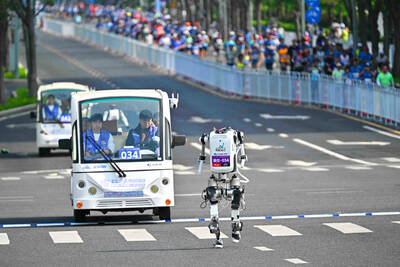
A humanoid robot that won a half-marathon race for robots in Beijing on Sunday ran faster than the human world record in a show of China’s technological leaps. The winner from Honor, a Chinese smartphone maker, completed the 21km race in 50 minutes and 26 seconds, said a WeChat post by the Beijing Economic-Technological Development Area, also known as Beijing E-Town, where the race began. That was faster than the human world record holder, Ugandan Jacob Kiplimo, who finished the same distance in about 57 minutes in March at the Lisbon road race. The performance by the robot marked a significant step forward
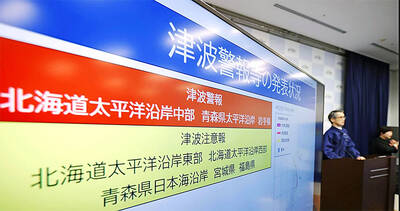
An earthquake registering a preliminary magnitude of 7.7 off northern Japan on Monday prompted a short-lived tsunami alert and the advisory of a higher risk of a possible mega-quake for coastal areas there. The Cabinet Office and the Japan Meteorological Agency said there was a 1% chance for a mega-quake, compared to a 0.1% chance during normal times, in the next week or so following the powerful quake near the Chishima and Japan trenches. Officials said the advisory was not a quake prediction but urged residents in 182 towns along the northeastern coasts to raise their preparedness while continuing their daily lives. Prime
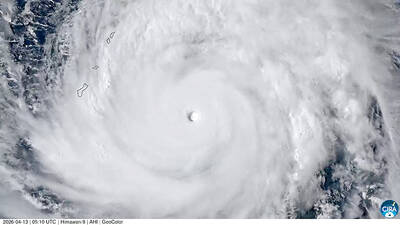
HAZARDOUS CONDITION: The typhoon’s sheer size, with winds extending 443km from its center, slowed down the ability of responders to help communities, an official said The US Coast Guard was searching for six people after losing contact with their disabled boat off the coast of Guam following Typhoon Sinlaku. The crew of the 44m dry cargo vessel, the US-registered Mariana, on Wednesday notified the coast guard that the boat had lost its starboard engine and needed assistance, Petty Officer 3rd Class Avery Tibbets said yesterday. The coast guard set up a one-hour communication schedule with the vessel, but lost contact on Thursday. A Coast Guard HC-130 Hercules aircraft was launched to search for the six people on board, but it had to return to Guam because of


 RSS
RSS