

Early yesterday morning, three gentle giants wandered out of a corral in the Kent countryside to become the first wild bison to roam in Britain for thousands of years.
The aim is for the animals’ natural behavior to transform a dense commercial pine forest into a vibrant natural woodland. Their taste for bark would kill some trees and their bulk open up trails, letting light spill on to the forest floor, while their love of rolling around in dust baths would create more open ground.
All this should allow new plants, insects, lizards, birds and bats to thrive.

Photo: AFP
The Wilder Blean project, near Canterbury, is an experiment to see how well the bison can act as natural “ecosystem engineers” and restore wildlife.
England is one of the most nature-depleted nations in the world. A more natural woodland should also absorb more carbon, helping to tackle the climate crisis.
Global heating was evident as the bison were released, with England in the grip of a heat wave and the early timing was to allow the bison to reach the shade of the woods before temperatures started to climb.
European bison are the continent’s largest land animal — bulls can weigh 1 tonne — and were extinct in the wild a century ago, but are recovering through reintroduction projects across Europe.
“The restoration of naturally functioning ecosystems is a vital and inexpensive tool in tackling the climate crisis,” Kent Wildlife Trust chief executive Evan Bowen-Jones said. “We want Wilder Blean to mark the beginning of a new era for conservation in the UK. We need to revolutionize the way we restore natural landscapes, relying less on human intervention and more on natural engineers like bison, boar and beaver.”
“Not only this, but we’re giving people in the UK — for the first time in over a thousand years — the chance to experience bison in the wild. It’s a really powerful, emotional, visceral experience and it’s something we’ve lost in this country,” Wildwood Trust director-general Paul Whitfield said.
The three bison are an older female from the Highland wildlife park in Scotland, which will be the matriarch of the herd, plus two young females from Fota wildlife park in Cork, Ireland.
“We could not have asked for a better matriarch,” said Donovan Wright, one of two new bison rangers employed by the project. “She’s very, very calm, she’s very confident.”
They are to be joined by a young bull from Germany in the middle of next month, whose arrival was delayed by import complications related to Brexit.
The three females were fitted with tracking collars on Sunday, an approach that would allow the team to plot the animals’ movements and glean insights into the plants they interact with.
Wright said bison are like giant seed banks.
“As they move, they collect seeds, and then they [are] also dispersing seeds along the route,” he said.
At first the females would have a 5 hectare double fenced area to explore, but this is to increase to 50 hectares when the bull arrives. The animals would eventually have access to 200 hectares.
Visitors to Blean Woods might be able to catch a glimpse of the bison from trails, the team said.
Bison-sized tunnels are also being built to allow the animals to safely cross existing footpaths. They are contained by two fences, one of which is electric.
The bison in other UK wildlife parks are contained in smaller areas and receive supplementary feeding.
“I cannot wait to see how the bison start to shape the Blean over a five, 10, 20-year period as they settle into their new home and start throwing their weight around,” said Tom Gibbs, the other bison ranger.
The rangers have spent time at the Kraansvlak project in the Netherlands, where people can now walk freely through an area occupied by 14 bison. There has never been a dangerous incident.
The bison are soon to be joined by other grazing animals, including Exmoor ponies, iron age pigs and Longhorn cattle, whose natural behaviors compliment the bison in managing the landscape without the need for human intervention.
Their impact would be closely watched over the long term, including soil sampling and worm counts, examining the vegetation structure, and monitoring invertebrates, birds and mammals.
“If we can create diverse, dynamic, bio-abundant habitats in our crowded corner of the southeast, why shouldn’t we be doing it in our national parks and protected landscapes?” Kent Wildlife Trust director of conservation Paul Hadaway said.
The rangers expect the bison to breed, with females producing one calf a year, and the Wilder Blean site is licensed for up to 10 animals.
In the future, they hope to provide bison to found other sites in the UK, as well as exchanging animals across Europe.
All 7,000 bison living in Europe are descended from just 12 zoo animals and the species is still classed as vulnerable, so maximizing genetic diversity is very important.

Long dubbed an “air-conditioned nation,” Singapore is experimenting with cooling alternatives from chilled beams to “passive displacement” to curb its thirst for energy-guzzling air-conditioning. The city-state has the highest per-capita air-conditioner ownership rate in Southeast Asia, with about 99 percent of private residences equipped with cooling units. Singapore’s local building sector accounts for one-fifth of its emissions, while cooling itself accounts for 40 to 60 percent of a building’s energy consumption, according to studies. A stroll down Orchard Road highlights that dependence. Shoppers are greeted by blasts of cool air that waft into the street as doors swing open — a major draw
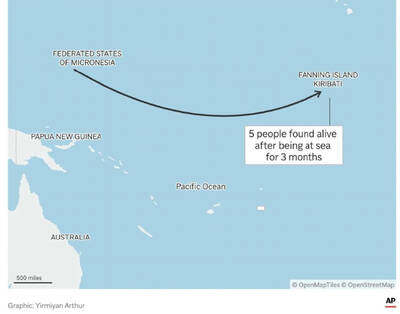
KIRIBATI: Nine people on a skiff had been reported missing after they failed to return to Ruo Island in Micronesia on July 30. Four people remained missing Five people, including two children, were rescued this week in the South Pacific island nation of Kiribati after three months drifting at sea in a 20-foot (6m) skiff, authorities said. Another four remained missing. Villagers rescued the group on Sunday off Fanning Island in Kiribati, the Australian Broadcasting Corp (ABC) reported, after they had drifted an estimated 5,400km east from the Federated States of Micronesia. The US Coast Guard in Guam yesterday confirmed that the skiff with nine people aboard had been reported missing after it failed to return to Ruo Island in Micronesia on July 30. 10-DAY SEARCH A 10-day search covering

China plans to roll out a broad set of standards governing the safety of artificial intelligence (AI) from development through deployment, representing some of the most comprehensive guidelines to guard against a loss of control over increasingly powerful artificial intelligence. The state economic planner yesterday said it was quickening legislation to govern and oversee how AI is developed and applied, covering the entire life cycle of models. The regulations would extend to areas from data to computing power, Wang Ruomeng (汪若夢), deputy director-general of the Department of Innovation and High-Tech Development at China’s National Development and Reform Commission, told a briefing in
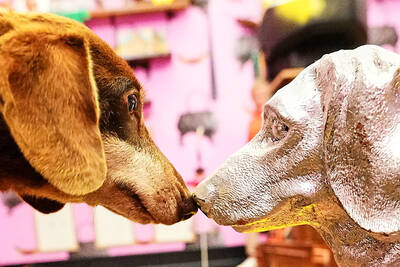
The humble dachshund is taking center stage in a new exhibition in Germany that explores the history of the sausage dog in art — and visitors are welcome to bring their four-legged friends along. “The Dachshund: An Icon off the Leash” opened at the Kunsthalle Bremen yesterday, showcasing artwork by dachshund owners and fans including Pablo Picasso, David Hockney and Andy Warhol. In addition to painting, drawing, photography and video, visitors can admire delights such as a wealth of stuffed toy dogs and many other dachshund-themed objects. Museum director Christoph Grunenberg believes it is the world’s first exhibition dedicated to the dachshund


 RSS