


Just like any other Portuguese bullfight, the elegant rider deftly guides his horse around the charging bull’s horns, before bending down to plant a bandarilha in its spine.
Except that no blood is spilled — the small spear is Velcro-padded, and sticks to a cushion attached to the bull’s back — and most of the spectators’ cheers are in English.
The scene takes place in Turlock, a small town in the heart of rural California, where tens of thousands of Portuguese Americans have lived for decades, keeping the traditions of their ancestral homeland alive, not least bullfighting.
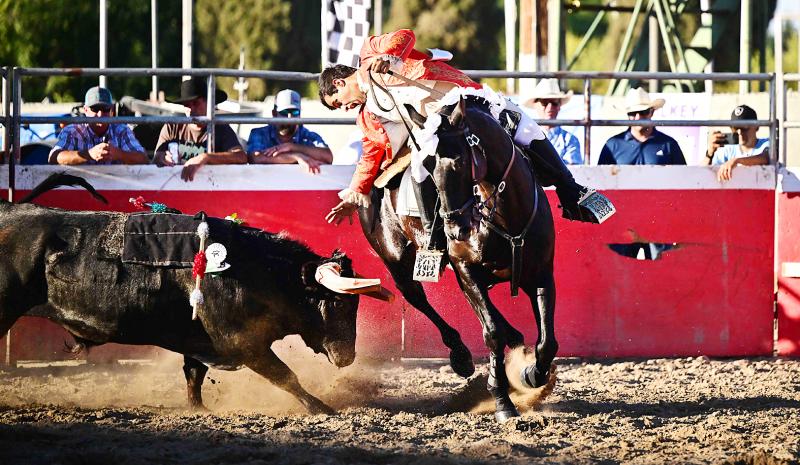
Photo: AFP
However, due to Californian law, there can be no bloodshed.
“The first time I came here in California, 15 years ago, it was like: ‘Woah, amazing,’ because they have everything like Portugal,” said Joao Soller Garcia, a cavaleiro, or horse rider, who traveled from Lisbon to take part in the bullfight.
“Go to a bullfight in Portugal and it’s the same thing,” he said shortly before entering the arena to be applauded by about 4,000 spectators.
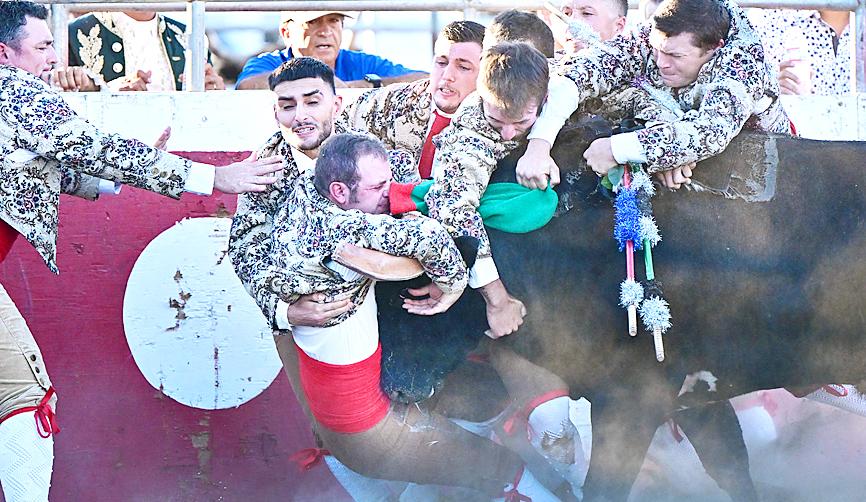
Photo: AFP
The majority of the crowd are of Portuguese descent — mainly immigrants from the Azores islands, who began to settle the agricultural area in the early 20th century.
The community has been growing ever since, with its own newspapers, radio stations and associations.
About 350,000 Californians proudly claim Portuguese heritage, and often remain fiercely attached to their culture and language.
This is the case for Jose, 30, who came to watch the bullfight with friends.
Born in California, he switches from English to Portuguese seemingly without noticing.
“It comes naturally to me. A lot of people here speak Portuguese in their daily life, even the younger ones, “ he said.
“Sometimes it is easier for me to express my feelings or to joke in Portuguese. Portuguese is a very emotional language,” he added.
Above the arena, the Portuguese flag flies alongside the US flag and the Portuguese national anthem strikes up before its US counterpart.
The bullfight is organized by a religious group, led by Antonio Mendes, a cattle breeder in his 70s who revived the tradition in 1993.
“We’re Portuguese and that’s part of our lifestyle, especially the island that I’m from — it’s just rooted,” he said.
Portuguese bullfights differ from the Spanish style, in that the animal is never killed in the arena.
However, in traditional Portuguese events, the bull has been weakened by several bandarilha strikes by the time the forcados — eight men with no horses or protection — enter the arena to tackle the animal with their bare hands.
Because the bulls in Turlock are not hurt, breeders like Mendes have created a bloodline which is just as combative, but less heavy.
“Here the bulls weigh about 900 to 1,000 pounds [408kg to 454kg], because it’s bloodless. In Portugal, they are 1,300, 1,400 pounds. Big bulls,” said George Martins, a forcado captain.
Teams like Martins’ are often dubbed “suicide squads” for a reason — one of them literally has the task of grabbing the bull by the horns, suffering powerful headbutts to the stomach as his companions wrestle with the animal.
“It’s not just brute strength ... it takes a lot of technique,” he said.
Joao Soller Garcia enjoys both the classic Portuguese style and its Californian adaptation.
“Compared to Portugal, it is a little bit more danger, because the bull is not hurt,” he said. “It’s completely bloodless and we have to be more careful ... the bull is at full strength.”
However, for Maxine Sousa-Correia, from a family of cattle breeders who have produced bulls for Californian fights since the 1970s, the use of Velcro bandarilhas diminishes the spectacle.
“Unfortunately, this is a mere imitation... We invented the Velcro pad and the Velcro on the end of the stick just so that it would at least add some color and some pageantry,” she said. “But at the same time, we’re not doing justice to this animal, because this is what this breed is all is for.”
Her husband, Frank Correia, added: “I think it sucks!”
“It should be done the way it is in Portugal, but we can’t, because we’re in the United States of America and, you know, they don’t appreciate the art,” he said.
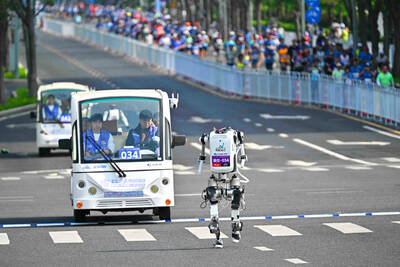
A humanoid robot that won a half-marathon race for robots in Beijing on Sunday ran faster than the human world record in a show of China’s technological leaps. The winner from Honor, a Chinese smartphone maker, completed the 21km race in 50 minutes and 26 seconds, said a WeChat post by the Beijing Economic-Technological Development Area, also known as Beijing E-Town, where the race began. That was faster than the human world record holder, Ugandan Jacob Kiplimo, who finished the same distance in about 57 minutes in March at the Lisbon road race. The performance by the robot marked a significant step forward

Four contenders are squaring up to succeed Antonio Guterres as secretary-general of the UN, which faces unprecedented global instability, wars and its own crushing budget crisis. Chile’s Michelle Bachelet, Argentina’s Rafael Grossi, Costa Rica’s Rebeca Grynspan and Senegal’s Macky Sall are each to face grillings by 193 member states and non-governmental organizations for three hours today and tomorrow. It is only the second time the UN has held a public question-and-answer, a format created in 2016 to boost transparency. Ultimately the five permanent members of the UN’s top body, the Security Council, hold the power, wielding vetoes over who leads the
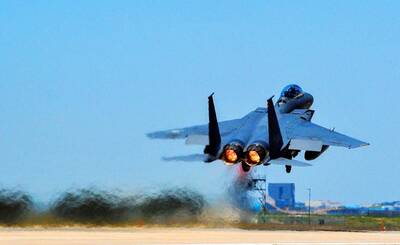
South Korea’s air force yesterday apologized for a 2021 midair collision involving two fighter jets, a day after auditors said the pilots were taking selfies and filming during the flight and held them responsible for the accident. “We sincerely apologize to the public for the concern caused by the accident that occurred in 2021,” an air force spokesman told a news conference, adding that one of the pilots involved had been suspended from flying duties, received severe disciplinary action and has since left the military. The apology followed a report released on Wednesday by the South Korean Board of Audit and Inspection,

An earthquake registering a preliminary magnitude of 7.7 off northern Japan on Monday prompted a short-lived tsunami alert and the advisory of a higher risk of a possible mega-quake for coastal areas there. The Cabinet Office and the Japan Meteorological Agency said there was a 1% chance for a mega-quake, compared to a 0.1% chance during normal times, in the next week or so following the powerful quake near the Chishima and Japan trenches. Officials said the advisory was not a quake prediction but urged residents in 182 towns along the northeastern coasts to raise their preparedness while continuing their daily lives. Prime


 RSS
RSS