


As US President Joe Biden visits the Middle East this week, one issue on the table is to be the status of two small Red Sea islands that are uninhabited, but of key strategic value.
Resolving the tricky status that stems from their location and turbulent history would help build trust between Israel and Saudi Arabia, two US allies taking gradual steps that Washington hopes could one day lead to diplomatic ties.
For now, the two barren islands — Tiran and Sanafir — are home only to soldiers of a decades-old multinational peacekeeping force, their waters occasionally visited by divers for their coral reefs.
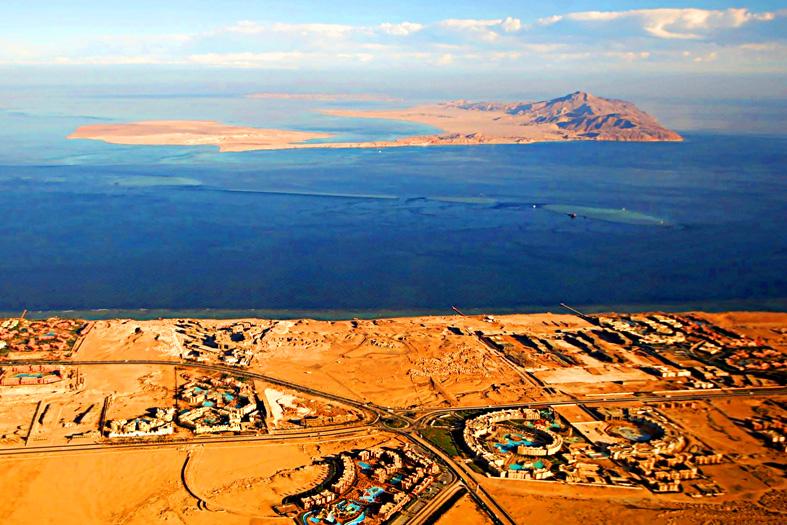
Photo: AFP
However, the islands have been fought over in the past, thanks to their key location at the entrance to the Gulf of Aqaba, featuring Jordan’s only seaport of the same name and Israel’s Eilat harbor.
Egypt ceded the islands, east of its resort town Sharm El-Sheikh, to Saudi Arabia in 2016, but the deal still requires Israel’s approval, at a time when the Jewish state and Saudi Arabia have no formal ties.
A senior Israeli official said on Thursday that the country would have “no objection” to greenlighting Egypt handing over the islands to Saudi Arabia as a step toward any normalization of ties between Saudi Arabia and Israel.
The issue is set to be on the agenda yesterday when Biden, after his Israel visit, was to meet Gulf leaders in Saudi Arabia’s Jeddah for a conference where Egyptian President Abdel Fattah al-Sisi was also expected.
Tiran — which hosts an airstrip for the peacekeepers — measures about 61km2, while Sanafir, to the east, is only about half that size.
The islands were under Egyptian sovereignty from 1950, but invaded by Israeli troops during the 1956 Suez Crisis that came after then-Egyptian president Gamal Abdel Nasser nationalized the canal.
Nasser’s 1967 closure of the Strait of Tiran, which cut off maritime access to Eilat and Aqaba, precipitated the Six Day War, after which Israel occupied the Sinai Peninsula and the two islands.
In 1979, the Camp David peace agreement provided for Egypt to recover the territories. As part of the Sinai’s demilitarization, Cairo was not allowed to station troops on the islands, where only peacekeepers for the Multinational Force and Observers were to be based.
In 2016 a Cairo-Riyadh agreement ceded the islands to Saudi Arabia in a controversial decision that sparked nationalist protests in Egypt, which were quickly stifled.
Critics accused al-Sisi of ceding the islands in return for Saudi Arabian aid and investment largesse. The Egyptian government has said that the islands were originally Saudi Arabian, but leased to Egypt in the 1950s.
The country’s courts handed down a series of contradictory rulings before the Egyptian Supreme Constitutional Court ruled in favor of the handover.
However, because the issue is governed by the Camp David agreement, the status of the islands has yet to be finalized, requiring Israel to ratify the transfer.

When a hiker fell from a 55m waterfall in wild New Zealand bush, rescuers were forced to evacuate the badly hurt woman without her dog, which could not be found. After strangers raised thousands of dollars for a search, border collie Molly was flown to safety by a helicopter pilot who was determined to reunite the pet and the owner. A week earlier, an emergency rescue helicopter found the woman with bruises and lacerations after a fall at a rocky spot at the waterfall on the South Island’s West Coast. She was airlifted on March 24, but they were forced to

CONFIDENCE BOOSTER: ’After parkour ... you dare to do a lot of things that you think only young people can do,’ a 67-year-old parkour enthusiast said In a corner of suburban Singapore, Betty Boon vaults a guardrail, crawls underneath a slide, executes forward shoulder rolls and scales a steep slope, finishing the course to applause. “Good job,” the 69-year-old’s coach cheers. This is “geriatric parkour,” where about 20 retirees learned to tackle a series of relatively demanding exercises, building their agility and enjoying a sense of camaraderie. Boon, an upbeat grandmother, said learning parkour has aided her confidence and independence as she ages. “When you’re weak, you will be dependent on someone,” she said after sweating it out with her parkour classmates in suburban Toa Payoh,

HIGH HOPES: The power source is expected to have a future, as it is not dependent on the weather or light, and could be useful for places with large desalination facilities A Japanese water plant is harnessing the natural process of osmosis to generate renewable energy that could one day become a common power source. The possibility of generating power from osmosis — when water molecules pass from a less salty solution to a more salty one — has long been known. However, actually generating energy from that has proved more complicated, in part due the difficulty of designing the membrane through which the molecules pass. Engineers in Fukuoka, Japan, and their private partners think they might have cracked it, and have opened what is only the world’s second osmotic power plant. It generates

Chinese dissident artist Gao Zhen (高兟), famous for making provocative satirical sculptures of former Chinese leader Mao Zedong (毛澤東), was tried on Monday over accusations of “defaming national heroes and martyrs,” his wife and a rights group said. Gao, 69, who was detained in 2024 during a visit from the US, faces a maximum three-year prison sentence, said his wife, Zhao Yaliang (趙雅良), and Shane Yi, a researcher at the Chinese Human Rights Defenders group which operates outside the nation. The closed-door, one-day trial took place at Sanhe City People’s Court in Hebei Province neighboring the capital, Beijing, and ended without a


 RSS
RSS