


A Saudi opposition party said on Sunday that one of its founding members was killed in Beirut, the capital of Lebanon.
The National Assembly Party, whose members live in exile, said that founding member Manea al-Yami was slain in “complicated circumstances.”
“Upon the news of the assassination, the party has been trying to verify its details and motives,” the party said in a statement.

Photo: AFP
“The party also holds the Saudi authorities responsible for exposing the people of this country to danger, forcing them to live in exile, and reside in unsafe environments because of their political beliefs or their demands for human rights,” it said.
The Lebanese Internal Security Forces issued a statement saying that al-Yami’s two brothers stabbed him to death in the southern Beirut suburb of Dahiyeh on Saturday evening.
The brothers are in custody and admitted they murdered al-Yami due to “family reasons,” the statement said.
Saudi Arabian Ambassador to Lebanon Waleed Bukhari issued a brief statement on the killing, writing on Twitter that he “highly appreciated the efforts of the Lebanese Internal Security Forces in uncovering the facts and bringing the perpetrators to justice for the murder of a Saudi citizen killed in Beirut’s southern suburbs.”
Al-Yami’s death was not reported by the Saudi Press Agency.
His party was established in September 2020 and is headquartered in London. It is critical of Saudi Arabia’s King Salman and the Al-Saud royal family, and calls for an elected parliament in Saudi Arabia.
Yahya Assiri, another founding member based in London, said that al-Yami was “generally worried” about being harmed, “but he wouldn’t specify from who.”
“His activism was done in an undisclosed manner, and [he] was a core member of the party,” Assiri said.
Ties between Lebanon and Gulf states have strained in recent years over Hezbollah’s growing political power in the country. Gulf states have especially been critical of opposition groups holding events in Dahiyeh, a political stronghold of Iran-backed Hezbollah, which Gulf states consider a terrorist organization.
Lebanese Minister of Interior and Municipalities Bassam Mawlawi ordered the deportation of members of outlawed Bahraini opposition party Al-Wefaq, after it held a conference criticizing the kingdom’s human rights record.
In January, Hezbollah hosted a conference for Saudi opposition figures on the anniversary of the death of influential Saudi Shiite cleric Nimr al-Nimr. He was one of 47 people who died in a mass execution by Saudi authorities in January 2016.
Yemen’s Iran-backed Houthi rebels were also present at the conference.

An American scientist convicted of lying to US authorities about payments from China while he was at Harvard University has rebuilt his research lab in Shenzhen, China, to pursue technology the Chinese government has identified as a national priority: embedding electronics into the human brain. Charles Lieber, 67, is among the world’s leading researchers in brain-computer interfaces. The technology has shown promise in treating conditions such as amyotrophic lateral sclerosis and restoring movement in paralyzed people. It also has potential military applications: Scientists at the Chinese People’s Liberation Army have investigated brain interfaces as a way to engineer super soldiers by boosting
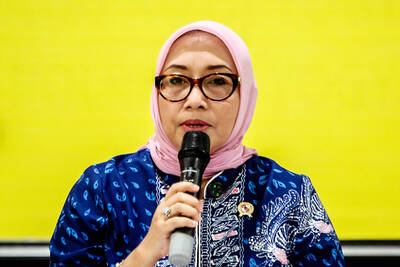
Indonesian police have arrested 13 people after shocking images of alleged abuse against small children at a daycare center went viral, sparking outrage across the nation, officials said on Monday. Police on Friday last week raided Little Aresha, a daycare center in Yogyakarta on Java island, following a report from a former employee. CCTV footage circulating on social media showed children, most younger than two, lying on the floor wearing only diapers, their hands and feet bound with rags. The police have confirmed that the footage is authentic. Police said they also found 20 children crammed into a room just 3m by 3m. “So
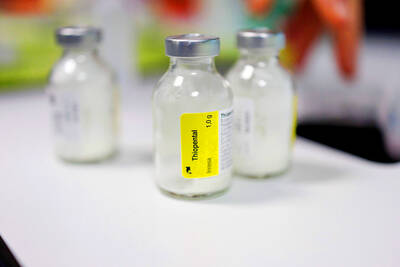
A grieving mother has ended her life at a clinic in Switzerland four years after the death of her only child. Wendy Duffy, 56, a physically healthy woman, died at the Pegasos clinic in Basel after struggling to cope with the death of her 23-year-old son, Marcus. The former care worker, from the West Midlands, England, had previously attempted to take her own life. The case comes as assisted dying would not become law in England and Wales after proposed legislation, branded “hopelessly flawed” by opponents, ran out of time. Ruedi Habegger, the founder of Pegasos, described Duffy’s death as

From post offices and parks to stations and even the summit of Mount Fuji, Japan’s vending machines are ubiquitous, but with the rapid pace of inflation cooling demand for their drinks, operators are being forced to rethink the business. Last month beverage giant DyDo Group Holdings announced it would remove about 20,000 vending machines — about 7 percent of their stock nationwide — by January next year, to “reconstruct a profitable network.” Pokka Sapporo Food & Beverage, based in Nagoya, also said last month it would sell its 40,000-machine operation to Osaka-based Lifedrink Co. “The strength of the vending machine


 RSS
RSS