


The number of fires breaking out in plastic recycling plants has soared in Turkey.
Experts and advocates suspect that it is not a coincidence, believing that some entrepreneurs want to get rid of unwanted garbage sometimes imported from Europe.
In Kartepe, an industrial town in the northwest, one of these sites was closed by the authorities in December last year after the outbreak of three fires in less than a month.
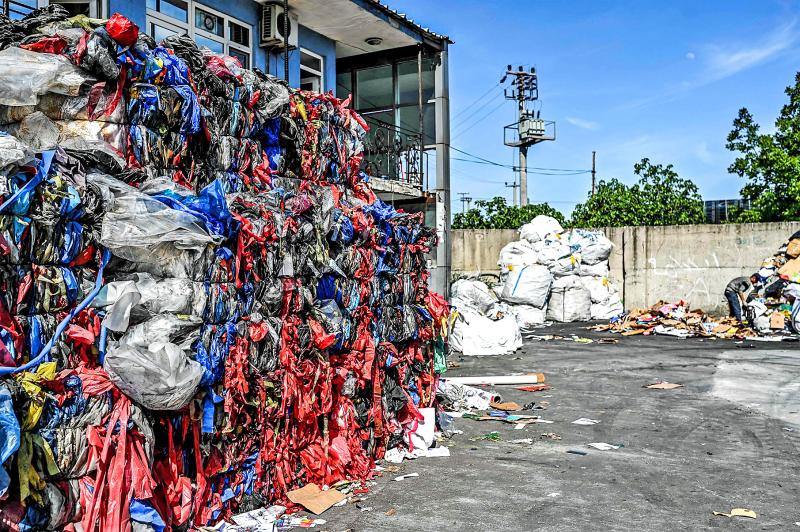
Photo: AFP
One burned for more than 50 hours, spewing toxic black smoke over the area wedged between the mountains and the Sea of Marmara.
“We don’t want our lakes and springs to be polluted,” said Beyhan Korkmaz, an environmental advocate in the city.
“Should we wear masks,” she said, concerned about the polluting dioxin emissions from a dozen similar fires within a 5km radius in less than two years.
There was a fire every three days in Turkey’s plastic reprocessing plants on average last year.
The number rose from 33 in 2019 to 121 this year, said Sedat Gundogdu, a professor specializing in plastic pollution at Cukurova University in Adana, Turkey.
Over the same period, Turkey became the leading importer of European plastic waste — ahead of Malaysia — after China banned imports at the start of 2018.
Nearly 520,000 tonnes arrived in Turkey last year, adding to the 4 to 6 million tonnes the country generates each year, data compiled by Greenpeace showed.
“The problem is not importing plastic from Europe. The problem is importing nonrecyclable or residual plastics,” said Baris Calli, professor of environmental engineering at Marmara University in Istanbul.
In a report published in August 2020, international police organization Interpol expressed concern about an “an increase in illegal waste fire and landfills in Europe and Asia,” citing Turkey in particular.
Following a regulation enacted in October last year, companies in the sector found guilty of arson can have their permits withdrawn.
However, Calli said the plastic industry lobby has grown stronger in Turkey in the past few years.
Turkey announced a ban on the import of plastic waste in May last year following an outcry after the publication of images of waste from Europe dumped in ditches and rivers.
However, the ban was lifted a week after it came into force.

‘CROSSING THE LINE’: China’s embassy in Seoul criticized US Forces Korea Commander General Xavier Brunson, asking if his ‘hostile’ remarks were authorized by Washington South Korea and the US are in talks over recent public remarks by the commander of US Forces Korea, Seoul’s presidential office said yesterday, after the comments drew sharp criticism from China. In a recent podcast interview, US Forces Korea Commander General Xavier Brunson described South Korea as “the dagger in the heart of Asia” from China’s east coast, prompting the Chinese embassy in Seoul to say that he had “truly crossed the line.” The interview came amid growing speculation that Washington might seek to expand the role of US Forces Korea in countering the growing regional influence of China, a key

Through the noise of rushing papers and whirring belts at a print factory in Kyoto, two creators watch their photo essay come to life in broadsheet form — part of an effort to win new audiences in the age of artificial intelligence (AI). Despite the decline of the publishing industry, self-publication and handmade “zine” magazines are growing in popularity in Japan, reflecting the nation’s enduring love of paper in the digital era. While speaking to Agence France-Presse at the plant, his hands black with ink, one of the creators, Kazuma Obara, said: “I think [paper] is a medium that engages all five

Australian researchers have trained lab-grown brain cells on a silicon computer chip to play the 1990s shooter game Doom and said they are just scratching the surface of what the neurons could be capable of doing. It is the science-fiction work of biotech boffins at Cortical Labs, who researched and developed the technology that harnesses the workings of the brain’s networking system. Each so-called “biological computer” contains about 200,000 living human brain cells, grown from stem cells that were harvested from blood donations. Having mastered the simple computer game Pong, where a paddle is moved up and down to send a ball

France experienced its hottest spring on record, the French weather service said on Tuesday, after an exceptional early heat wave that also broke highs for the season in England and Wales. Meteo-France said the average nationwide temperature over March to May was 13.8°C — about 1.7°C above the norm, and surpassing records set in 2011 and 2020. “The warmest spring since records began in 1900,” it said in a bulletin. All three months were warmer than average, but the onset of an “unprecedented heatwave” late last month pushed the mercury to highs typically seen at the height of the summer. “Our country had never


 RSS
RSS