


Hong Kong is to proceed with relaxing COVID-19 curbs despite recording hundreds of cases a day, as the territory’s virus policy drifts further from Beijing’s “zero COVID-19” approach.
Hong Kong Chief Executive Carrie Lam (林鄭月娥) yesterday said that the territory would roll back social distancing measures tomorrow as previously announced, including opening bars and extending the hours for restaurants to serve customers.
“It is reasonable to have 200 to 300 cases each day,” Lam said at a regular weekly briefing. “We don’t need to worry too much. It is also our assessment that we can safely enter the second phase of easing social distancing measures.”
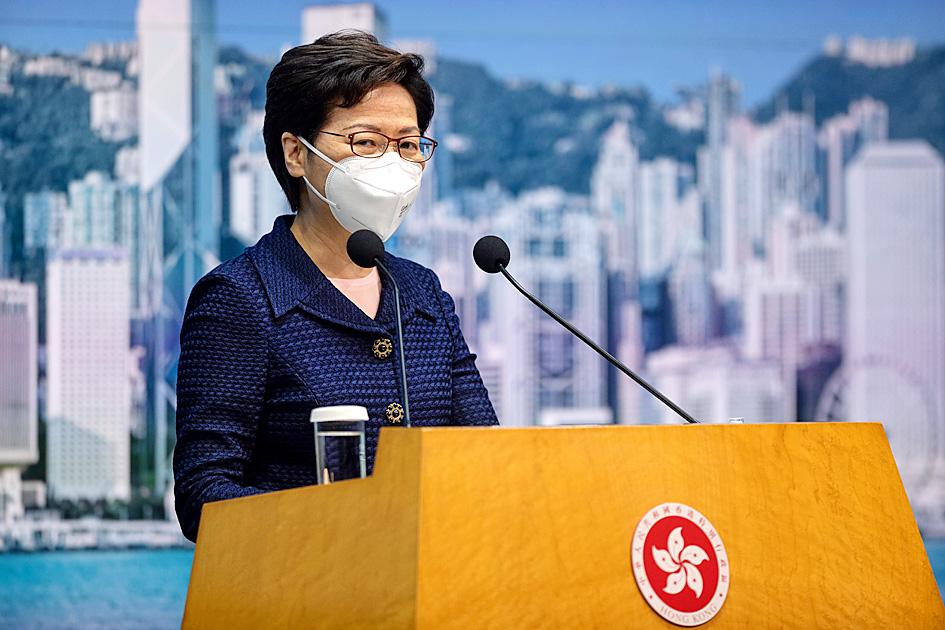
Photo: EPA-EFE
From tomorrow, dining at restaurants is to be extended to midnight, bars will be permitted to open until 2am and mask requirements for indoor exercise will be lifted.
Lam continued to cite reopening the border with mainland China as one of her government’s top priorities, without saying how that would happen.
Shanghai, China’s most-populous city and one of the nation’s major economic engines, is slowly exiting a lockdown that confined 25 million people to their homes for six weeks as Chinese President Xi Jinping (習近平) sticks with the nation’s strict “zero COVID-19” policy.
The trigger for easing in Shanghai was reporting zero infections outside the city’s extensive quarantine program.
That is a far cry from the situation in Hong Kong, where hundreds of new cases are still being reported daily.
Instead, Hong Kong officials are focusing on driving up the territory’s vaccination rate to prevent a spike in serious illness that could overwhelm hospitals.
By the end of this month, all eligible residents will need to have had three vaccine doses to use Hong Kong’s Vaccine Pass, a requirement to enter restaurants and many public places.
The May 31 deadline was moved up from June 30, as local officials push to boost the territory’s vaccination rate. Just over half of Hong Kong’s eligible residents have received their third jab, government data showed.
Hong Kong still lags much of the world in its return to normalcy, with the territory maintaining mandatory seven-day hotel quarantines for vaccinated incoming travelers.
JPMorgan Chase & Co chief executive officer for Asia-Pacific Filippo Gori told Bloomberg TV yesterday in an interview that it was important that Hong Kong “keeps on moving on the relaxation process,” citing border controls as the next measure officials should ease.
“If we could have home quarantine, from a business standpoint, it would make an enormous difference because it would remove a lot of stress,” Gori said.


Through the noise of rushing papers and whirring belts at a print factory in Kyoto, two creators watch their photo essay come to life in broadsheet form — part of an effort to win new audiences in the age of artificial intelligence (AI). Despite the decline of the publishing industry, self-publication and handmade “zine” magazines are growing in popularity in Japan, reflecting the nation’s enduring love of paper in the digital era. While speaking to Agence France-Presse at the plant, his hands black with ink, one of the creators, Kazuma Obara, said: “I think [paper] is a medium that engages all five
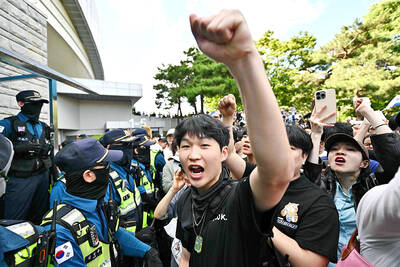
‘ABSURD MISTAKE’: The election commission said that there had been a failure to anticipate turnout after 14 polling stations ran short of ballot papers South Korean riot police yesterday cleared protesters from a Seoul polling station after a 35-hour blockade sparked by a shortage of ballot papers during local elections earlier this week. Wednesday’s election was the first nationwide vote since South Korean President Lee Jae-myung took office following the ouster of Yoon Suk-yeol over his short-lived martial law declaration. Lee’s ruling Democratic Party swept most races, but failed to flip the crucial Seoul mayoral seat. The South Korean National Election Commission apologized, blaming a failure to anticipate turnout after 14 polling stations in Seoul ran short of ballot papers. Some polling stations stayed open until 10pm to

France experienced its hottest spring on record, the French weather service said on Tuesday, after an exceptional early heat wave that also broke highs for the season in England and Wales. Meteo-France said the average nationwide temperature over March to May was 13.8°C — about 1.7°C above the norm, and surpassing records set in 2011 and 2020. “The warmest spring since records began in 1900,” it said in a bulletin. All three months were warmer than average, but the onset of an “unprecedented heatwave” late last month pushed the mercury to highs typically seen at the height of the summer. “Our country had never

A Sherpa guide was found crawling to base camp on Mount Everest a week after he went missing and was reunited with his family, who had given up hope he would return. Dawa Sherpa was last seen on Friday last week descending the mountain, but he did not reach base camp even though his client did. The pair were among the last climbers on the mountain as the climbing season came to an end and the route was dismantled. Dawa was located by a cleaning crew on Thursday morning as he was crawling down the snowy slopes around the Khumbu Icefall, just above


 RSS
RSS