


North Korea yesterday imposed a nationwide lockdown to control its first acknowledged COVID-19 outbreak after saying for more than two years that it had a perfect record keeping out the virus that has spread to nearly every place in the world.
The size of the outbreak was not immediately known, but it could have serious consequences, because the country has a poor healthcare system and its 26 million people are believed to be mostly unvaccinated against COVID-19.
Some experts say that the North, by its admission of an outbreak, might be seeking outside aid.
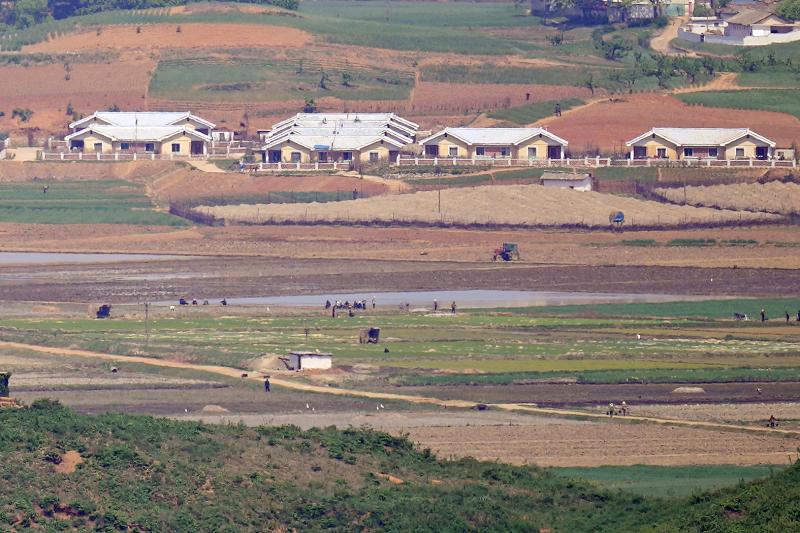
Photo: AP
The North’s Korean Central News Agency (KCNA) said that tests of samples collected on Sunday from an unspecified number of people with fevers in the capital, Pyongyang, confirmed they were infected with the Omicron variant of SARS-CoV-2.
In response, North Korean leader Kim Jong-un during called for a thorough lockdown of cities and counties, and said that workplaces should be isolated by units to block the virus from spreading, KCNA said.
Kim urged health workers to step up disinfection efforts at workplaces and homes, and mobilize reserve medical supplies.
It was crucial to stabilize transmissions and eliminate the infection source as fast as possible, while also easing the inconveniences to the public caused by the virus controls, he said.
The country would surely overcome what he described as an unexpected outbreak, because its government and people are “united as one.”
North Korea, which continues to employ one of the world’s most restrictive border controls, did not provide further details about its lockdown.
A photographer on the South Korean side of the border saw dozens of people working in farm fields or walking on footpaths at a North Korean border town — an indication that the lockdown does not require people to stay home, or it exempts farm work.
The measures described in state media and Kim’s declaration that economic goals should be met possibly indicate that North Korea is not strictly confining people to their homes, and is focusing more on restricting travel and supplies between regions to slow the viral spread, analyst Cheong Seong-chang at South Korea’s Sejong Institute said.
The North’s government has shunned vaccines offered by the UN-backed COVAX distribution program, possibly because those have international monitoring requirements.
The South Korean Ministry of Unification, which handles inter-Korean affairs, said that Seoul is willing to provide medical assistance and other help to the North based on humanitarian considerations.
Relations between the Koreas have deteriorated since 2019 amid a stalemate in nuclear negotiations and the North’s increasingly provocative weapons demonstrations.
Kim Sin-gon, a professor at Seoul’s Korea University College of Medicine, said North Korea likely is signaling its willingness to receive outside vaccines shipments, but wants many more doses than offered by COVAX to inoculate its entire population multiple times.
North Korea would also want COVID-19 medicines as well as medical equipment shipments that are banned by UN sanctions, he said.

Malaysia yesterday installed a motorcycle-riding billionaire sultan as its new king in lavish ceremonies for a post seen as a ballast in times of political crises. The coronation ceremony for Malaysia’s King Sultan Ibrahim, 65, at the National Palace in Kuala Lumpur followed his oath-taking in January as the country’s 17th monarch. Malaysia is a constitutional monarchy, with a unique arrangement that sees the throne change hands every five years between the rulers of nine Malaysian states headed by centuries-old Islamic royalty. While chiefly ceremonial, the position of king has in the past few years played an increasingly important role. Royal intervention was

X-37B COMPARISON: China’s spaceplane is most likely testing technology, much like US’ vehicle, said Victoria Samson, an official at the Secure World Foundation China’s shadowy, uncrewed reusable spacecraft, which launches atop a rocket booster and lands at a secretive military airfield, is most likely testing technology, but could also be used for manipulating or retrieving satellites, experts said. The spacecraft, on its third mission, was last month observed releasing an object, moving several kilometers away and then maneuvering back to within a few hundred meters of it. “It’s obvious that it has a military application, including, for example, closely inspecting objects of the enemy or disabling them, but it also has non-military applications,” said Marco Langbroek, a lecturer in optical space situational awareness at Delft

The Philippine Air Force must ramp up pilot training if it is to buy 20 or more multirole fighter jets as it modernizes and expands joint operations with its navy, a commander said yesterday. A day earlier US National Security Adviser Jake Sullivan said that the US “will do what is necessary” to see that the Philippines is able to resupply a ship on the Second Thomas Shoal (Renai Shoal, 仁愛暗沙) that Manila uses to reinforce its claims to the atoll. Sullivan said the US would prefer that the Philippines conducts the resupplies of the small crew on the warship Sierra Madre,

AIRLINES RECOVERING: Two-thirds of the flights canceled on Saturday due to the faulty CrowdStrike update that hit 8.5 million devices worldwide occurred in the US As the world continues to recover from massive business and travel disruptions caused by a faulty software update from cybersecurity firm CrowdStrike, malicious actors are trying to exploit the situation for their own gain. Government cybersecurity agencies across the globe and CrowdStrike CEO George Kurtz are warning businesses and individuals around the world about new phishing schemes that involve malicious actors posing as CrowdStrike employees or other tech specialists offering to assist those recovering from the outage. “We know that adversaries and bad actors will try to exploit events like this,” Kurtz said in a statement. “I encourage everyone to remain vigilant


 RSS
RSS