


US President Joe Biden on Tuesday accused the Chinese government of trying to interfere in negotiations over a broad China competition bill that would bolster domestic semiconductor manufacturing.
“Fundamentally, this is a national security issue. This is one of the reasons why the Chinese Communist Party is lobbying folks to oppose this bill,” Biden said on Tuesday in Troy, Alabama. “And it’s an issue that unites Democrats and Republicans. So, let’s get it done.”
He spoke during a tour of a Lockheed Martin Corp plant and made the case for passage of the long-stalled legislation by citing the more than 200 semiconductors needed to manufacture a Javelin antitank missile, which has been deployed by Ukrainian forces against Russian invaders.
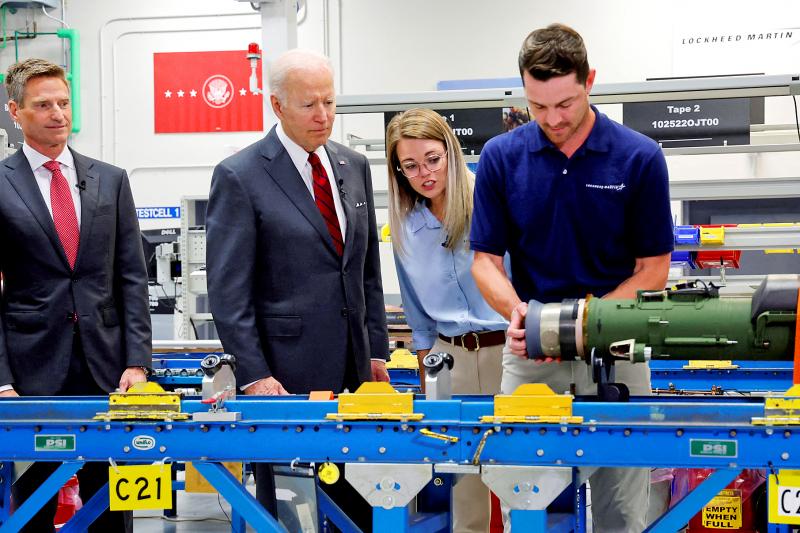
Photo: Reuters
Biden’s comments, made during remarks that centered chiefly on the war in Ukraine, were the most critical yet of the Chinese Communist Party.
The US Senate and House of Representatives could soon begin the formal conference process so the two chambers can reconcile their different versions of the measure, which is intended to strengthen competition with China. However, final passage is still months off.
BIPARTISAN SUPPORT
Members of both parties support the US$52 billion in the legislation for domestic semiconductor manufacturing, but disagree on other provisions.
The Chinese embassy in Washington has been seeking meetings with US administration officials, congressional offices, think tanks and companies to gather information about the status of the bill and what provisions are likely to make it to the president’s desk, people familiar with the meeting requests said.
Administration officials have all declined the requests, as have many of the congressional offices, the people said.
An embassy spokesperson did not respond to a request for comment.
The White House declined to provide more details of the president’s accusation.
Biden often cites past conversations with Chinese President Xi Jinping (習近平) in which he challenged Xi’s view that democracies cannot deliver for their people.
After 15 months in office, the White House has yet to articulate a comprehensive China strategy, including what it will do with respect to economic disputes.
US officials for months have been deliberating about potential tariff reduction, new trade probes and the enforcement of former US president Donald Trump’s phase one trade deal.
Republicans believe the lack of a strategy that distinguishes the Biden team from Trump’s policies presents a vulnerability for Democrats in the November midterm elections.
POLICY OUTLINE
US Secretary of State Antony Blinken is set to outline the administration’s China policy in a speech this morning, but people familiar with the plans said it is not expected to lay out any new initiatives or details on the economic front.
Biden’s team continues to be at odds over what to do with hundreds of billions of US dollars in existing tariffs on Chinese goods, and has diverging views of whether and how hard to scrutinize US investments in China.


Through the noise of rushing papers and whirring belts at a print factory in Kyoto, two creators watch their photo essay come to life in broadsheet form — part of an effort to win new audiences in the age of artificial intelligence (AI). Despite the decline of the publishing industry, self-publication and handmade “zine” magazines are growing in popularity in Japan, reflecting the nation’s enduring love of paper in the digital era. While speaking to Agence France-Presse at the plant, his hands black with ink, one of the creators, Kazuma Obara, said: “I think [paper] is a medium that engages all five
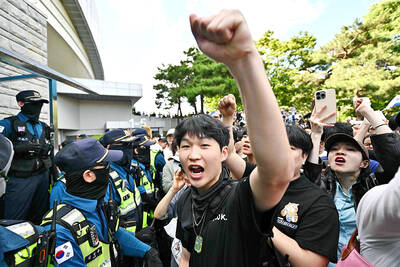
‘ABSURD MISTAKE’: The election commission said that there had been a failure to anticipate turnout after 14 polling stations ran short of ballot papers South Korean riot police yesterday cleared protesters from a Seoul polling station after a 35-hour blockade sparked by a shortage of ballot papers during local elections earlier this week. Wednesday’s election was the first nationwide vote since South Korean President Lee Jae-myung took office following the ouster of Yoon Suk-yeol over his short-lived martial law declaration. Lee’s ruling Democratic Party swept most races, but failed to flip the crucial Seoul mayoral seat. The South Korean National Election Commission apologized, blaming a failure to anticipate turnout after 14 polling stations in Seoul ran short of ballot papers. Some polling stations stayed open until 10pm to

France experienced its hottest spring on record, the French weather service said on Tuesday, after an exceptional early heat wave that also broke highs for the season in England and Wales. Meteo-France said the average nationwide temperature over March to May was 13.8°C — about 1.7°C above the norm, and surpassing records set in 2011 and 2020. “The warmest spring since records began in 1900,” it said in a bulletin. All three months were warmer than average, but the onset of an “unprecedented heatwave” late last month pushed the mercury to highs typically seen at the height of the summer. “Our country had never

A Sherpa guide was found crawling to base camp on Mount Everest a week after he went missing and was reunited with his family, who had given up hope he would return. Dawa Sherpa was last seen on Friday last week descending the mountain, but he did not reach base camp even though his client did. The pair were among the last climbers on the mountain as the climbing season came to an end and the route was dismantled. Dawa was located by a cleaning crew on Thursday morning as he was crawling down the snowy slopes around the Khumbu Icefall, just above


 RSS
RSS