


Ukrainian Minister of Foreign Affairs Dmytro Kuleba has asked China to provide security guarantees for Kyiv, in a lengthy interview containing some of the most direct criticisms of Moscow published by Beijing’s state media.
Western powers and Ukraine have repeatedly urged China to condemn Russia’s invasion as it tries to maintain a supposedly neutral stance, with the US threatening consequences if Beijing provides military or economic support to Moscow.
“Ukraine is studying the possibility of acquiring security guarantees from permanent members of the UN Security Council, including China, and other major powers,” Kuleba was quoted as saying by Xinhua news agency on Saturday.
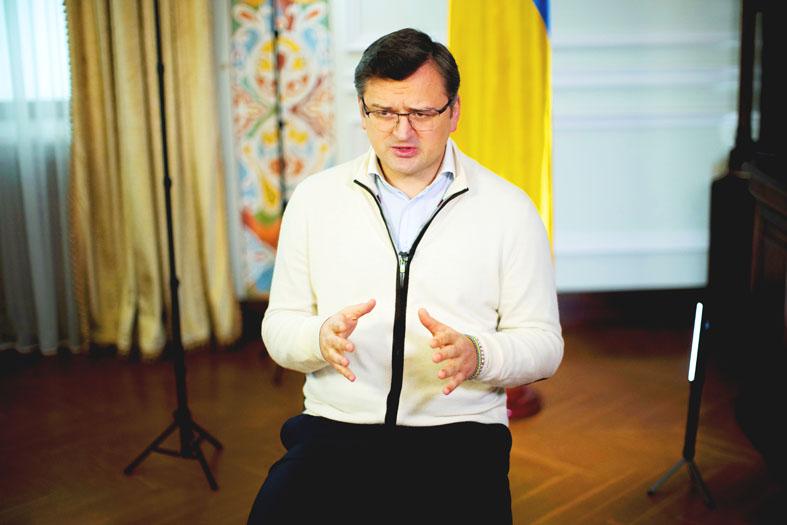
Photo: AP
“We propose that China becomes one of the guarantors of Ukraine’s security, this is a sign of our respect and trust in the People’s Republic of China,” Kuleba added.
China in 2013 pledged to provide Ukraine with “security guarantees” if it was invaded or threatened with nuclear attack, but appeared evasive on the same issue in the wake of Russia’s invasion on Feb. 24.
Asked about the guarantee last month, a Chinese Ministry of Foreign Affairs spokesman suggested that such “security assurances have clear limitations on the content and are triggered under specific conditions,” in reference to a similar UN security resolution on non-nuclear states.
Chinese officials have often blamed NATO for provoking Moscow’s invasion and accused the West of escalating the conflict by sending weapons to Ukraine.
Beijing’s state media has also repeatedly amplified Russian propaganda surrounding the war and largely avoided attributing Ukrainian civilian deaths to Moscow’s military aggression.
Kuleba has only had two calls with Chinese Minister of Foreign Affairs Wang Yi (王毅) since the invasion, while Wang met Russian Minister of Foreign Affairs Sergey Lavrov in China last month and reiterated that cooperation between the two countries has “no limits.”
In the Xinhua interview, Kuleba also accused Russia of having “compromised” Beijing’s Belt and Road Initiative, saying that the consequences of the global food security crisis would threaten China’s economy.
“We also believe that this war is not in China’s interests,” he was quoted as saying.
His remarks directly referred to Russia’s actions as an “invasion” — a term that Chinese officials and state media have sought to avoid.
“The situation is not escalating because of Ukraine. We are exercising our right to defend ourselves,” he said, in an apparent rebuff of Chinese warnings against other states providing arms to Kyiv.
While Chinese President Xi Jinping (習近平) has not yet spoken publicly with Ukrainian President Volodymyr Zelenskiy, he called Russian President Vladimir Putin the day after the invasion.
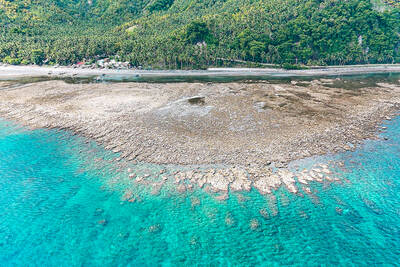
Arsenio Butil Jr fell to his knees and began to pray when last week’s deadly magnitude 7.8 earthquake began shaking his home on the coast of the southern Philippines. When he opened his eyes, he saw a once-familiar shoreline changing in real time, with swathes of previously submerged coral suddenly pushing above the waterline. The June 8 quake, driven by a shifting of the nearby Cotabato Trench, toppled buildings, triggered landslides and killed at least 76 people on the southern island of Mindanao. The tectonic forces at work also thrust chunks of the island’s coastline upward in a phenomenon known as “coastal uplift,”
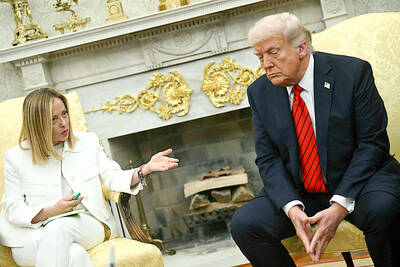
NATO ALLIES: The Italian PM accused Trump of ‘constant, unprovoked ... senseless’ attacks and said ‘my popularity is none of your concern. I suggest you focus on yours’ Italian Prime Minister Giorgia Meloni on Saturday fired back at US President Donald Trump, saying his “constant, unprovoked attacks are senseless” after he escalated a diplomatic row by accusing her of repeatedly seeking a photograph with him. The clash has opened an unusually personal rift between Trump and one of Europe’s most prominent right-wing leaders, who had sought to cast herself as a bridge between Washington and the continent during Trump’s return to power. Trump had initially told Italian broadcaster La7 that Meloni “begged” him for a picture at last week’s G7 summit in France, saying he agreed only because
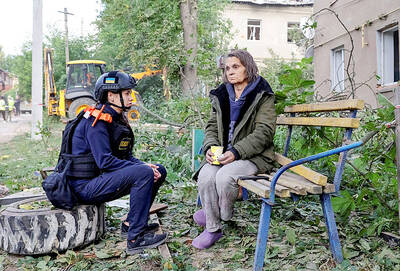
President Volodymyr Zelenskiy on Saturday said that Russian forces were preparing an impending massive attack on Ukraine and warned residents to take special care as Russian strikes in different regions killed at least six people. “Tonight and in the coming hours, it is especially important to pay close attention to air raid warnings,” Zelenskiy said in his nightly video address. “The Russians have prepared for a massive attack. Please take care of yourselves.” Russian forces have staged a series of heavy attacks on Kyiv in the past few weeks and in other major cities. Strikes on Monday last week killed
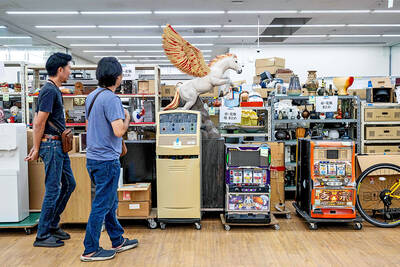
YUCK OR YUM? While it is difficult to sell second-hand goods that are more than seven years old in Japan, they are still popular in foreign markets, an executive said Under a scorching sun in a Bangkok suburb, a whistle blew, and shouts filled the air as dozens of shoppers rushed into a warehouse bearing the sign “Japanese Second-Hand Store.” From bags and bicycles to surfboards and suitcases, the Japanese second-hand market is booming, with quality-conscious buyers in other Asian countries increasingly tapping into the circular economy trend. “What is considered garbage for them can still be useful in Thailand,” said 36-year-old Lookpoo Sathitpanyapon, who runs an online store selling toy keychains. “That bag, that bag,” one shopper shouted while racing through the warehouse, filled with everything from colorful toys


 RSS
RSS