


Shanghai yesterday tightened the first phase of a two-stage COVID-19 lockdown, asking some residents to stay indoors unless they are getting tested as the number of new daily cases exceeded 4,400.
The financial hub, home to 26 million people, is in its second day of a lockdown authorities have imposed by dividing the city roughly along the Huangpu River, splitting the historic center from the eastern financial and industrial district of Pudong to allow for staggered testing.
While Shanghai’s caseload remains modest by global standards — a record 4,381 asymptomatic cases and 96 symptomatic cases for Monday — the city has become a testing ground for China’s “zero COVID” strategy as it tries to bring the Omicron variant of SARS-CoV-2 under control.

Photo: AFP
Residents east of the Huangpu were locked down in their housing compounds on Monday.
Three residents yesterday told reporters that neighborhood committees had told them they were no longer allowed to step outside their homes.
“Children were still having picnics yesterday and having fun,” said one of them, who declined to be identified, citing privacy concerns.
Wu Qianyu, an official with the municipal health commission, told a briefing that a “clear request” had been made to residents not to leave their apartments, even to take pets for a walk or throw out trash, during “a key stage in nucleic acid testing.”
Wu said that 8.26 million tests were performed by as many as 17,000 testing personnel in the city’s locked-down districts on Monday.
“The vast numbers of medical staff, grass-roots cadres, community workers and volunteers shared the very hard work on the front line of epidemic prevention and control, and should be thanked,” she said.
There were signs of frustration on China’s social media, with dozens of residents seeking help for relatives, with some struggling to access medical services.
Although China is sticking to its “zero COVID” plan, experts elsewhere remain sceptical about the efficacy of lockdowns.
“It is clear from Australia and elsewhere in the world that lockdowns are simply not effective against Omicron — so expect a big wave coming,” said Adrian Esterman, an expert in biostatistics at the University of South Australia.
Drone footage published by state media showed empty streets below the skyscrapers of the city’s Lujiazui District.
Public transport in the east has been shut and all unapproved vehicles ordered off the streets.
Residents in the west of the city have been stocking up at shops and markets in anticipation of their lockdown from Friday.
The city government rolled out new measures to try to support businesses affected by the restrictions, including rent exemptions and tax rebates.
The Global Times quoted Peking University economist Cao Heping (曹和平) as saying that while the city’s growth would be hit, the national economy would not suffer greatly.

VAGUE: The criteria of the amnesty remain unclear, but it would cover political violence from 1999 to today, and those convicted of murder or drug trafficking would not qualify Venezuelan Acting President Delcy Rodriguez on Friday announced an amnesty bill that could lead to the release of hundreds of prisoners, including opposition leaders, journalists and human rights activists detained for political reasons. The measure had long been sought by the US-backed opposition. It is the latest concession Rodriguez has made since taking the reins of the country on Jan. 3 after the brazen seizure of then-Venezuelan president Nicolas Maduro. Rodriguez told a gathering of justices, magistrates, ministers, military brass and other government leaders that the ruling party-controlled Venezuelan National Assembly would take up the bill with urgency. Rodriguez also announced the shutdown
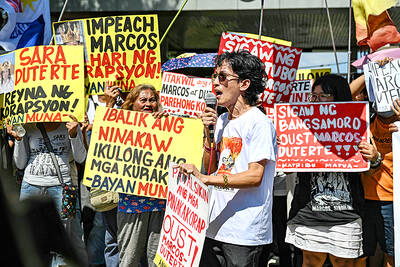
Civil society leaders and members of a left-wing coalition yesterday filed impeachment complaints against Philippine Vice President Sara Duterte, restarting a process sidelined by the Supreme Court last year. Both cases accuse Duterte of misusing public funds during her term as education secretary, while one revives allegations that she threatened to assassinate former ally Philippine President Ferdinand Marcos Jr. The filings come on the same day that a committee in the House of Representatives was to begin hearings into impeachment complaints against Marcos, accused of corruption tied to a spiraling scandal over bogus flood control projects. Under the constitution, an impeachment by the
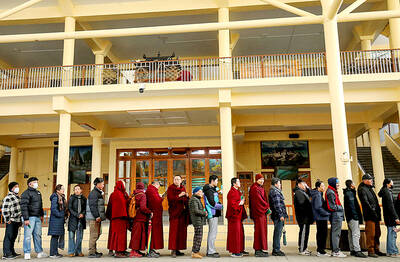
Exiled Tibetans began a unique global election yesterday for a government representing a homeland many have never seen, as part of a democratic exercise voters say carries great weight. From red-robed Buddhist monks in the snowy Himalayas, to political exiles in megacities across South Asia, to refugees in Australia, Europe and North America, voting takes place in 27 countries — but not China. “Elections ... show that the struggle for Tibet’s freedom and independence continues from generation to generation,” said candidate Gyaltsen Chokye, 33, who is based in the Indian hill-town of Dharamsala, headquarters of the government-in-exile, the Central Tibetan Administration (CTA). It
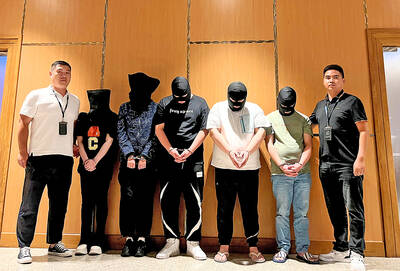
China executed 11 people linked to Myanmar criminal gangs, including “key members” of telecom scam operations, state media reported yesterday, as Beijing toughens its response to the sprawling, transnational industry. Fraud compounds where scammers lure Internet users into fake romantic relationships and cryptocurrency investments have flourished across Southeast Asia, including in Myanmar. Initially largely targeting Chinese speakers, the criminal groups behind the compounds have expanded operations into multiple languages to steal from victims around the world. Those conducting the scams are sometimes willing con artists, and other times trafficked foreign nationals forced to work. In the past few years, Beijing has stepped up cooperation


 RSS
RSS