


A woman burned alive by her husband, others shot dead by a father or a teenage brother — bloody violence against women has spiked in northern Iraq’s Kurdish region.
The autonomous area, keen on projecting an image of a relative haven of stability and tolerance in war-battered Iraq, has seen a sharp rise in femicide, killings motivated by gender.
“In the past two months, there has been an increase in femicide compared to the previous year,” said Hiwa Karim Jwamir of the Kurdish General Directorate for Combating Violence Against Women.
In the first two months of this year, 11 women were killed in autonomous Iraqi Kurdistan, most of them shot, said the official based in Sulaimaniyah.
Forty-five women were killed last year, up from 25 the previous year, Jwamir said.
On a Friday before dawn, a 15-year-old teenager was fatally wounded by six bullets fired by her father in the village of Soran.
The man told police that his daughter “went out with two boys late at night,” said a domestic violence unit that also records so-called “honor killings.”
Across Iraq, gender-based violence rose 125 percent to more than 22,000 cases between 2020 and last year, the UN Children’s Fund has said.
“Cases of violence against women are on the rise,” said Kurdistan activist Bahar Munzir, director of local group the People’s Development Organisation. “Most of the women who are killed are victims of a family member.”
A few days before International Women’s Day on March 8, the body of a 20-year-old woman was found on the side of the road in Erbil, the capital of Kurdistan.
Maria Sami, the victim, was known on social networks for her feminist speeches.
The following day, on March 9, Kirkuk police announced the arrest of the killer, her 18-year-old brother.
While he was still on the run, he spoke by telephone to a Kurdish television channel and tried to justify the killing by saying that his sister had failed to obey the family.
Late last month, mother-of-two Shinyar Huner Rafiq died in hospital, five days after being admitted with serious burns.
“Her husband had come home one evening in a state of intoxication,” her father, Huner Rafiq, said. “He doused her body in gasoline and set it on fire.”
Police arrested her husband.
“Before dying, Shinyar told us the facts,” her father said. “We recorded it, and we submitted the video to the investigators.”
Kurdish Prime Minister Masrour Barzani denounced the “horrific case,” saying that he was “deeply troubled” by the spate of violent attacks against women.
The government must impose “the heaviest possible penalty on perpetrators,” he said in a statement. “There is no honor in honor killings.
“I’m determined to protect every woman, girl and child from abuse... This scourge must end,” he added.
In June 2011, Kurdistan passed a law criminalizing domestic violence and female genital mutilation.
The law, which threatens life in prison for “honor” crimes, was hailed by non-governmental groups as a major step forward.
However, the law’s enforcement is hampered by a climate of impunity and a common fear of speaking out.
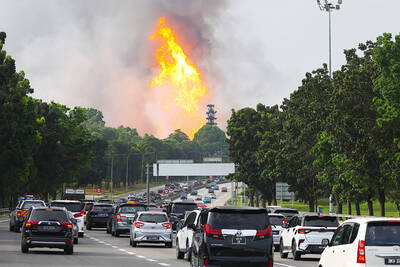
A fire caused by a burst gas pipe yesterday spread to several homes and sent a fireball soaring into the sky outside Malaysia’s largest city, injuring more than 100 people. The towering inferno near a gas station in Putra Heights outside Kuala Lumpur was visible for kilometers and lasted for several hours. It happened during a public holiday as Muslims, who are the majority in Malaysia, celebrate the second day of Eid al-Fitr. National oil company Petronas said the fire started at one of its gas pipelines at 8:10am and the affected pipeline was later isolated. Disaster management officials said shutting the
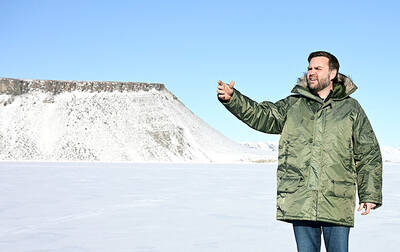
US Vice President J.D. Vance on Friday accused Denmark of not having done enough to protect Greenland, when he visited the strategically placed and resource-rich Danish territory coveted by US President Donald Trump. Vance made his comment during a trip to the Pituffik Space Base in northwestern Greenland, a visit viewed by Copenhagen and Nuuk as a provocation. “Our message to Denmark is very simple: You have not done a good job by the people of Greenland,” Vance told a news conference. “You have under-invested in the people of Greenland, and you have under-invested in the security architecture of this

Japan unveiled a plan on Thursday to evacuate around 120,000 residents and tourists from its southern islets near Taiwan within six days in the event of an “emergency”. The plan was put together as “the security situation surrounding our nation grows severe” and with an “emergency” in mind, the government’s crisis management office said. Exactly what that emergency might be was left unspecified in the plan but it envisages the evacuation of around 120,000 people in five Japanese islets close to Taiwan. China claims Taiwan as part of its territory and has stepped up military pressure in recent years, including

UNREST: The authorities in Turkey arrested 13 Turkish journalists in five days, deported a BBC correspondent and on Thursday arrested a reporter from Sweden Waving flags and chanting slogans, many hundreds of thousands of anti-government demonstrators on Saturday rallied in Istanbul, Turkey, in defence of democracy after the arrest of Istanbul Mayor Ekrem Imamoglu which sparked Turkey’s worst street unrest in more than a decade. Under a cloudless blue sky, vast crowds gathered in Maltepe on the Asian side of Turkey’s biggest city on the eve of the Eid al-Fitr celebration which started yesterday, marking the end of Ramadan. Ozgur Ozel, chairman of the main opposition Republican People’s Party (CHP), which organized the rally, said there were 2.2 million people in the crowd, but


 RSS
RSS