


Senior Chinese officials early last month told senior Russian officials not to invade Ukraine before the end of the Winter Olympics, the New York Times reported, quoting White House officials and a European official who cited a Western intelligence report.
The Times said that the intelligence report indicated that senior Chinese officials had some level of knowledge about Russia’s plans or intentions to invade Ukraine before Russian President Vladimir Putin launched the operation last week.
A source familiar with the matter confirmed that China had made the request, but declined to provide details. The source declined to be identified due to the sensitivity of the matter.
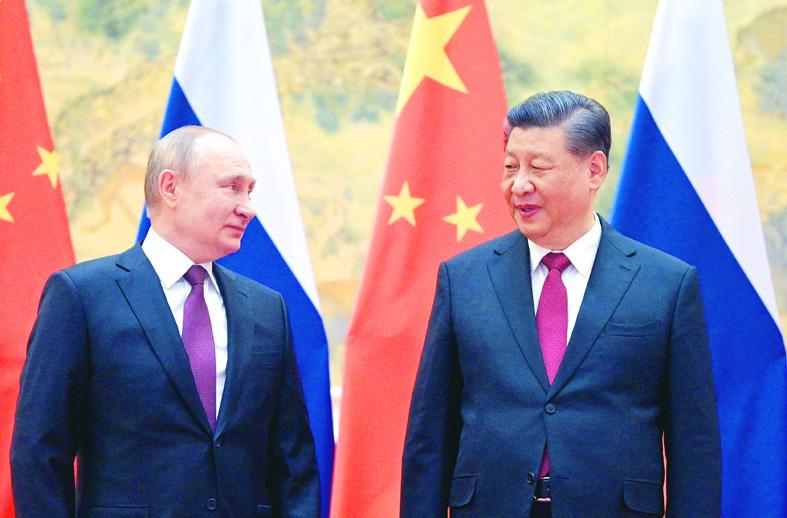
Photo: AFP
“The claims mentioned in the relevant reports are speculations without any basis, and are intended to blame-shift and smear China,” said Liu Pengyu (劉鵬宇), a spokesman for the Chinese embassy in Washington.
The US Department of State, the CIA and the White House National Security Council did not immediately respond to requests for comment.
After weeks of warnings from Western leaders, Russia unleashed a three-pronged invasion of Ukraine from the north, east and south on Thursday last week, just days after the Beijing Winter Olympics ended.
Putin and Chinese President Xi Jinping (習近平) met at the start of the Olympics on Feb. 4 and declared an upgraded “no limits” partnership in which they pledged to collaborate more against the West.
The New York Times said that the intelligence on the exchange between the Chinese and Russian officials was collected by a Western intelligence service and was considered credible by officials reviewing it.
US officials have confirmed previous Times reporting that Washington passed on to senior Chinese officials intelligence on the Russian troop buildup around Ukraine ahead of the invasion in the hope that Beijing would persuade Moscow to stand down its troops.
The newspaper said that senior officials in the US and in allied governments passed around the intelligence as they discussed when Putin might attack Ukraine, but intelligence services had varying interpretations, adding that it was not clear how widely the information was shared.
One official that the Times said was familiar with the intelligence said the material did not necessarily indicate the conversations about an invasion took place at the level of Xi and Putin.
Bonny Lin, a China expert at the Center for Strategic and International Studies think tank, said it was unclear how much Xi knew about Putin’s intentions.
She added that China had been slow to evacuate citizens from Ukraine, which suggested it was not fully prepared.
“Given the evidence we have so far, I think we can’t rule out either possibility definitely — that Xi didn’t know and that Xi may have known,” she said.


Through the noise of rushing papers and whirring belts at a print factory in Kyoto, two creators watch their photo essay come to life in broadsheet form — part of an effort to win new audiences in the age of artificial intelligence (AI). Despite the decline of the publishing industry, self-publication and handmade “zine” magazines are growing in popularity in Japan, reflecting the nation’s enduring love of paper in the digital era. While speaking to Agence France-Presse at the plant, his hands black with ink, one of the creators, Kazuma Obara, said: “I think [paper] is a medium that engages all five
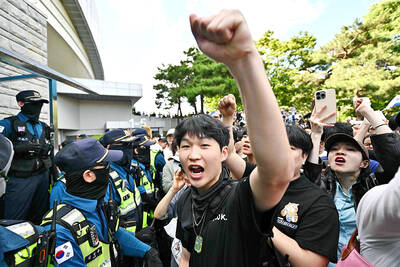
‘ABSURD MISTAKE’: The election commission said that there had been a failure to anticipate turnout after 14 polling stations ran short of ballot papers South Korean riot police yesterday cleared protesters from a Seoul polling station after a 35-hour blockade sparked by a shortage of ballot papers during local elections earlier this week. Wednesday’s election was the first nationwide vote since South Korean President Lee Jae-myung took office following the ouster of Yoon Suk-yeol over his short-lived martial law declaration. Lee’s ruling Democratic Party swept most races, but failed to flip the crucial Seoul mayoral seat. The South Korean National Election Commission apologized, blaming a failure to anticipate turnout after 14 polling stations in Seoul ran short of ballot papers. Some polling stations stayed open until 10pm to

France experienced its hottest spring on record, the French weather service said on Tuesday, after an exceptional early heat wave that also broke highs for the season in England and Wales. Meteo-France said the average nationwide temperature over March to May was 13.8°C — about 1.7°C above the norm, and surpassing records set in 2011 and 2020. “The warmest spring since records began in 1900,” it said in a bulletin. All three months were warmer than average, but the onset of an “unprecedented heatwave” late last month pushed the mercury to highs typically seen at the height of the summer. “Our country had never

A Sherpa guide was found crawling to base camp on Mount Everest a week after he went missing and was reunited with his family, who had given up hope he would return. Dawa Sherpa was last seen on Friday last week descending the mountain, but he did not reach base camp even though his client did. The pair were among the last climbers on the mountain as the climbing season came to an end and the route was dismantled. Dawa was located by a cleaning crew on Thursday morning as he was crawling down the snowy slopes around the Khumbu Icefall, just above


 RSS
RSS