


The video shows a ghostly scene. A nighttime battle is taking place in a forest. There are flashes and mysterious bangs. An unidentified figure cries out in pain. The wounded man is wearing a helmet. Otherwise there are few clues as to where the footage was shot, or what exactly is going on.
A TV report by Russia’s state-run channel gave the answer. The man seen in eerie silhouette was a Ukrainian saboteur, it said.
He was part of a diversionary team sent across enemy lines into pro-Russian separatist territory. His mission? To blow up a local chlorine plant in the rebel-held town of Horlivka, the channel said.
During the firefight two infiltrators were killed, it added. By happy coincidence, representatives of the Donetsk People’s Republic — one of two pro-Moscow entities in the east of Ukraine — retrieved the video from the wounded man’s head camera. He had chucked it away, the channel told its viewers.
There was only one problem with the Kremlin’s dramatic account of the incident. It was entirely fake.
The soundtrack of shooting and explosions was actually more than a decade old. It had been recorded in April 2010, according to open source researchers, during a Finnish military exercise.
Ukraine’s intelligence service believes the video is the work of the GRU, Russia’s military spy agency, which has worked actively in Ukraine since the 2014 annexation of Crimea and the shooting down of Malaysia Airlines Flight MH17. The film’s creators appear to have lifted the original Finnish video from the Internet.
They spliced its soundtrack on to new video content made two weeks ago — editing out a few excited “ooohs” from Finnish recruits.
“Russia has a long record of doing this. It isn’t surprising,” said Elliot Higgins, founder of the investigative Web site Bellingcat. “What’s surprising is they haven’t got any better at doing it. In some ways they have got worse. It’s really dumb and lazy.”
Higgins said international audiences were mostly impervious to Kremlin disinformation, but he said domestic Russian viewers tended to believe fake TV footage, which was “theatrically” created for state propaganda purposes.
This is especially true of the older generation, he said.
Russian TV has begun actively promoting information which suggests a vast humanitarian crisis is unfolding in eastern Ukraine. It has claimed residents have come under heavy Ukrainian shelling — something Kyiv says is not true.
The information has ranged from reports on increased bombardment to more outlandish “provocations,” such as attempted car bombing on Friday last week outside the separatist administration building in Donetsk.
The same day, the territory’s pro-Moscow leader, Denis Pushilin, released a video saying the situation had become so grave civilians had to be bussed out to safety.
Pushilin’s evacuation order was released on Friday last week, but Bellingcat discovered from the video’s metadata on Telegram that it had actually been filmed two days earlier.
“It’s incompetence,” Higgins said.
At the time the situation across the line of control between the Ukrainian military and the separatists was calm.
The video editing technology might be new, but the message is an old one.
Finnish media have pointed out that the Soviet Union in November 1939 used a similar excuse to start the winter war against Finland.
The day before the Soviet invasion Moscow claimed that Finnish troops had launched “an attack.”
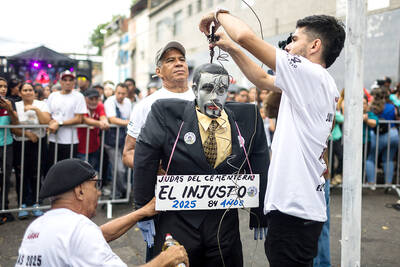
POLITICAL PRISONERS VS DEPORTEES: Venezuela’s prosecutor’s office slammed the call by El Salvador’s leader, accusing him of crimes against humanity Salvadoran President Nayib Bukele on Sunday proposed carrying out a prisoner swap with Venezuela, suggesting he would exchange Venezuelan deportees from the US his government has kept imprisoned for what he called “political prisoners” in Venezuela. In a post on X, directed at Venezuelan President Nicolas Maduro, Bukele listed off a number of family members of high-level opposition figures in Venezuela, journalists and activists detained during the South American government’s electoral crackdown last year. “The only reason they are imprisoned is for having opposed you and your electoral fraud,” he wrote to Maduro. “However, I want to propose a humanitarian agreement that

ECONOMIC WORRIES: The ruling PAP faces voters amid concerns that the city-state faces the possibility of a recession and job losses amid Washington’s tariffs Singapore yesterday finalized contestants for its general election on Saturday next week, with the ruling People’s Action Party (PAP) fielding 32 new candidates in the biggest refresh of the party that has ruled the city-state since independence in 1965. The move follows a pledge by Singaporean Prime Minister Lawrence Wong (黃循財), who took office last year and assumed the PAP leadership, to “bring in new blood, new ideas and new energy” to steer the country of 6 million people. His latest shake-up beats that of predecessors Lee Hsien Loong (李顯龍) and Goh Chok Tong (吳作棟), who replaced 24 and 11 politicians respectively

Young women standing idly around a park in Tokyo’s west suggest that a giant statue of Godzilla is not the only attraction for a record number of foreign tourists. Their faces lit by the cold glow of their phones, the women lining Okubo Park are evidence that sex tourism has developed as a dark flipside to the bustling Kabukicho nightlife district. Increasing numbers of foreign men are flocking to the area after seeing videos on social media. One of the women said that the area near Kabukicho, where Godzilla rumbles and belches smoke atop a cinema, has become a “real

‘WATER WARFARE’: A Pakistani official called India’s suspension of a 65-year-old treaty on the sharing of waters from the Indus River ‘a cowardly, illegal move’ Pakistan yesterday canceled visas for Indian nationals, closed its airspace for all Indian-owned or operated airlines, and suspended all trade with India, including to and from any third country. The retaliatory measures follow India’s decision to suspend visas for Pakistani nationals in the aftermath of a deadly attack by shooters in Kashmir that killed 26 people, mostly tourists. The rare attack on civilians shocked and outraged India and prompted calls for action against their country’s archenemy, Pakistan. New Delhi did not publicly produce evidence connecting the attack to its neighbor, but said it had “cross-border” links to Pakistan. Pakistan denied any connection to


 RSS
RSS