


Two former Iranian prisoners have opened a successful “jail restaurant” to help raise funds to free convicts languishing behind bars for unpaid debts.
A storefront picture of their Cell 16 diner in eastern Tehran shows a frustrated prisoner holding a chicken leg in one hand and trying with the other to bend the bars of his cell to escape.
The idea of the restaurant was hatched in prison.
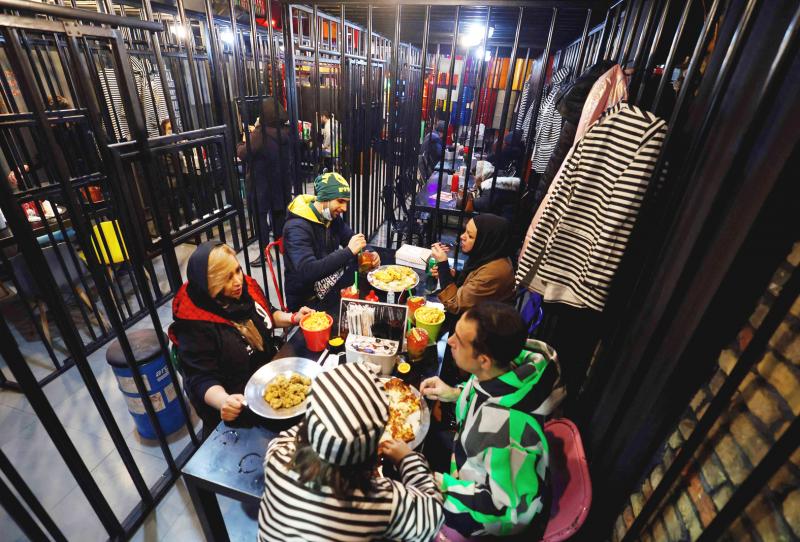
Photo: AFP
“I met my partner while we were in police custody,” 31-year-old Benyamin Nakhat said. “I was working at the iron market in Tehran, but I went bankrupt. I found myself penniless.”
His business partner, Arman Alizadeh, a 30-year-old exporter, was also drowning in debt.
Iranian law is harsh on writing checks that bounce, and on the failure to pay agreed dowries or bank loans: Offenders are jailed until the money is repaid.
More than 11,000 Iranians are behind bars for failing to pay their debts, prison officials said.
That is almost five percent of Iran’s total prison population.
Two years after their release, the jail-time friends opened Cell 16, with its dining tables in separate prison cells.
“Decorating the place was easy, we just reproduced the place where we’d been held,” Nakhat said, smiling. “We wanted to show that prison isn’t necessarily a place filled with bad guys.”
“Inmates are sometimes people who haven’t committed crimes, but have had misfortune. It can happen to anyone,” he added.
With the help of social media, the business has been a success, having first opened in 2016 with just seven “cell” tables. It has expanded to two more eateries, in Tehran and the central city of Isfahan.
However, the owners have not forgotten their comrades in trouble.
“We want to help inmates by raising funds,” Alizadeh said. “We help indebted prisoners by sometimes launching campaigns for help from donors or clients.”
“We post the requests on our Instagram page and everyone contributes in their own way. Parts of the restaurant’s proceeds will also be used to help free prisoners,” Alizadeh added.
“It’s often the wives of prisoners who seek help. We choose those who seem to us to have priority: For example, a married person with children, or sick persons unable to work to repay a loan,” he said.
Several associations and celebrities are involved in such charities.
The Islamic Republic News Agency last year reported that US$130 million had been donated to repay the debts of thousands of prisoners.
Cell 16 also employs newly released prisoners.
Accompanied by her two friends, diner Hasti Berjissian, 24, a purchasing manager in a factory, likes the concept.
“We’ve been coming here since it opened,” she said, taking a bite of pizza. “The food is good, but above all, we want to help the prisoners.”
In another cell, Shiva Shemshaki, 33, celebrated her husband’s birthday.
“I come because a friend of ours has been in prison for nine months for unpaid debts. He had bought some goods but, because of inflation, he was ruined,” she said.
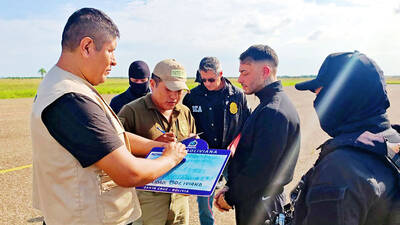
KINGPIN: Marset allegedly laundered the proceeds of his drug enterprise by purchasing and sponsoring professional soccer teams and even put himself in the starting lineups Notorious Latin American narco trafficker Sebastian Marset, who eluded police for years, was handed over to US authorities after his arrest on Friday in Bolivia. Marset, a Uruguayan national who was on the US most-wanted list, was passed to agents of the US Drug Enforcement Administration at Santa Cruz airport in Bolivia, then put on a US airplane, Bolivian state television showed. “The arrest and deportation were carried out pursuant to a court order issued by the US justice system,” Bolivian Minister of Government Marco Antonio Oviedo told reporters. The alleged kingpin was arrested in an upscale neighborhood of Santa
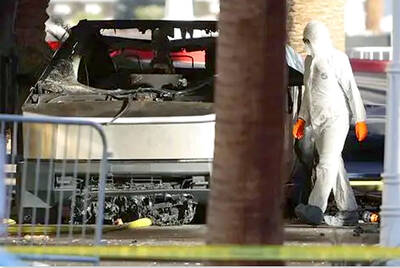
ACTIONABLE ADVICE: The majority of chatbots tested provided guidance on weapons, tactics and target selections, with Perplexity and Meta AI deemed to be the least safe From school shootings to synagogue bombings, leading artificial intelligence (AI) chatbots helped researchers plot violent attacks, according to a study published on Wednesday that highlighted the technology’s potential for real-world harm. Researchers from the nonprofit watchdog Center for Countering Digital Hate and CNN posed as 13-year-old boys in the US and Ireland to test 10 chatbots, including ChatGPT, Google Gemini, Perplexity, Deepseek and Meta AI. Eight of the chatbots assisted the make-believe attackers in more than half the responses, providing advice on “locations to target” and “weapons to use” in an attack, the study said. The chatbots had become a “powerful accelerant for
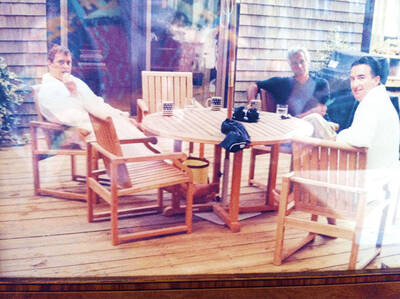
SCANDAL: Other images discovered earlier show Andrew bent over a female and lying across the laps of a number of women, while Mandelson is pictured in his underpants A photograph of former British prince Andrew and veteran politician Peter Mandelson sitting in bathrobes alongside late sex offender Jeffrey Epstein was unearthed on Friday in previously published documents. The image is believed to be the first known photograph of the two men with Epstein. They are currently engulfed in scandal in the UK over their ties to their mutual friend. The undated photograph, first reported by ITV News, shows King Charles III’s disgraced brother and former British ambassador to the US sitting barefoot outside on a wooden deck. They appear to have mugs with a US flag on them
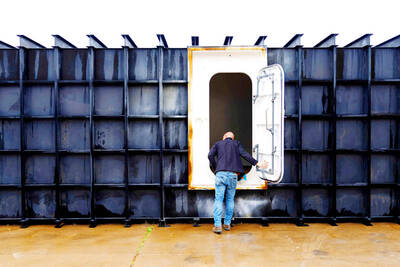
Since the war in the Middle East began nearly two weeks ago, the telephone at Ron Hubbard’s bomb shelter company in Texas has not stopped ringing. Foreign and US clients are rushing to buy his bunkers, seeking refuge in case of air raids, nuclear fallout or apocalypse. With the US and Israel pounding Iran, and Tehran retaliating with strikes across the region, Hubbard has seen demand for his product soar, mostly from Gulf nation customers in Bahrain, Qatar, Kuwait and the United Arab Emirates. “You can imagine how many people are thinking: ‘I wish I had a bomb shelter,’” Hubbard, 63, said in


 RSS
RSS