


A team of scientists are sailing to “the place in the world that’s the hardest to get to,” so they can better figure out how much and how fast seas would rise because of global warming eating away at Antarctica’s ice.
Thirty-two scientists yesterday were to start a more than two-month mission aboard a US research ship to investigate the crucial area where the massive, but melting, Thwaites glacier faces the Amundsen Sea and might eventually lose large amounts of ice because of warm water.
The Florida-sized glacier has been given the nickname the “doomsday glacier” because of how much ice it has and how much seas could rise if it all melts — more than 65cm over hundreds of years.
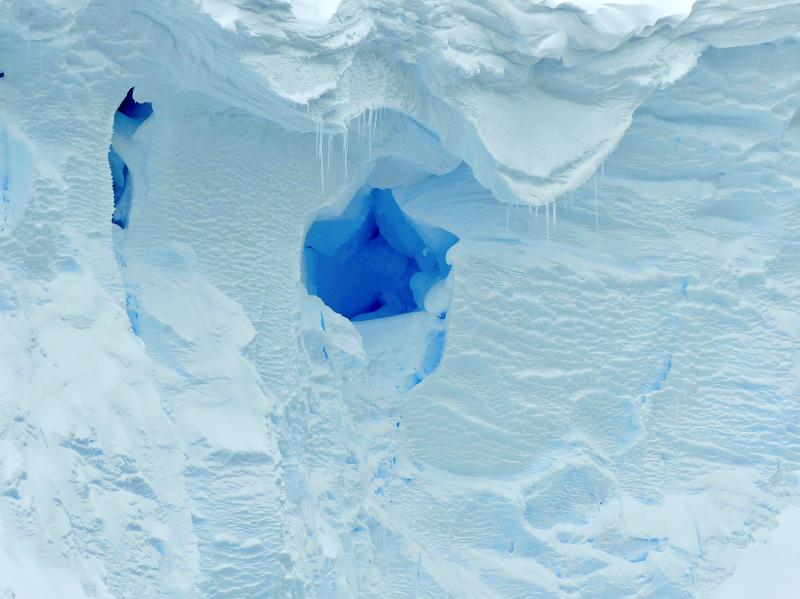
Photo: AP
Because of its importance, the UK and the US are conducting a US$50 million mission to study Thwaites, the widest glacier in the world by land and sea.
Not near any of the continent’s research stations, Thwaites is on Antarctica’s western half, east of the jutting Antarctic Peninsula, which used to be the area scientists worried most about.
“Thwaites is the main reason I would say that we have so large an uncertainty in the projections of future sea level rise and that is because it’s a very remote area, difficult to reach,” Anna Wahlin, an oceanographer from the University of Gothenburg in Sweden, said on Wednesday aboard the RV Nathaniel B. Palmer, which was to leave its port in Chile hours later. “It is configured in a way so that it’s potentially unstable, and that is why we are worried about this.”
Thwaites is putting about 45 billion tonnes of ice into the water a year.
The British Antarctic Survey says the glacier is responsible for 4 percent of global sea rise, and the conditions leading it to lose more ice are accelerating, University of Colorado ice scientist Ted Scambos said from McMurdo station last month.
Oregon State University ice scientist Erin Pettit said that Thwaites appears to be collapsing in three ways: melting from below by ocean water; the land part of the glacier “is losing its grip” to the place it attaches to the seabed, so a large chunk can come off into the ocean and later melt; and the glacier’s ice shelf is breaking into hundreds of fractures like a damaged vehicle windshield.
The fractures are what Pettit said she fears would be the most troublesome with 10km long cracks forming in just a year.
No one has stepped foot on the key ice-water interface at Thwaites. In 2019, Wahlin was on a team that explored the area from a ship using a robotic ship, but never went ashore.
Wahlin’s team is to use two robot ships — her own large one called Ran which she used in 2019 and the more agile Boaty McBoatface, the crowdsource named drone that could go further under the area of Thwaites that protrudes over the ocean — to get under Thwaites.
The ship-bound scientists are to measure water temperature, the sea floor and ice thickness. They are to look at cracks in the ice, how the ice is structured and tag seals on islands off the glacier.
Thwaites “looks different from other ice shelves,” Wahlin said. “It almost looks like a jumble of icebergs that have been pressed together. So it’s increasingly clear that this is not a solid piece of ice like the other ice shelves are, nice smooth solid ice. This was much more jagged and scarred.”

The Bolivian government on Friday struck a deal with protesting miners, but was still grappling with blockades and demonstrations by other workers across La Paz. Other groups are still blocking access roads into the city, which is also the seat of the government. Police on Thursday prevented the miners from entering the main square by using tear gas, while the demonstrators hurled stones and explosives with slingshots. Protests against the policies of Bolivian President Rodrigo Paz have convulsed the Andean nation since early this month, and roadblocks were choking routes into La Paz throughout Friday, the national road authority said. Miners demanded that Paz

The Philippines said it has asked the country’s Supreme Court to allow it to arrest former Philippine president Rodrigo Duterte’s chief drug war enforcer to stand trial in an international tribunal. The International Criminal Court (ICC) last week unsealed an arrest warrant against Philippine Senator Ronald dela Rosa, accusing him along with Duterte and other “coperpetrators” of the “crime against humanity of murder.” Dela Rosa briefly sought refuge in the Philippine Senate last week while asking the Philippine Supreme Court to stop an ongoing attempt by government agents to arrest him. “By his own conduct, he has placed himself outside the protection of
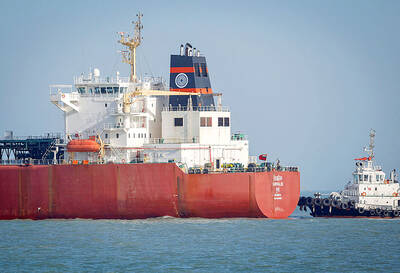
A ship anchored off the United Arab Emirates (UAE) was seized and taken toward Iran and another — a cargo ship near Oman — sank after being attacked, authorities said on Thursday, as tensions escalated near the Strait of Hormuz. It was not immediately clear who was behind these incidents, but they happened as a senior Iranian official reiterated his country’s claim of control over the waterway and another said it had a right to seize oil tankers connected to the US. The turmoil in the strait has been a sticking point for weeks in talks between the US and Iran to

The researchers in Ireland looked at their computer screen, marveling at a medieval book tracked down in a Roman library. They flipped through its digitized pages and found their sought-after treasure: the oldest surviving English poem. “We were extremely surprised. We were speechless. We couldn’t believe our eyes when we first saw that,” said Elisabetta Magnanti, a visiting research fellow at Trinity College Dublin’s school of English. The poem was also within the main body of Latin text, she said, calling it “extraordinary.” Composed in Old English by a Northumbrian agricultural worker in the 7th century, Caedmon’s Hymn appears within some copies of


 RSS
RSS