


A US federal appeals court on Thursday rejected former US president Donald Trump’s bid to prevent the release of White House records relating to the Jan. 6 attack on the Capitol.
The appeals court agreed with a lower court ruling that US President Joe Biden could waive executive privilege on the records, so that they could be handed over to a Congressional panel investigating the violence by Trump supporters.
Trump, who has been accused of fomenting the attack on the US Congress, sought to exercise his privilege as a former president to keep the documents and phone records that might relate to the attack a secret, but the court said that Biden’s Judgement carried more weight in the case.
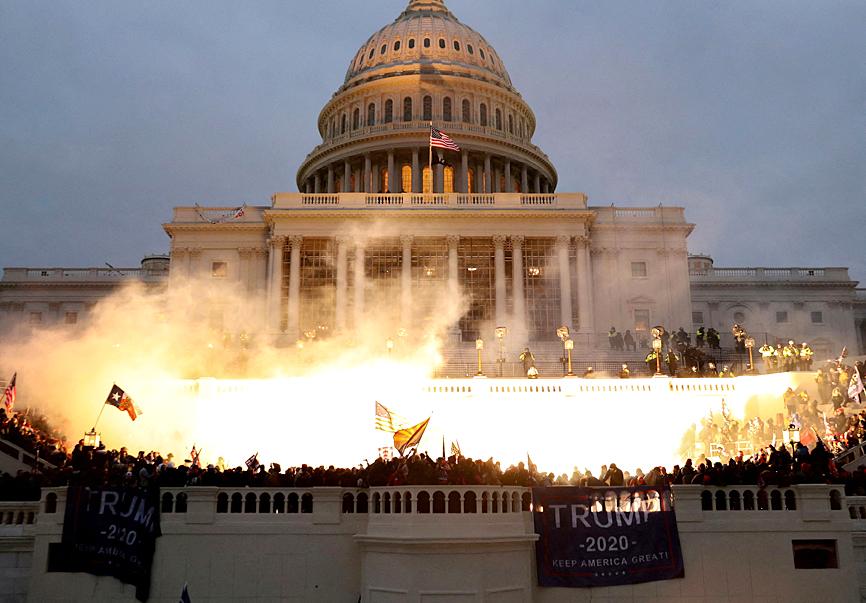
Photo: Reuters
“The right of a former president certainly enjoys no greater weight than that of the incumbent,” the appeals court said in its ruling.
“In this case, President Biden, as the head of the executive branch, has specifically found that Congress has demonstrated a compelling need for these very documents and that disclosure is in the best interests of the nation,” the court said.
The ruling did not trigger the immediate release of the records, as the appeals court said that Trump’s lawyers would have two weeks to appeal the case to the Supreme Court.
There, Trump’s attorneys are expected to request a new freeze on the release while the high court reviews the unprecedented case.
“Regardless of today’s decision by the appeals court, this case was always destined for the Supreme Court,” Trump spokeswoman Liz Harrington said.
The appeals court said the public interest was greater than Trump’s own in relation to the records, which are held by the National Archives.
“That public interest is heightened when, as here, the legislature is proceeding with urgency to prevent violent attacks on the federal government and disruptions to the peaceful transfer of power,” it said.
The records are sought by the House Select Committee investigating the Jan. 6 violence, in which hundreds of Trump supporters forced the shutdown of Congress and delayed a joint session to confirm that Biden had won last year’s presidential election over Trump.
Documents that Trump hoped to block include records from his top aides and memos to his former press secretary. The more than 770 pages include records of his former chief of staff Mark Meadows, former senior adviser Stephen Miller and former deputy counsel Patrick Philbin.
Trump had also hoped to block the release of the White House Daily Diary — a record of his activities, trips, briefings and phone calls.
Another trove of documents Trump does not want Congress to see includes memos to his former press secretary Kayleigh McEnany, a handwritten note on the Jan. 6 events and a draft text of his speech at a “Save America” rally, which preceded the attack.
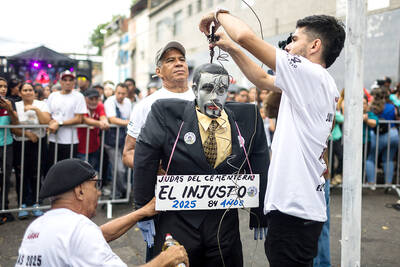
POLITICAL PRISONERS VS DEPORTEES: Venezuela’s prosecutor’s office slammed the call by El Salvador’s leader, accusing him of crimes against humanity Salvadoran President Nayib Bukele on Sunday proposed carrying out a prisoner swap with Venezuela, suggesting he would exchange Venezuelan deportees from the US his government has kept imprisoned for what he called “political prisoners” in Venezuela. In a post on X, directed at Venezuelan President Nicolas Maduro, Bukele listed off a number of family members of high-level opposition figures in Venezuela, journalists and activists detained during the South American government’s electoral crackdown last year. “The only reason they are imprisoned is for having opposed you and your electoral fraud,” he wrote to Maduro. “However, I want to propose a humanitarian agreement that
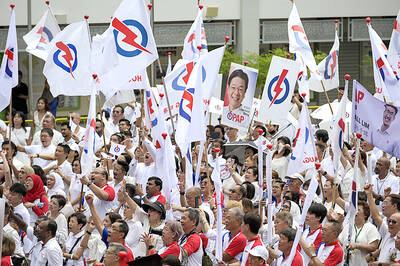
ECONOMIC WORRIES: The ruling PAP faces voters amid concerns that the city-state faces the possibility of a recession and job losses amid Washington’s tariffs Singapore yesterday finalized contestants for its general election on Saturday next week, with the ruling People’s Action Party (PAP) fielding 32 new candidates in the biggest refresh of the party that has ruled the city-state since independence in 1965. The move follows a pledge by Singaporean Prime Minister Lawrence Wong (黃循財), who took office last year and assumed the PAP leadership, to “bring in new blood, new ideas and new energy” to steer the country of 6 million people. His latest shake-up beats that of predecessors Lee Hsien Loong (李顯龍) and Goh Chok Tong (吳作棟), who replaced 24 and 11 politicians respectively

Archeologists in Peru on Thursday said they found the 5,000-year-old remains of a noblewoman at the sacred city of Caral, revealing the important role played by women in the oldest center of civilization in the Americas. “What has been discovered corresponds to a woman who apparently had elevated status, an elite woman,” archeologist David Palomino said. The mummy was found in Aspero, a sacred site within the city of Caral that was a garbage dump for more than 30 years until becoming an archeological site in the 1990s. Palomino said the carefully preserved remains, dating to 3,000BC, contained skin, part of the

Russian hackers last year targeted a Dutch public facility in the first such an attack on the lowlands country’s infrastructure, its military intelligence services said on Monday. The Netherlands remained an “interesting target country” for Moscow due to its ongoing support for Ukraine, its Hague-based international organizations, high-tech industries and harbors such as Rotterdam, the Dutch Military Intelligence and Security Service (MIVD) said in its yearly report. Last year, the MIVD “saw a Russian hacker group carry out a cyberattack against the digital control system of a public facility in the Netherlands,” MIVD Director Vice Admiral Peter Reesink said in the 52-page


 RSS
RSS