


Nuclear-armed North Korea yesterday fired what appeared to be a short-range missile into the sea, the South Korean military said, as Pyongyang’s UN ambassador insisted the nation had an undeniable right to test its weapons.
The projectile was fired from the northern province of Jagang into waters off the east coast, the South’s Joint Chiefs of Staff said.
A Japanese Ministry of Defense spokesman said it “appears to be a ballistic missile.”
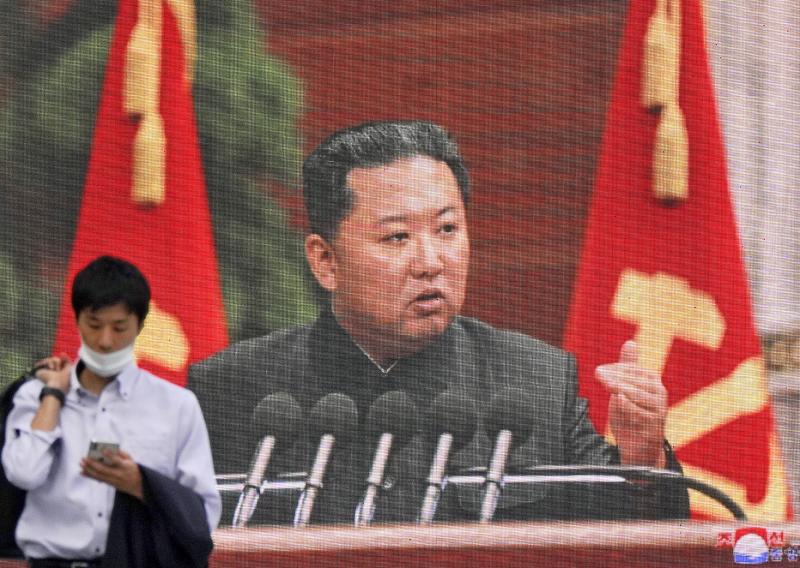
Photo: EPA-EFE
Less than an hour later, North Korean Ambassador to the UN Kim Song told the UN General Assembly in New York: “Nobody can deny the right to self-defense for” the Democratic People’s Republic of Korea.
It is the latest in a series of mixed messages from Pyongyang, coming days after North Korean leader Kim Jong-un’s influential sister Kim Yo-jong, a key adviser to her brother, dangled the prospect of an inter-Korean summit.
However, “impartiality” and mutual respect would be required, she said, calling for the South to “stop spouting an impudent remark.”
She condemned as “double standards” South Korean and US criticism of the North’s military developments, while the allies build up their own capacities.
Washington condemned the North’s latest launch, calling it a “threat” to Pyongyang’s neighbors and the international community.
“This launch is in violation of multiple UN Security Council Resolutions,” the US Department of State said in a statement.
“Our commitment to the defense of the Republic of Korea and Japan remains ironclad,” it added.
South Korean President Moon Jae-in, who has only months left in office, reiterated at the UN General Assembly his longstanding calls for a formal declaration of an end to the Korean War.
The North invaded the South in 1950 and hostilities ceased three years later with an armistice rather than a peace treaty, leaving them technically still in a state of conflict.
Pyongyang is under multiple sets of international sanctions over its banned programs to develop nuclear weapons and ballistic missiles.
In his own General Assembly speech, Kim Song said North Korea had a right to “develop, test, manufacture and possess” weapons systems equivalent to those of the South and its US ally.
“We are just building up our national defense in order to defend ourselves and reliably safeguard the security and peace of the country,” he said.
Pyongyang has already carried out several missile launches this month, one involving long-range cruise missiles and another that the South’s military said was of short-range ballistic missiles.
Seoul also successfully test-fired a submarine-launched ballistic missile for the first time, making it one of a handful of nations with the advanced technology.
Talks between Pyongyang and Washington have been largely at a standstill since a 2019 summit in Hanoi between leader Kim and then-president Donald Trump collapsed over sanctions relief and what the North would be willing to give up in return.
The North has since then repeatedly excoriated the South and Moon, and blown up a liaison office on its side of the border that Seoul had built.
After an emergency meeting, the South’s National Security Committee issued a statement yesterday expressing “regret over the launch at a time when political stability on the Korean Peninsula is very critical.”
“It looks like North Korea wants to see how genuine Seoul is when it comes to its willingness to improve inter-Korean ties — and to officially end the Korean War,” University of North Korean Studies professor Yang Moo-jin said.
“Pyongyang will monitor and study Moon’s reaction after today’s launch and decide on what they want to do on things such as restoring the inter-Korean hotline,” he added.

Through the noise of rushing papers and whirring belts at a print factory in Kyoto, two creators watch their photo essay come to life in broadsheet form — part of an effort to win new audiences in the age of artificial intelligence (AI). Despite the decline of the publishing industry, self-publication and handmade “zine” magazines are growing in popularity in Japan, reflecting the nation’s enduring love of paper in the digital era. While speaking to Agence France-Presse at the plant, his hands black with ink, one of the creators, Kazuma Obara, said: “I think [paper] is a medium that engages all five
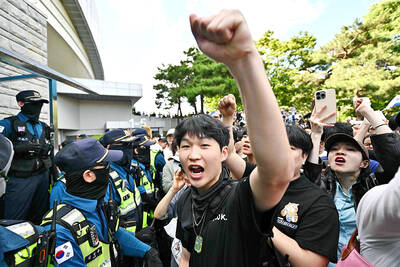
‘ABSURD MISTAKE’: The election commission said that there had been a failure to anticipate turnout after 14 polling stations ran short of ballot papers South Korean riot police yesterday cleared protesters from a Seoul polling station after a 35-hour blockade sparked by a shortage of ballot papers during local elections earlier this week. Wednesday’s election was the first nationwide vote since South Korean President Lee Jae-myung took office following the ouster of Yoon Suk-yeol over his short-lived martial law declaration. Lee’s ruling Democratic Party swept most races, but failed to flip the crucial Seoul mayoral seat. The South Korean National Election Commission apologized, blaming a failure to anticipate turnout after 14 polling stations in Seoul ran short of ballot papers. Some polling stations stayed open until 10pm to

Australian researchers have trained lab-grown brain cells on a silicon computer chip to play the 1990s shooter game Doom and said they are just scratching the surface of what the neurons could be capable of doing. It is the science-fiction work of biotech boffins at Cortical Labs, who researched and developed the technology that harnesses the workings of the brain’s networking system. Each so-called “biological computer” contains about 200,000 living human brain cells, grown from stem cells that were harvested from blood donations. Having mastered the simple computer game Pong, where a paddle is moved up and down to send a ball

France experienced its hottest spring on record, the French weather service said on Tuesday, after an exceptional early heat wave that also broke highs for the season in England and Wales. Meteo-France said the average nationwide temperature over March to May was 13.8°C — about 1.7°C above the norm, and surpassing records set in 2011 and 2020. “The warmest spring since records began in 1900,” it said in a bulletin. All three months were warmer than average, but the onset of an “unprecedented heatwave” late last month pushed the mercury to highs typically seen at the height of the summer. “Our country had never


 RSS
RSS