


India told China that their bilateral relations would only develop when both countries pull their troops back from a confrontation on their disputed Himalayan border, the Indian foreign minister said.
Indian Minister of External Affairs Subrahmanyam Jaishankar discussed the possibility of both sides pulling back when he met Chinese Minister of Foreign Affairs Wang Yi (王毅) on the sidelines of a regional conference in Dushanbe on Thursday.
“Discussed disengagement in our border areas. Underlined that progress in this regard is essential for restoration of peace and tranquillity, which is the basis for development of bilateral ties,” Jaishankar wrote on Twitter.
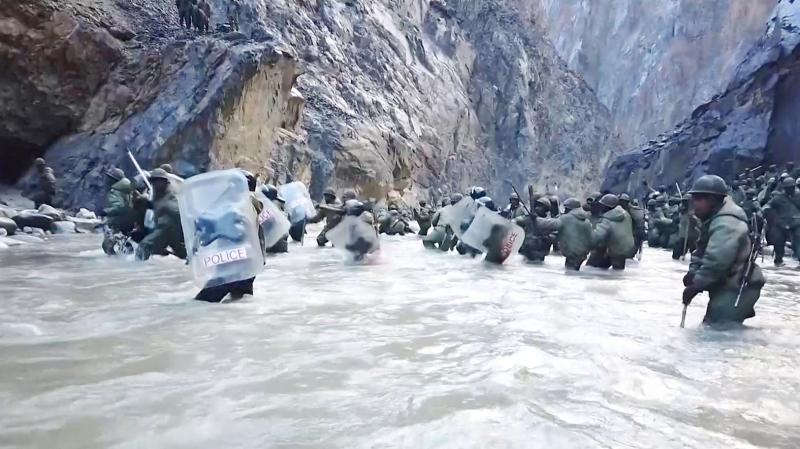
Photo: China Central Television / AFP
Thousands of Indian and Chinese soldiers have been locked in confrontation in the western Himalayas since last year, when animosity over a decades-old border dispute blew up.
In June last year, tension erupted into hand-to-hand fighting resulting in deaths on both sides, the first between them in decades.
After several rounds of talks between their commanders, their forces have stepped back on some sections of the border, including Pangong Tso, a contested glacial lake area near the site of last year’s clashes.
Nevertheless, troops backed by artillery remain stationed in close proximity in other sectors.
“China has always handled the China-India border issue properly and with a positive attitude,” Wang said.
Both sides should “work together to maintain peace and tranquility in the border areas, and stop border incidents from recurring,” he added.
As two major emerging economies, China and India should push bilateral ties back to a healthy and stable track, a statement from the Chinese Ministry of Foreign Affairs cited Wang as saying.
China and India went to war over their border in 1962 and have never resolved the dispute.
Even so, in the past few years, trade ties have flourished.

Young Chinese, many who fear age discrimination in their workplace after turning 35, are increasingly starting “one-person companies” that have artificial intelligence (AI) do most of the work. Smaller start-ups are already in vogue in Silicon Valley and elsewhere, with rapidly advancing AI tools seen as a welcome teammate even as they threaten layoffs at existing firms. More young people in China are subscribing to the model, as cities pledge millions of dollars in funding and rent subsidies for such ventures, in alignment with Beijing’s political goal of “technological self-reliance.” “The one-person company is a product of the AI era,” said Karen Dai

South Korea’s air force yesterday apologized for a 2021 midair collision involving two fighter jets, a day after auditors said the pilots were taking selfies and filming during the flight and held them responsible for the accident. “We sincerely apologize to the public for the concern caused by the accident that occurred in 2021,” an air force spokesman told a news conference, adding that one of the pilots involved had been suspended from flying duties, received severe disciplinary action and has since left the military. The apology followed a report released on Wednesday by the South Korean Board of Audit and Inspection,

About 240 Indians claiming descent from a Biblical tribe landed at Tel Aviv airport on Thursday as part of a government operation to relocate them to Israel. The newcomers passed under a balloon arch in blue and white, the colors of the Israeli flag, as dozens of well-wishers welcomed them with a traditional Jewish song. They were the first “bnei Menashe” (“sons of Manasseh”) to arrive in Israel since the government in November last year announced funding for the immigration of about 6,000 members of the community from the states of Manipur and Mizoram in northeast India. The community claims to descend from

‘TROUBLING’: The firing of Phelan, who was an adviser to a nonprofit that supported the defense of Taiwan, was another example of ‘dysfunction’ under Trump, a US senator said US Secretary of the Navy John Phelan has been fired, a US official and a person familiar with the matter said on Wednesday, in another wartime shakeup at the Pentagon coming just weeks after US Secretary of Defense Pete Hegseth ousted the Army’s top general. The Pentagon announced his departure in a brief statement, saying he was leaving the administration “effective immediately,” but it did not provide a reason or say whether it was his decision to go. The sources, who spoke on condition of anonymity, said Phelan was dismissed in part because he was moving too slowly to implement reforms to


 RSS
RSS