


Nine Hong Kong democracy advocates and former lawmakers yesterday were sentenced to prison terms of up to 10 months for their roles in last year’s banned candlelight vigil commemorating the 1989 Tiananmen Square Massacre.
The nine are part of a group of 12 defendants who earlier this month pled guilty to participating in the vigil that was the only large-scale public commemoration on Chinese soil of the 1989 crackdown in Beijing on student-led protests.
Three others were given suspended sentences.
They were all charged with taking part in an unauthorized assembly, with seven of them facing an additional charge for inciting others to take part in the event.
Police last year banned the annual vigil for the first time in three decades, citing public health risks from the COVID-19 pandemic.
Critics have said that the ban is part of the crackdown on opposition in the territory following months of democracy demonstrations in 2019.
More than 10 democracy advocates turned up at the June 4 vigil, despite the ban and thousands followed suit. The crowds broke through barriers set up around the Victoria Park venue to light candles and sing songs, despite police warnings.
Police later arrested more than 20 who participated, including leaders of the Hong Kong Alliance in Support of Patriotic Democratic Movements of China, the group that organizes the yearly vigil.
Some of those sentenced yesterday, such as former lawmaker Albert Ho (何俊仁) and Figo Chan (陳皓桓), former leader of the defunct Civil Human Rights Front, are in prison over other unauthorized assemblies.
Eight other democracy advocates who were charged over last year’s Tiananmen vigil — including Jimmy Lai (黎智英), founder of the defunct Apple Daily newspaper, as well as former lawmaker and Hong Kong Alliance chairman Lee Cheuk-yan (李卓人) — have pleaded not guilty and are to stand trial in November.
Democracy advocate Joshua Wong (黃之鋒) and three others had previously pleaded guilty for their roles in the event, and were sentenced to between four and 10 months in jail.
In June last year, Beijing imposed a National Security Law on Hong Kong that targets secession, subversion, terrorism and foreign collusion in the territory’s affairs. More than 100 people have been arrested under the legislation.
Beijing and Hong Kong officials have been criticized for rolling back freedoms promised to Hong Kong for 50 years when the former British colony was handed over to China in 1997.


Through the noise of rushing papers and whirring belts at a print factory in Kyoto, two creators watch their photo essay come to life in broadsheet form — part of an effort to win new audiences in the age of artificial intelligence (AI). Despite the decline of the publishing industry, self-publication and handmade “zine” magazines are growing in popularity in Japan, reflecting the nation’s enduring love of paper in the digital era. While speaking to Agence France-Presse at the plant, his hands black with ink, one of the creators, Kazuma Obara, said: “I think [paper] is a medium that engages all five
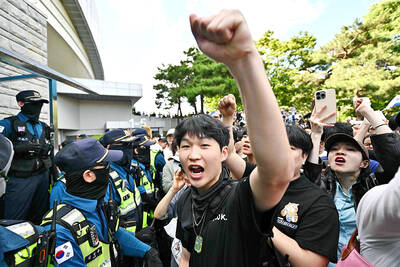
‘ABSURD MISTAKE’: The election commission said that there had been a failure to anticipate turnout after 14 polling stations ran short of ballot papers South Korean riot police yesterday cleared protesters from a Seoul polling station after a 35-hour blockade sparked by a shortage of ballot papers during local elections earlier this week. Wednesday’s election was the first nationwide vote since South Korean President Lee Jae-myung took office following the ouster of Yoon Suk-yeol over his short-lived martial law declaration. Lee’s ruling Democratic Party swept most races, but failed to flip the crucial Seoul mayoral seat. The South Korean National Election Commission apologized, blaming a failure to anticipate turnout after 14 polling stations in Seoul ran short of ballot papers. Some polling stations stayed open until 10pm to

France experienced its hottest spring on record, the French weather service said on Tuesday, after an exceptional early heat wave that also broke highs for the season in England and Wales. Meteo-France said the average nationwide temperature over March to May was 13.8°C — about 1.7°C above the norm, and surpassing records set in 2011 and 2020. “The warmest spring since records began in 1900,” it said in a bulletin. All three months were warmer than average, but the onset of an “unprecedented heatwave” late last month pushed the mercury to highs typically seen at the height of the summer. “Our country had never
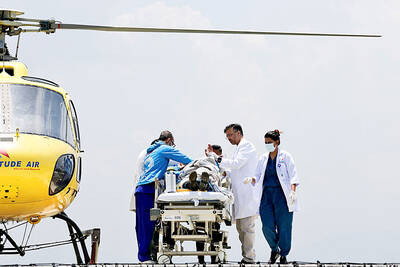
A Sherpa guide was found crawling to base camp on Mount Everest a week after he went missing and was reunited with his family, who had given up hope he would return. Dawa Sherpa was last seen on Friday last week descending the mountain, but he did not reach base camp even though his client did. The pair were among the last climbers on the mountain as the climbing season came to an end and the route was dismantled. Dawa was located by a cleaning crew on Thursday morning as he was crawling down the snowy slopes around the Khumbu Icefall, just above


 RSS
RSS