


Friends and family initially mocked one Jordanian family’s new venture of making soap from donkey milk, but now, a year on, the company is cleaning up as customers bray for more.
Atan Donkey Milk Soaps produces 100 percent natural soaps at a small manufacturing workshop in Amman from the milk of 12 donkeys on its farm in Madaba, 35km southwest of the Jordanian capital.
Although other regions around the Mediterranean produce soap from donkey milk, this is a first for Jordan.
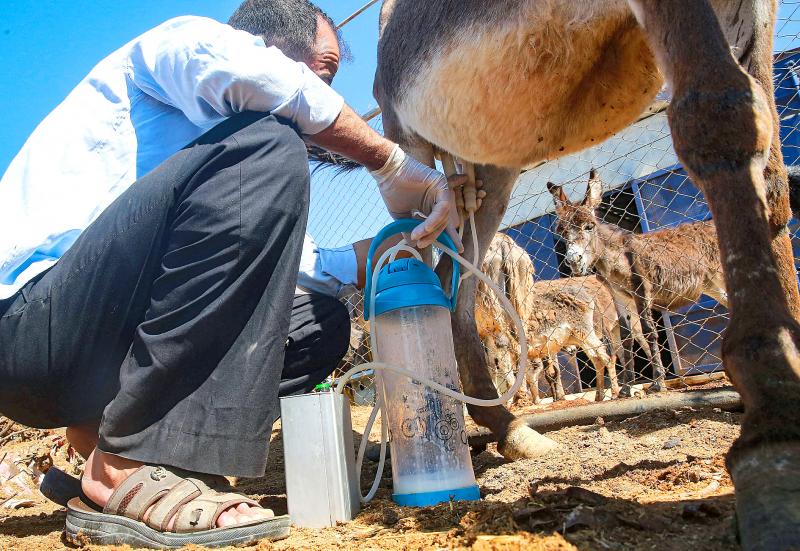
Photo: AFP
“At the beginning, many laughed at the idea,” said Emad Attiyat, 32, cofounder of the project, which takes its name from atan, the Arabic word for a female donkey, or jenny.
Skeptics said that they “would use nothing on [their] skin related to donkeys,” added Attiyat, who has a degree in management information systems.
However, “after trying the soap, all that changed, and now we produce more than 4,500 bars of soap per month to meet the demand,” he said, standing next to the barn where the animals are housed.
Donkey’s milk is said to be rich in minerals and proteins that can help moisturize the skin.
It also has high levels of antioxidants, which protect the skin from sunlight and the effects of aging, according to beauticians.
One liter of milk produces about 30 bars of soap, but milking each female is a painstaking task done with the help of a hand-held electronic pump.
Each donkey has to be milked three times per day to get about 1 liter of fluid, while leaving about 1 liter for its foal. The milk is frozen and then transferred to the company’s workshop in Amman to be turned into soap.
Research has shown that donkey milk can “help regenerate skin cells, reduce signs of aging and help cure some skin diseases such as eczema,” Attiyat’s mother, Salma al-Zubi, said.
She was the one who came up with the idea of trying the venture.
An environmental advocate and retired teacher, she said that donkey’s milk soap contributes to balancing the skin’s moisture levels and removing wrinkles, as well as eliminating spots and acne.
In her 60s, she helps mix ingredients in a large steel bowl at the Amman workshop, wearing a white mask and blue gloves.
Olive oil, almond oil, coconut oil and shea butter are added to the donkey milk to produce the soap that is sold on their Facebook page.
A small 85g bar of soap costs 8 Jordanian dinars (US$11), while a large 125g bar of soap is sold for 10 dinars.
One liter of donkey’s milk in Europe can cost as much as 60 euros (US$71), and is used in making some expensive cheeses.
Attiyat is hoping to expand production to face and hand creams and lotions.
The milk is “rich in proteins and minerals, including magnesium, copper, sodium, manganese, zinc, calcium and iron — all of which are very important for the skin,” said dietician Susanna Haddad, who works at a beauty center in Amman.
Loyal customer, lawyer Esraa al-Turk, 48, said that she was attracted to the donkey milk soap because it is a natural product.
“I take care of my skin,” she said, adding that although she did not wear much makeup, she had now “become more daring to leave home without any cosmetics on my face.”

Through the noise of rushing papers and whirring belts at a print factory in Kyoto, two creators watch their photo essay come to life in broadsheet form — part of an effort to win new audiences in the age of artificial intelligence (AI). Despite the decline of the publishing industry, self-publication and handmade “zine” magazines are growing in popularity in Japan, reflecting the nation’s enduring love of paper in the digital era. While speaking to Agence France-Presse at the plant, his hands black with ink, one of the creators, Kazuma Obara, said: “I think [paper] is a medium that engages all five
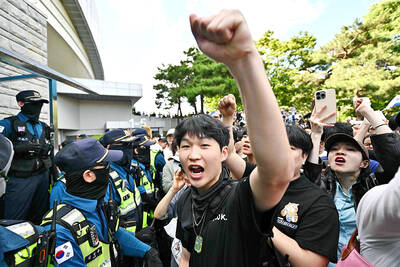
‘ABSURD MISTAKE’: The election commission said that there had been a failure to anticipate turnout after 14 polling stations ran short of ballot papers South Korean riot police yesterday cleared protesters from a Seoul polling station after a 35-hour blockade sparked by a shortage of ballot papers during local elections earlier this week. Wednesday’s election was the first nationwide vote since South Korean President Lee Jae-myung took office following the ouster of Yoon Suk-yeol over his short-lived martial law declaration. Lee’s ruling Democratic Party swept most races, but failed to flip the crucial Seoul mayoral seat. The South Korean National Election Commission apologized, blaming a failure to anticipate turnout after 14 polling stations in Seoul ran short of ballot papers. Some polling stations stayed open until 10pm to

Australian researchers have trained lab-grown brain cells on a silicon computer chip to play the 1990s shooter game Doom and said they are just scratching the surface of what the neurons could be capable of doing. It is the science-fiction work of biotech boffins at Cortical Labs, who researched and developed the technology that harnesses the workings of the brain’s networking system. Each so-called “biological computer” contains about 200,000 living human brain cells, grown from stem cells that were harvested from blood donations. Having mastered the simple computer game Pong, where a paddle is moved up and down to send a ball

France experienced its hottest spring on record, the French weather service said on Tuesday, after an exceptional early heat wave that also broke highs for the season in England and Wales. Meteo-France said the average nationwide temperature over March to May was 13.8°C — about 1.7°C above the norm, and surpassing records set in 2011 and 2020. “The warmest spring since records began in 1900,” it said in a bulletin. All three months were warmer than average, but the onset of an “unprecedented heatwave” late last month pushed the mercury to highs typically seen at the height of the summer. “Our country had never


 RSS
RSS