


A Utah company has stopped selling a kit that encases Glock handguns in Lego blocks, amid an uproar and after the Danish toymaker demanded that it cease and desist.
Marketing the “Block19” as a “a childhood dream come to life,” Culper Precision introduced it on Instagram, saying: “We wanted the [US constitution’s] Second Amendment to simply be too painful to tread on, so there was only one logical solution.”
Red, yellow and blue blocks made the original weapon barely visible, disguising it as a child’s toy.
Selling the kits for US$549 to US$765, the company enticed adult gun users to buy the firearm “made out of the Legos you got from Santa.”
At the urging of gun control advocates, Lego sent the company a cease-and-desist letter, demanding that it stop producing the Block19.
Culper Precision president Brandon Scott told the Washington Post that a lawyer told him Lego might have a case if he kept offering the Block19, so he decided to comply.
“They had a similar reaction to you,” he said. “Where it was like: ‘Is it wise to make a gun look like a toy?’”
A report from the nonprofit Everytown for Gun Safety showed that from March to December last year, unintentional shooting deaths by children of themselves or others increased 31 percent from the same period in 2019.
The COVID-19 pandemic kept millions of children home as gun ownership reached record highs — the problem continues.
Last week, a 12-year-old in California died after he accidentally shot himself with a gun that his friend brought to a sleepover.
Shannon Watts of Everytown for Gun Safety, which sent a letter to Lego about the Block19, told the BBC there was a risk that children might be drawn to use firearms “even when guns don’t look like toys.”
The company does not appear to be apologetic: Culper Precision said on Instagram on Tuesday: “Our business is taking a firearm of known value” and transforming it into a “personalized invaluable treasure for a fair price.”
People “have the right to customize their property to make it look like whatever they want,” it added.

ROCKY RELATIONS: The figures on residents come as Chinese tourist numbers drop following Beijing’s warnings to avoid traveling to Japan The number of Chinese residents in Japan has continued to rise, even as ties between the two countries have become increasingly fractious, data released on Friday showed. As of the end of December last year, the number of Chinese residents had increased by 6.5 percent from the previous year to 930,428. Chinese people accounted for 22.6 percent of all foreign residents in Japan, making them by far the largest group, Japanese Ministry of Justice data showed. Beijing has criticized Tokyo in increasingly strident terms since Japanese Prime Minister Sanae Takaichi last year suggested that a military conflict around Taiwan could

A retired US colonel behind a privately financed rocket launch site in the Dominican Republic sees the project as a response to China’s dominance of the space race in Latin America. Florida-based Launch on Demand is slated to begin building a US$600 million facility in a remote region near the border with Haiti late this year. The project is designed to meet surging demand for the heavy-lift rockets needed to put clusters of satellites into orbit. It is also an answer to China’s growing presence in the region, said CEO Burton Catledge, a former commander of the US Air Force’s 45th Operations

Germany is considering Australia’s Ghost Bat robot fighter as it looks to select a combat drone to modernize its air force, German Minister of Defense Boris Pistorius said yesterday. Germany has said it wants to field hundreds of uncrewed fighter jets by 2029, and would make a decision soon as it considers a range of German, European and US projects developing so-called “collaborative combat aircraft.” Australia has said it will integrate the Ghost Bat, jointly developed by Boeing Australia and the Royal Australian Air Force, into its military after a successful weapons test last year. After inspecting the Ghost Bat in Queensland yesterday,
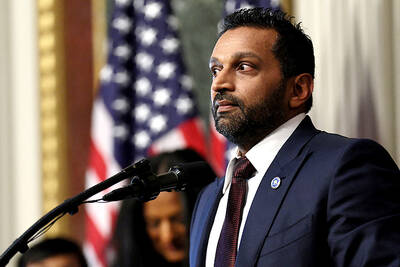
A pro-Iran hacking group claimed to breach FBI Director Kash Patel’s personal e-mail inbox and posted some of the contents online. The e-mails provided by the hacking group include travel details, correspondence with leasing agents in Washington and global entry, and loyalty account numbers. The e-mail address the hackers claim to have compromised has been previously tied to Patel’s personal details, and the leaked e-mails contain photos of Patel and others, in addition to correspondence with family members and colleagues. “The FBI is aware of malicious actors targeting Director Patel’s personal email information,” the agency said in a statement on


 RSS
RSS