


Not long after Belarus diverted an international flight, forced it to land in Minsk and then arrested journalist Roman Protasevich on board, an online campaign to discredit him began.
Stories alleging that Protasevich had ties with neo-Nazis appeared initially in Russian-language media and quickly spread in dozens of languages.
Photographs of young men doing Nazi salutes or wearing SS insignia began to pop up on social media, claiming to show Protasevich in his younger years in what experts called a disinformation campaign similar to others against Kremlin critics.
Reporters tracked down the man in the Nazi salute photo.
Konstantin Akhromenko, a young Belarusian, confirmed his identity and said that the picture was taken “10 to 12 years ago.”
“We were never Nazis. We took such photos just for laughs, because the Belarusian state propaganda called us Nazis,” Akhromenko said.
Similarly, the man in the SS helmet turned out to be not Protasevich, but Eduard Lobov, a former Belarusian political prisoner who became a volunteer fighter in eastern Ukraine.
Many posts focused on the fact that Protasevich, by his own account, spent time with Ukrainian paramilitary units in eastern Ukraine after Russia annexed the Crimean Peninsula in 2014.
Labeling him a “terrorist” and “extremist,” they said that he fought with the Azov battalion.
Protasevich’s family, colleagues and even some Azov fighters said that he was in Ukraine only as a journalist, albeit embedded with Ukrainian forces.
Some online claims about Protasevich contain photos of a young man in a military uniform, but reporters have been unable to verify if it is in fact him.
In some of the pictures that bear a resemblance to him, the young man is wearing a military uniform; in others he is brandishing a Kalashnikov rifle and smiling.
Often he is surrounded by soldiers wearing the insignia of the Azov battalion, a volunteer unit formed in the wake of Russia’s annexation of Crimea.
Vladyslav Sobolevsky, the chief of staff of the Azov battalion from 2014 to 2017, said that Protasevich had joined as a journalist to “help Ukraine and in the future to help his own country.”
“His views were: Lukashenko must leave. Belarus should be free,” Sobolevsky said, referring to Belarusian President Alexander Lukashenko.
Likewise, Protasevich’s father, Dmitry, who lives in Poland, has said that Roman Protasevich never fought as a soldier.
“My son is and was a journalist. He was in Donbas as a journalist doing his job,” Dmitry Protasevich said.
This was confirmed by Azov commander Andriy Biletsky and by battalion spokeswoman Anastasya Rymar, both of whom said that Roman Protasevich followed the unit only to report on the action and did not take part in the fighting.
The 26-year-old often mentioned his time in Ukraine in interviews, and there is a video of him being treated for a battle wound.
However, he always maintained he was there to document the fighting rather than fight himself.
Euvsdisinfo.eu, a project of the EU’s foreign service set up to combat Russian disinformation, said that there was a deliberate attempt at Roman Protasevich’s online “denigration.”
An article on the project’s website compared these “disinformation efforts” to those seen against Kremlin critics such as anti-corruption campaigner Alexei Navalny.
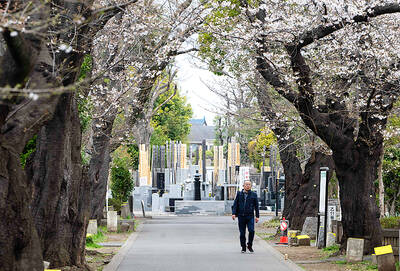
ROCKY RELATIONS: The figures on residents come as Chinese tourist numbers drop following Beijing’s warnings to avoid traveling to Japan The number of Chinese residents in Japan has continued to rise, even as ties between the two countries have become increasingly fractious, data released on Friday showed. As of the end of December last year, the number of Chinese residents had increased by 6.5 percent from the previous year to 930,428. Chinese people accounted for 22.6 percent of all foreign residents in Japan, making them by far the largest group, Japanese Ministry of Justice data showed. Beijing has criticized Tokyo in increasingly strident terms since Japanese Prime Minister Sanae Takaichi last year suggested that a military conflict around Taiwan could
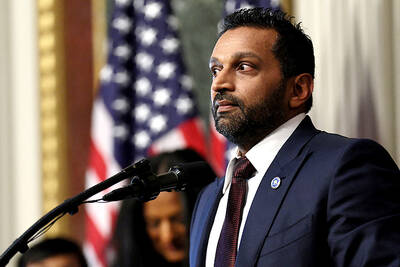
A pro-Iran hacking group claimed to breach FBI Director Kash Patel’s personal e-mail inbox and posted some of the contents online. The e-mails provided by the hacking group include travel details, correspondence with leasing agents in Washington and global entry, and loyalty account numbers. The e-mail address the hackers claim to have compromised has been previously tied to Patel’s personal details, and the leaked e-mails contain photos of Patel and others, in addition to correspondence with family members and colleagues. “The FBI is aware of malicious actors targeting Director Patel’s personal email information,” the agency said in a statement on
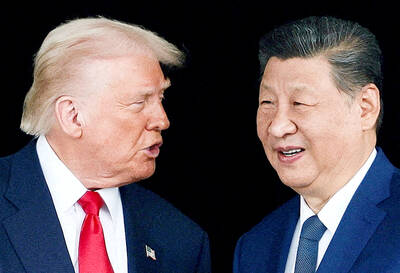
RIVALRY: ‘We know that these are merely symbolic investigations initiated by China, which is in fact the world’s most profligate disrupter of supply chains,’ a US official said China has started a pair of investigations into US trade practices, retaliating against similar probes by US President Donald Trump’s administration as the superpowers stake out positions before an expected presidential summit in May. The move, announced by the Chinese Ministry of Commerce on Friday, is a direct mirror of steps Trump took to revive his tariff agenda after the US Supreme Court last month struck down some of his duties. “China expresses its strong dissatisfaction and firm opposition to these actions,” a ministry spokesperson said in a statement, referring to the so-called Section 301 investigations initiated on March 11.
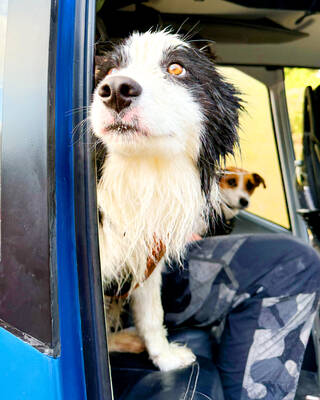
When a hiker fell from a 55m waterfall in wild New Zealand bush, rescuers were forced to evacuate the badly hurt woman without her dog, which could not be found. After strangers raised thousands of dollars for a search, border collie Molly was flown to safety by a helicopter pilot who was determined to reunite the pet and the owner. A week earlier, an emergency rescue helicopter found the woman with bruises and lacerations after a fall at a rocky spot at the waterfall on the South Island’s West Coast. She was airlifted on March 24, but they were forced to


 RSS
RSS